


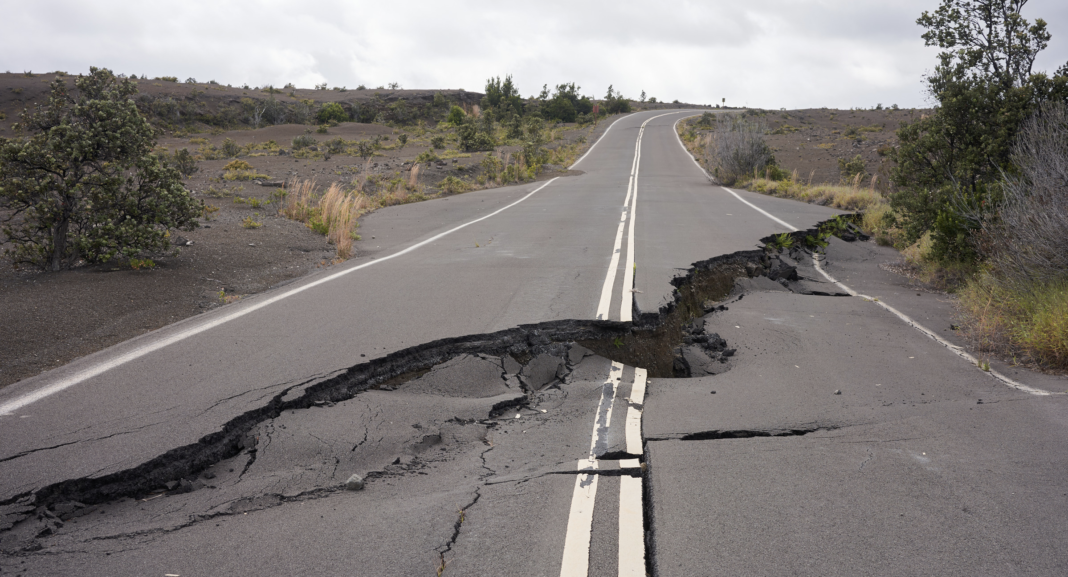
With the next big earthquake overdue, new state initiatives are giving Californians unprecedented ways to protect themselves.
With the 35th anniversary of the devastating Loma Prieta Earthquake upcoming this October 17, the California Office of Emergency Services (Cal OES) is rolling out measures including a first-in-the-nation earthquake early warning system, a Great ShakeOut preparedness drill, multilingual education and an earthquake detection app.
Loma Prieta was a 6.9 magnitude earthquake that hit the Greater San Francisco Bay Area in 1989, killing 63 people, injuring 3,757 and wreaking an estimated $5.6 to $6 billion in damages — equal to $13.8 to $14.7 billion today.
Within the next 30 years, there’s a 72% chance that a similar earthquake measuring 6.7 will hit the Bay Area; 51% chance of an earthquake measuring 7; and 20% chance of an earthquake measuring 7.5, according to U.S. Geological Survey data.
For the Los Angeles region, estimates are 60% for an earthquake measuring 6.7; 46% for an earthquake measuring 7; and 31% for an earthquake measuring 7.5.
“However, earthquakes remain unpredictable. It really is hard, despite all our scientific advances, to reputably predict earthquakes and the billions in damage they can cause,” said Amy Palmer, deputy director of crisis communications for Cal OES.
“You may have lived through or seen some of the horrifying images of freeways and homes collapsing 35 years ago … We never want to take for granted that Californians know what to do when the shaking starts,” she added. “As we’re facing more — and varied — disasters in California, the bright spot is that it’s never been easier to get life-saving information through events like the Great ShakeOut.”
The Great ShakeOut
This year’s Great ShakeOut, an annual international earthquake preparedness drill, will happen throughout California at 10:17 a.m. on Thursday, October 17, the 35th anniversary of Loma Prieta.
Over 9.6 million people have already registered statewide, and over 52 million worldwide.
“That’s nearly 10 million souls practicing to save their lives, and we’re expecting to surpass our largest-ever count with a few more million this next week,” said José Lara, CalOES Seismic Hazards Branch manager.
Those in San Diego, Los Angeles and Sacrameento may also prepare for earthquakes one-on-one through CalOES on-site tours held at UC San Diego on October 14; youth reentry nonprofit Homeboy Industries on October 15; and CSU Sacramento on October 16.
“We’re focusing on schools and youth areas because we find that in high-risk, vulnerable communities who need these preparedness messages most, whenever we’re able to reach the children, parents often get prepared as well,” said Lara.
Each tour stop will feature a 7.0 magnitude earthquake simulator “that we won’t allow anybody to stand up in, because it does such a realistic job that we truly feel that there would be an injury,” he continued. “Whenever people who have never experienced a very strong shake steep out of the simulator, they ask: ‘What’s the best thing I could do to prepare today?’”
‘Drop, cover and hold’
When the big shake comes, Cal OES recommends dropping to the floor, taking cover from falling or flying objects and holding on to something steady.
“In footage of an earthquake, there’s often a moment where people freeze and don’t know the right thing to do, and that’s exactly what we’re trying to combat,” said Lara. “The best thing to do is drop, cover and hold on.”
The 6.7 magnitude Northridge earthquake of 1994, for instance, killed 57 people and injured over 8,700 in the Los Angeles area, with damages estimated between $13 and $50 billion.
Yet, 55% of human injuries were caused by falling furniture or objects, while only 1% were caused by building damage.
“It’s no longer the guidance that we ask you to stand beneath a doorway or leave the building as soon as possible. Most injuries come from that,” Lara explained. “That guidance comes from decades ago, before most of our buildings were designed to ‘Life Safety Codes,’ which mean that the building will let you survive with minimal injuries.”
Resources for the future
“Unlike other weather-driven scenarios, earthquakes aren’t predictable, but technology is giving us unprecedented opportunities to be ready,” said Sonya Harris, senior advisor of Cal OES disaster preparedness campaign Listos California.
Among this new technology is the California Earthquake Early Warning System, the first of its kind in the nation, launched in 2019 and since improved to send alerts up to 30 seconds before an earthquake occurs.
So far, Californians have received millions of alerts, largely through the MyShake app — which is free, available in the state’s top six languages and offers preparedness tips alongside alerts.
For privacy or battery protection, users can opt to share their zip code rather than their location, which the app never saves.
More earthquake preparedness resources are available in 14 languages through Listos California.
“We also encourage everyone to enable emergency and local awareness alerts in their phone settings — but our future is one where no one has to download an app at all to receive an alert, one where earthquake early warning systems will be where fire alerts and automatic sprinklers now are in buildings,” said Lara.
“There will come a time when, if you’re working in a factory and an earthquake occurs, the assembly line will automatically turn off, the turbines on our dams will immediately shut down and we can cut off traffic through a bridge before the shaking arrives,” he continued.
“There’s often a myth that it takes more time or money than we thought to be prepared — but all these resources are free and take moments to connect to,” added Harris. “We’re honoring those we’ve lost to earthquakes, and how far we’ve come to have these seconds that will save lives.”