


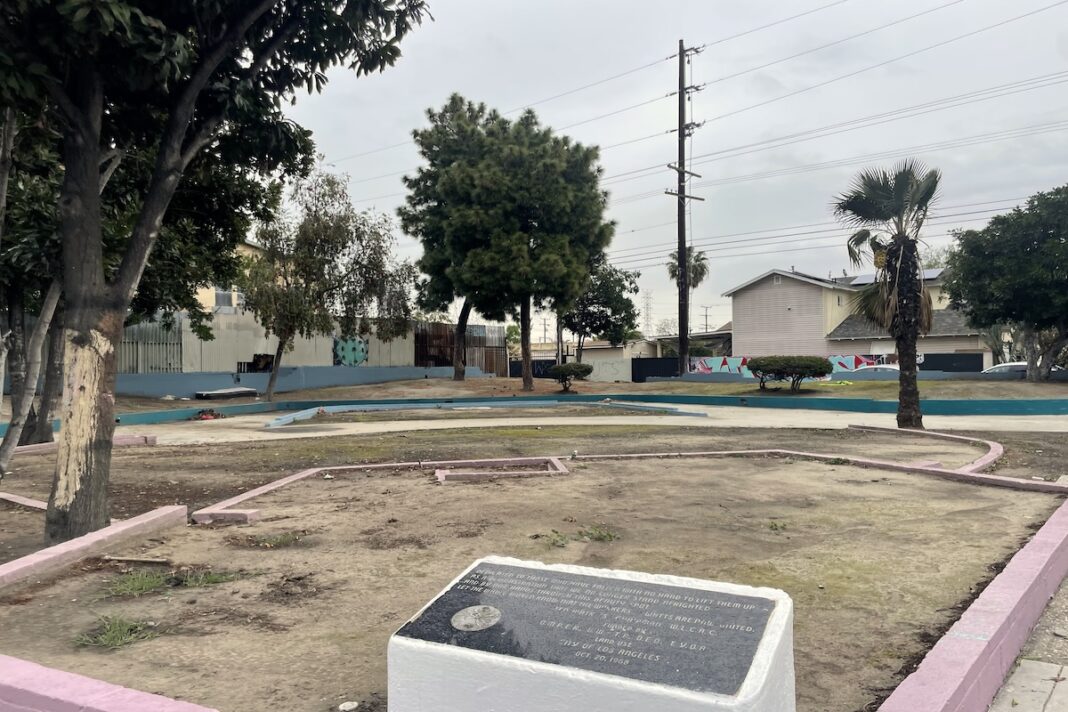
LOS ANGELES — A place of conflict and violence in South Los Angeles is being transformed by local residents into a “tranquility park,” a space to relax, meet with friends, and soak up a little greenery amidst hot asphalt and fast-moving cars.
Siris Barrios lives just a five-minute walk away from the vacant lot, which is owned by the city, on a busy corner of Central Avenue. That empty space in the neighborhood’s fabric seemed to attract bad things—fights, drug dealing, broken booze bottles, and other trash.
Barrios is director of social impact and community organizing at T.R.U.S.T. South LA, a nonprofit organization that is working to stabilize neighborhoods south of downtown Los Angeles through affordable housing, public transportation projects, and now new parks. She played an important role in meetings with nearby residences to envision a park with plenty of shaded seating, a water feature, a mosaic, and meditation and yoga classes.
In the process, Barrios has also found deeper meaning in repurposing this blank space in her own neighborhood. There were so many conflicts at this site in the past, she said, that “the idea of transforming it into a safe, beautiful, and tranquil space carries a lot of symbolism for the neighborhood.”
The park has personal significance for Lillian Washington, too. She grew up down the block and remembers using the vacant lot as an informal park before it became a place to avoid.
“My brothers would ride their skateboards, and I would ride my skates,” said Washington. “In the summer, we would have picnics, birthday parties, and even camp with our neighbors. It was a really amazing getaway from home.”

Washington is now an organizer with Community Coalition, or CoCo, a nonprofit that works to transform the social and economic conditions in South L.A. that foster addiction, crime, violence, and poverty.
Washington is following in her father’s footsteps. She said that he has advocated to turn that vacant lot into a beautiful park for years. “When I was asked about spaces for a new pocket park,” she said, “that was the first spot that came to mind.”
This vision is now coming to life thanks to a new park-building initiative that advocates call the “Link” model. Link connects communities with the people and institutions that are essential to effective park-building, supercharging their capacity to get new parks built and old ones renovated, and allowing local residents and organizations to take the lead in bringing much-needed and improved green space to their neighborhoods.
The future tranquility park is just one example of the work that Link is empowering across Los Angeles County. The initiative is making rapid progress in several other cities in addition to Los Angeles, including Cudahy, El Monte, Long Beach, and Maywood.
“People have told us they want more parks in their communities, and we wanted to figure out how to deliver them equitably,” said Alfredo Gonzalez, director of environmental equity and justice at Resources Legacy Fund, one of Link’s philanthropic funders.
The model connects four key players in the ecosystem of successful park building: local residents, a trusted local community-based organization, an experienced nonprofit, and municipal agencies. The community organization engages residents to determine their needs. Residents shape the park’s design to fit their visions. The nonprofit provides technical support, such as planning and design, grant writing, and construction management. And the municipal agency ensures that the city takes ownership and responsibility for the long term.
Though every neighborhood has its own needs, the Link initiative has found that common themes emerge when residents imagine their ideal parks. People consistently want shade, playgrounds, exercise equipment, picnic tables, soccer fields, clean restrooms, and water play areas.

But creating parks isn’t enough. Maintenance is also critical.
“Every community struggles with a lack of resources for maintaining parks, which is a shame,” said Gonzalez. “Parks should be treated like critical infrastructure, just like roads, hospitals, and schools.”
The Link roadmap doesn’t end when a park is built. It includes keeping parks clean, safe, and accessible. But sustainable funding remains a challenge. “Operating and maintaining parks is a lot of work,” said Tori Kjer, executive director of the Los Angeles Neighborhood Land Trust, which is providing technical support for several of the park projects in the Link initiative. “Securing long-term funding for upkeep is crucial.”
While building parks, Link is also creating a network of advocates for equitable green space across Los Angeles.
“Now we have a cohort across Long Beach, the San Fernando Valley, South L.A., and East L.A. with trusted relationships in their neighborhoods, who can come together on future initiatives,” said Gonzalez.
The Link initiative is also bringing new organizations into the growing network, including some that were not focused on parks in the past, including organizations that focused on social justice, jobs, housing, and economic issues. They have now come to see access to green space as a key issue for community health and equity.
“We are speaking this language more often than we were before,” said Barrios. “Now it is part of our worldview. And green space is part of the conversation.”
Washington hopes that when the new tranquility park in her neighborhood is completed, it will be named after her father to honor generations of hard work and advocacy in South L.A.
“He has done so much for the community and for this little spot on Central,” Washington said. “This transformation symbolizes that we can evolve and grow. It’s an amazing and beautiful thing that brings the community together.”
This story was produced by American Community Media in collaboration with the Laboratory for Environmental Narrative Strategies (LENS) at UCLA as part of the Greening American Cities initiative supported by the Bezos Earth Fund. Read more stories like this by visiting the Greening Communities homepage.

