


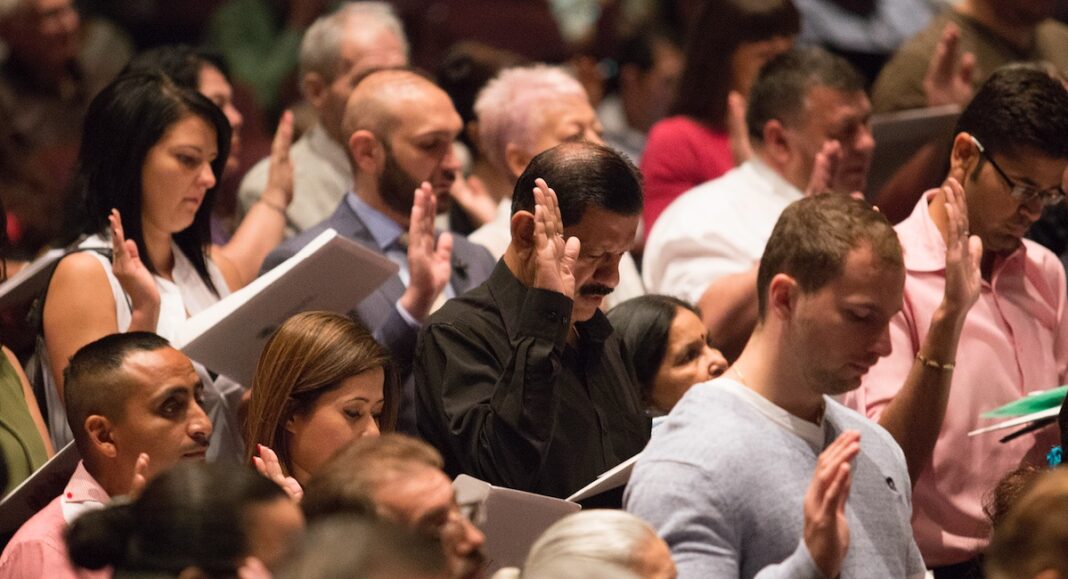
Starting October 20, applicants for U.S. citizenship will face stricter requirements, including a more rigorous civics and history exam, as well as a more invasive assessment of applicants’ moral character. Zenobia Lai is with the Houston Immigration Legal Services Collaborative, which works to support immigrants through the naturalization process. She says the new regulations issued by the Trump Administration earlier this summer will disproportionately impact poorer immigrants from non-English speaking countries, and that they are already having a chilling effect among communities. (This interview has been edited for length and clarity.)
How will recent changes to the naturalization test impact test takers?
Right now there is a set of 100 civics and history questions that an immigration officer can pull from, selecting 10 questions to test an applicant. If they answer six questions right, they pass that part of the test. For applications that are filed on or after October 20th, the number of questions an officer can pull from increases from 100 to 128. And the number of questions an officer can ask doubles to 20. To pass, test takers must answer 12 questions correctly or they fail. It is a verbal test, which means answers must be given in English. For a lot of immigrants, especially older immigrants, this can be a huge challenge.
There are some exemptions on the language requirement, right? For older applicants, for example.

If you are 50 years old, and you have been a green card holder for longer than 20 years, you can bring an interpreter with you. So basically, the English requirement is waived, but you still need to pass the civics and history requirement. If you are 55 or older, and you have been a green card holder for longer than 15 years, you can also bring an interpreter. Those 65 or above who have been a green card holder for longer than 20 years are eligible to bring an interpreter and are also given a shorter civics and history test.
The test will also now involve a stricter assessment of “moral character.” How will the government make that assessment?
The most direct way is by screening an applicant’s criminal record. Until recently, officers only screened records going back five years for minor offenses. (There is no such limit for more serious crimes, like murder or domestic violence.) Under the new policy, officers will screen records beyond the usual five-year limit for all crimes while also expanding the types of crimes that could make one ineligible for citizenship. Exactly how that is being applied, we still don’t know.
Applicants will also now have to affirmatively show they are a good person, though there’s not a lot of guidance. Suggestions include showing that you hold a steady job, you support your family, you pay child support, or better yet, you volunteer to coach Little League, or you volunteer at a local food pantry, or you go to church. Immigrants who work long hours don’t have the spare time to engage in these add-on activities. The new guidance also suggests officers may require testimony from people in an applicant’s immediate circle. Does that mean applicants now have to come up with affidavits from employers, co-workers, friends, or neighbors to say they are a person with good moral character? That is something we are still trying to figure out.
Is it possible that could also include screening applicants’ social media accounts?
There is this vague notion of “un-American activity,” whatever that means. If you criticize certain global affairs, is that un-American? If you exchange some lighthearted jokes, could that be interpreted as un-American? I would really urge people to be very careful about how they use social media and not leave a trail that may come back to haunt them.
There are concerns about the “public charge” rule, that people who need assistance from the state may be denied citizenship. Are those concerns valid?
Technically, receiving public assistance has not been a disqualifying factor for citizenship, but under the extensive good moral character evaluation, there are questions as to whether an officer might consider someone who receives public benefits to be a person with insufficient good moral character. That is something we are watching.
What are you hearing from the community about these changes?
As part of our Give Citizenship a Boost campaign we’ve been surveying clients who have taken the citizenship test since 2023. We’ve collected almost 700 client surveys. One question we ask is whether they faced any challenges during the citizenship interview? One area where we have seen a dramatic increasing from past years is that more people are reporting they experienced increased hostility from interviewers, that they were asked about things not relevant to the citizenship application, including details about family or household members. That is very concerning.
Application fees have also gone up considerably, haven’t they?
Back in the early ‘90s, when I started doing this work, it was $40. Now it’s $760. And starting October 28th, payments can only be made using credit cards or debit cards, no physical checks. All these policy changes are making the citizenship process more difficult and are discouraging people from even applying.
The data show an increase in citizenship applications surpassing even pre-pandemic levels. How do you think immigrants are thinking about this moment?
There is that tension, right. A lot of immigrants know that being a citizen is the ultimate protection against deportation. But then at the same time, the process has also become more difficult. So it’s really discouraging people from seeking citizenship. I would still say, if you’re eligible to apply, do apply. But definitely consult with qualified legal experts to make sure there is nothing in your background that you just happen to forget that may be an issue.
Which US cities or metropolitan areas have the highest rates of naturalization?
Houston. We say that we want to be the citizenship capital of the country. I think we are now. It’s amazing.