


By Alfonso Sierra
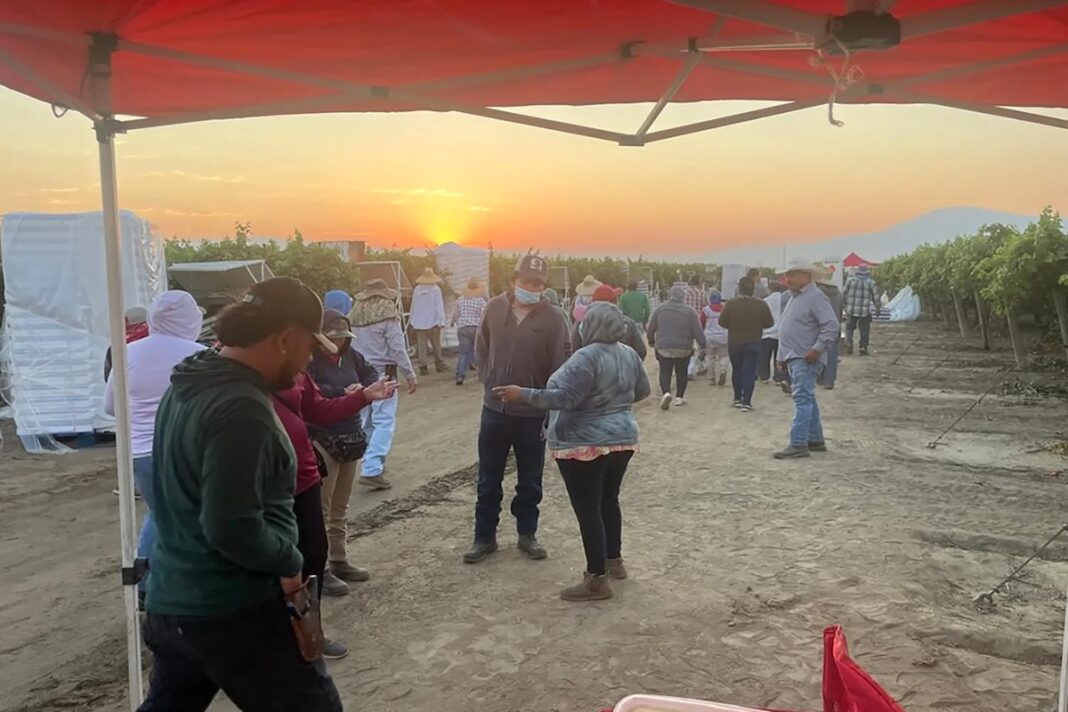
BAKERSFIELD, Calif. – Fear is a constant in Kern County’s agricultural fields, with workers afraid that Immigration and Customs Enforcement (ICE) agents will arrive at any moment and begin raids as has happened in Los Angeles and Ventura counties.
Many long-time agricultural workers say they’ve never experienced anything like what they are seeing now.
“Whenever I leave my house, I entrust myself to God and whatever happens,” says Reyna Sánchez, 60. Originally from the southern Mexican state of Oaxaca, Sánchez has lived and worked in Kern County for the past 20 years. “What I have to do is work, [because] without work there is no food.”
A mother of two, both adults and with kids of their own, Sánchez says she relies on field work to cover her living expenses. Every day at 5 AM she leaves home in a “raite,” Mexican slang for ride, toward the grape fields in McFarland, about 25 miles away. “I leave with a lot of fear that in one of those rides I will not return, and I will not see my children and grandchildren again.”
Gloria Robles from Guatemala has worked the grape harvest for 25 years. She tells El Popular that she watched the raids in Los Angeles earlier this summer certain that one of these days ICE is going to show up and “take us.”
Robles’ husband suffers from high blood pressure and diabetes, and she says that when she leaves for work, she worries she may be detained, leaving him with no one to care for him. “He requires daily care, bathing, eating healthy, and helping him get to the bathroom,” she said. “Who will take care of him.”
ICE raids and the Trump Administration’s broader mass deportation agenda have taken a heavy toll on the nation’s agricultural sector, with farmers reporting severe labor shortages and with prices on the shelves rising.
One study from August found a nationwide decrease of 155,000 agricultural workers between March and July of this year. The same study also found a related rise in the cost of vegetables and meat during the same period.
Another study found that in California the state’s overall workforce fell by 3.1% in the wake of ICE raids in Los Angeles, the largest single decline since the Great Recession, with the largest decline among noncitizens.
Bryan Little is senior director of policy advocacy for the California Farm Bureau. He says his organization does not have data on the number of times local fields in Kern County have been targeted by raids, though he acknowledged there has been a loss of income across the sector.
He added the diminished labor supply is causing an increase in labor costs, which will inevitably be passed on to the consumer.
Lasting scars
Hector Hernandez is executive director of the Centro de Unidad Popular Benito Juarez, a volunteer-based organization serving migrants mainly from Oaxaca in the Central Valley. Pointing to vineyards in Arvin, south of Bakersfield, he said, “They have not been harvested. The grapes continue to hang from the vines and now it’s too late to cut them. And there’s no one to do it.”
Hernandez added the deportations have “destabilized” the farmworker community, leaving lasting “psychological scars.”
That fear extends beyond work to everyday activities such as commuting to and from home, dropping kids off at school or simply going to the store for groceries, he explained.
Workers interviewed for this story say they now live in a state of hyper vigilance, constantly looking behind them, anxious over the slightest sound. Such stress and uncertainty can have serious consequences on a person’s mental health, including depression, anxiety, and post-traumatic stress disorder.
For many there is perhaps no greater fear than that of family separation, as happened to Perla Morales Luna, a mother of two who was apprehended by Customs and Border Patrol (CBP) agents in National City, San Diego County, in March while on her way to pay rent. Her two young daughters were with her at the time of the arrest.
A video of the arrest went viral on social media, sparking a public outcry.
“These people are being terrorized,” said Teresa Romero, president of the United Farm Workers Union, the nation’s largest farmworker advocacy group, adding workers stay home for a couple of days, hoping to avoid being detained, but the loss of income eventually catches up to them. Many head straight to work and then come home, avoiding any unnecessary stops along the way.
A legal path
“We are trying to help workers get their papers in order,” Romero told El Popular, adding the organization is also working to pass the bipartisan Farm Workforce Modernization Act, which would offer a path to citizenship for undocumented farmworkers while amending the temporary H2A visa program, streamlining the application process.
The bill is currently under consideration in the House.
“People have to understand that farmworkers are the ones who have put food on our tables for decades and we must show them the respect and gratitude that is due to them,” Romero told El Popular.
Robles agrees. “We don’t hurt anyone. We just work and bring food to homes in the United States.”
Antonio Torres contributed reporting for this story.