


By Suk Koo Lee | Korea Daily Atlanta
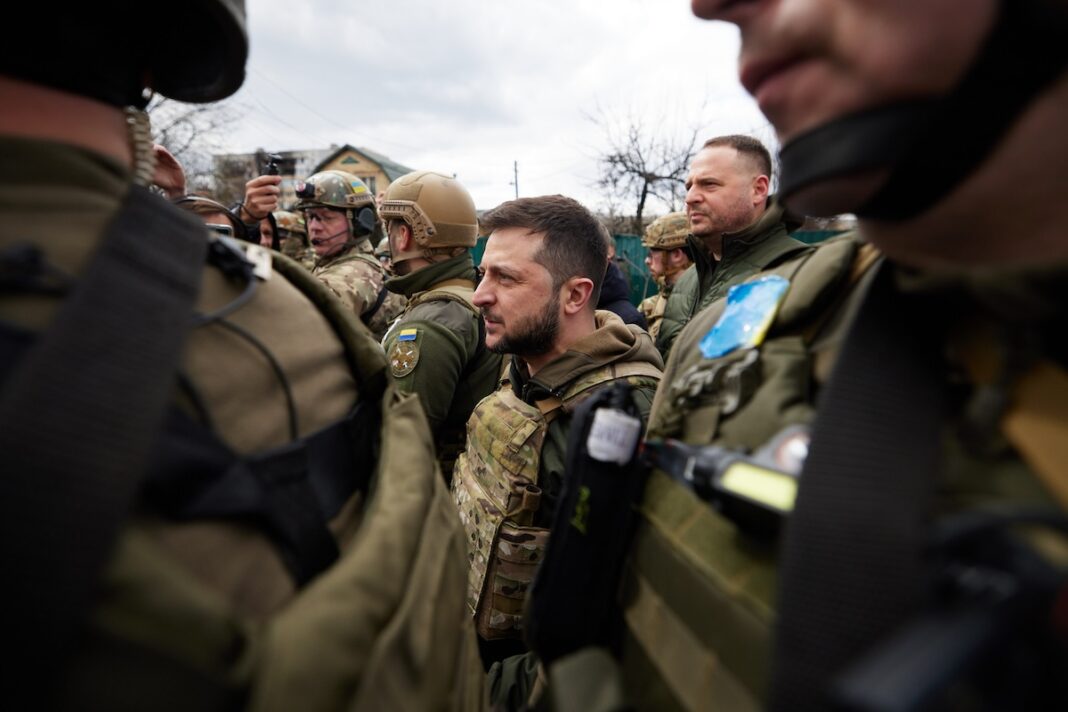
Image: Ukrainian President Volodymyr Zelenskyy visits Bucha, in northern Ukraine in 2022. (Image via Rawpixel.)
The 2022 Ukraine-Russia War began on February 24, 2022, at 4:50 a.m. with a full-scale Russian invasion. It’s been three years now. The 2022 War in Ukraine is similar to the Korean War in 1950. The time and duration of the invasion, the course of events, the international nature of the war, and the massive human and material damage are similar.
They are also similar in that they involve a unilateral invasion by one side, a ceasefire negotiated without the consent of the invaded country, and an ending. The problem is that the aftermath of 2022 War is likely to be felt in Korea as well.
The Korean War unfolded as a proxy war, with Soviet support, the entry of the Chinese Communist Party, and the intervention of United Nations forces, including the United States. Despite South Korean opposition, an armistice was signed by the U.S., North Korean, and Chinese forces. President Syngman Rhee secured a U.S.-Korea Mutual Defense Treaty, a U.S. military presence, and promises of post-war reconstruction assistance, but no prosecution of war criminals or reunification. The armistice line was drawn almost exactly as it was before the war.
The same is true for the 2022 Russian Invasion of Ukraine. On February 18, the United States held talks with Russia in Riyadh, Saudi Arabia, to end the conflict. Ukraine was excluded from the negotiations, just as South Korea was excluded from the 1953 armistice. Russia, which currently occupies 25% of Ukraine’s territory, insists that its occupied southeastern regions are non-negotiable. Of course, there will be some give and take during the negotiations.
Trump is not favorable to Zelensky. (The two fell into a now highly publicized shouting match at the White House on Feb. 28, with Zelensky cutting the meeting short without signing a deal that would have given the US rights to Ukraine’s mineral deposits.) Trump claims that Biden and Zelensky made an error in judgment that led to the war. He doesn’t argue that it was caused by Russia’s growing influence and security ambitions. Trump also presses Zelensky on what bargaining chips Ukraine has. He knows that Ukraine cannot fight a war on its own. It’s like South Korea’s situation in the Korean War.
South Korea was able to secure security and other support from the U.S. during the Korean War thanks to the Cold War. Still, Ukraine may have to walk away with no such guarantees, losing territory and suffering massive human and material damage. The woes of a weak state…
Once the war is over, Trump’s eyes are likely to shift to the Korean Peninsula. He describes Kim Jong Un as “smart” and has a good relationship with him. He says he will meet with him soon.
But North Korea will never give up its nukes. Trump is likely to try to finalize a nuclear deal with North Korea on the condition that it scraps its intercontinental ballistic missiles. If North Korea dismantles its ICBMs, the North Korean nuclear threat to the U.S. disappears. Trump would then use this for domestic politics to pat himself on the back. He would similarly use the end of the Ukraine-Russia War and the elimination of the North Korean nuclear threat as leverage to win the Nobel Peace Prize.
Like the end-of-war negotiations that excluded Ukraine, South Korea may have to wait and see as the US-North Korea negotiations exclude South Korea. Worse, Trump appears indifferent to the 70-year U.S.-South Korea alliance.
The U.S. Commerce Secretary unilaterally canceled a meeting with 20 members of a South Korean economic delegation visiting Washington, DC. After protests, the delegation was allowed to meet for 30 minutes several weeks later, with only marginal investments dangled and without Trump or other key figures present.
This is the reality of South Korea. The international tides are high, and the Korean ship is adrift without a captain.
This story was originally published in Korea by the Korea Daily Atlanta. It is republished here with permission.