


By Grace Aguinaldo-Limbag Nall | Filipino Press
Mixed race relationships are rising throughout the United States – from 9 million in 2010 to 33.8 million in 2020, according to the U.S. Census – a 27.6 percent increase. The Pew Research Center reports that San Diego-Carlsbad, Ca., is among the top 10 metropolitan areas with the highest number of inter-racial newlyweds. Here is a glimpse into the lives of three inter-racial couples.
Myrna and Chris Psillas – The Rice Dispenser
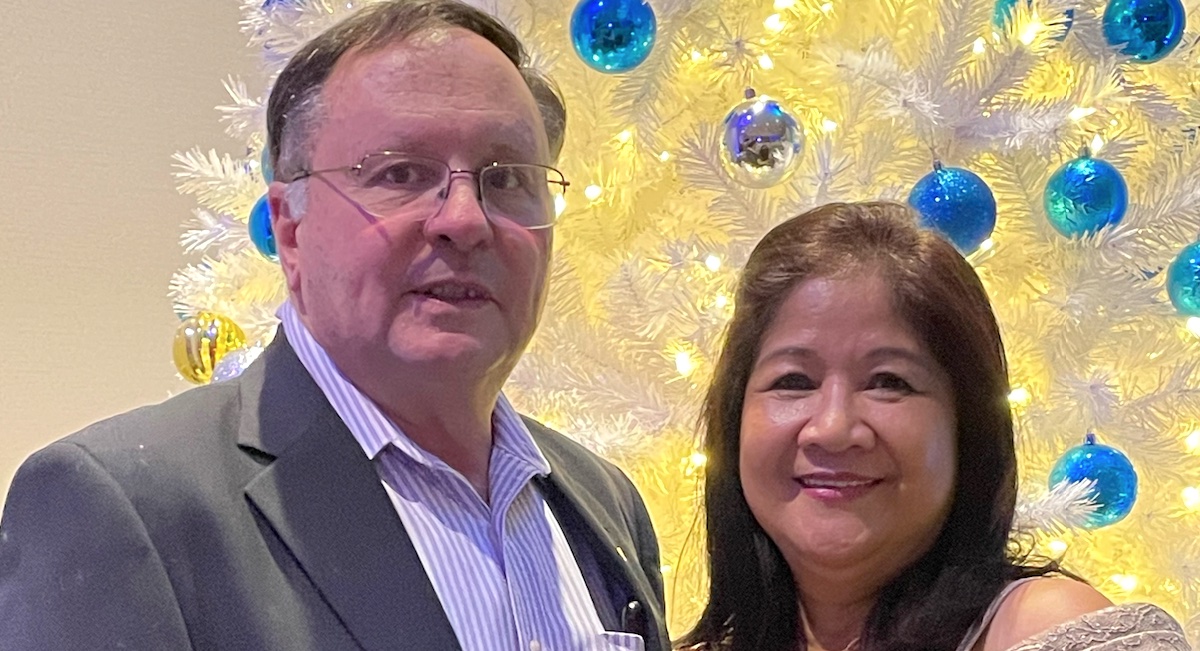
Myrna and Chris Psillas (pictured above) are in their 60s and have been married for 36 years. They have four adult children and five grandchildren. Myrna finished her nursing degree in Manila but worked a majority of her career in the United States. She is a retired Registered Nurse.
Chris graduated with a BA in journalism broadcasting and is now a retired U.S. Marine.
“I grew up in Olongopo, the Philippines, with a big family. My mom and dad, four sisters and five brothers,” said Myrna.
Chris grew up in Albuquerque. “My father’s parents were from Greece. My mother’s parents were rednecks from Oklahoma. In growing up we had a kind of multicultural background.”
They met over the phone when Myrna was 25 years old, studying nursing in college. Chris was with the Marines, stationed on sea duty at Subic Bay. When they eventually met in person, they felt a mutual warmth. Myrna found Chris “funny, a good conversationalist, well-educated, kind and gentle.” And Chris found Myrna “pretty…friendly and very shy.” When they married, they worried about finances but both found work – Chris in the military and Myrna as a registered nurse.
“As it turned out, we always had money, said Chris. “The kids always had what they needed and wanted most of the time.”
Chris’ military career took the family to Japan, Korea, finally settling in the U.S. It took close to 10 years before Chris managed to meet Myrna’s family all in one place. “Her family was scattered – some in the Philippines, some in the U.S., some working overseas.”
Myrna and Chris enrolled their four children in American schools. Their youngest daughter attended a bilingual elementary school and is fluent in English and Spanish.
What knit the family together for Myrna was “being patient with each other,” which helped build on the love and respect they shared.
Chris recalled a time when they were newlyweds. “One of our wedding gifts was a rice dispenser. I looked at it and said, ‘who would ever eat that much rice?”
Myrna laughed. Today, they eat rice most of the time. “We’ve had that same dispenser for 25 years.”
As they talk, you can see how 36 years of marriage has kept their relationship strong by celebrating each other’s culture.
“With Chris, he doesn’t say no when I cook something,” said Myrna, “He tastes it first before he says he doesn’t like it…Most of the food I make for the family, he eats anyway.”
Chris claims to make “pretty good” Filipino food. “Yeah, Chris is a good cook,” said Myrna. “In fact, he is the one doing most of the cooking nowadays.”
They like to plan a culturally rich menu for every holiday: Greek food on New Year’s Eve a mix of steak, Pancit and rice on Christmas; American on Thanksgiving.
Myrna is Catholic and Chris is Greek Orthodox. Both attend different churches but attend each other’s church for Mother’s Day and Father’s Day.
As a mixed-race couple, their advice is to focus on finding joy” and “not focus on the differences. Instead, celebrate them,” said Chris. “Every culture has something to offer and food to share. If you focus on these things, you’re a happier person.”
Merril and Alex – High School Sweethearts

Merril and Alex Linoner met in high school. They are now in their 30s and have been married for five years. Merril is Filipino, and Alex is half-Japanese, half-German. They were both born and raised in San Diego and graduated from San Diego State University.
Since they knew each other in high school, it was easier for their parents to accept their inter-racial relationship.
“My parents were happy and supportive of my decision to marry Alex,” said Merril. “We also had been together for eight years so it was expected that we would take the next step in our relationship.”
In Alex’s case, his parents, too, were happy “once they saw that Merrill took good care of me,” he said.
When it comes to disputes, Merrill feels that she makes “certain decisions based on my culture and how I was raised,” and this could result in confusion. Alex agreed with Merrill that “a lot of explanation and understanding” is needed to resolve issues.
Merril said that both families embraced their multi-cultural unit and spend time teaching their children about their cultures. “I think our children are growing up to be well-rounded individuals.”
Their two children, ages one and four, are still young, but Merril said they “will ensure that they embrace their race and ethnicity through education and passing along family traditions.” They both plan on teaching them to learn about other cultures.
Marissa Banez and J.B. – Raising A Child of the World
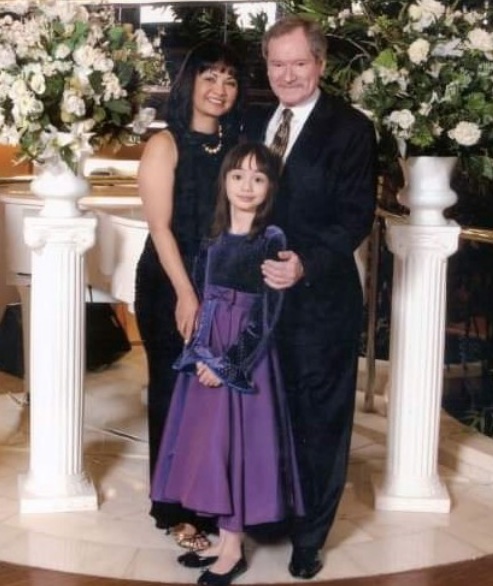
“I’m the ninth out of 10 children, I was born in Baguoi City, the Philippines, and my family came to the U.S. and settled in Los Angeles when I was nine in 1969,” said Marissa Banez, who is also a published children’s book author. She says that her first book, Hope and Fortune, is a modern-day fairytale, featuring multicultural, multiracial, and multigenerational fairies of different shapes and sizes who give practical advice to a child who has lost her way.
Marissa graduated from the University of California Hastings College of Law (now known as the UC College of Law, San Francisco). Currently she works for a large international firm focusing on products liability litigation.
Marissa met her husband while shopping for books at a Manhattan bookstore. “He was born in a wealthy family in pre-Castro Cuba,” said Marissa. “I had a great education and a stable career by then. So it wasn’t as if I was acting recklessly in deciding to marry.”
There was no opposition to their marriage, said Marissa. “I have a very diverse family, with six of my nine siblings married to non-Filipinos. My current and former siblings-in-law are/were Norwegian, German, African American, Creole, Costa Rican and Anglo-American.”
She and her husband have a 23-year-old daughter.
“My child doesn’t worry about or have any problems with her mixed race,” said Marissa. It helps that almost all her cousins are mixed ethnicity. Marissa said she raised her to be “a citizen of the world,” and expressly exposed her to different cultures and races from a young age.
She has friends of many different backgrounds (racially, culturally, and socio-economically). Although she will loudly proclaim that she is a Filipina-Cuban, she looks White and can seamlessly move in and out of various groups.
This article is part of the Love Across Colorlines series, a collaboration of 20+ ethnic media outlets looking at interracial marriage in California at a time of rising hate. Visit Love Across Colorlines to see more in the series.