By Nevin Kallepalli
REDDING, Calif. — Since the spring, community organizers and law enforcement have been responding to a troubling wave of alleged hate crimes and hate incidents in Shasta and the surrounding counties. The most high-profile incident involved allegations of an unprovoked white motorist shooting toward a neighboring Latino family outside their home in Igo, as he yelled disparagingly about their perceived ethnic background.
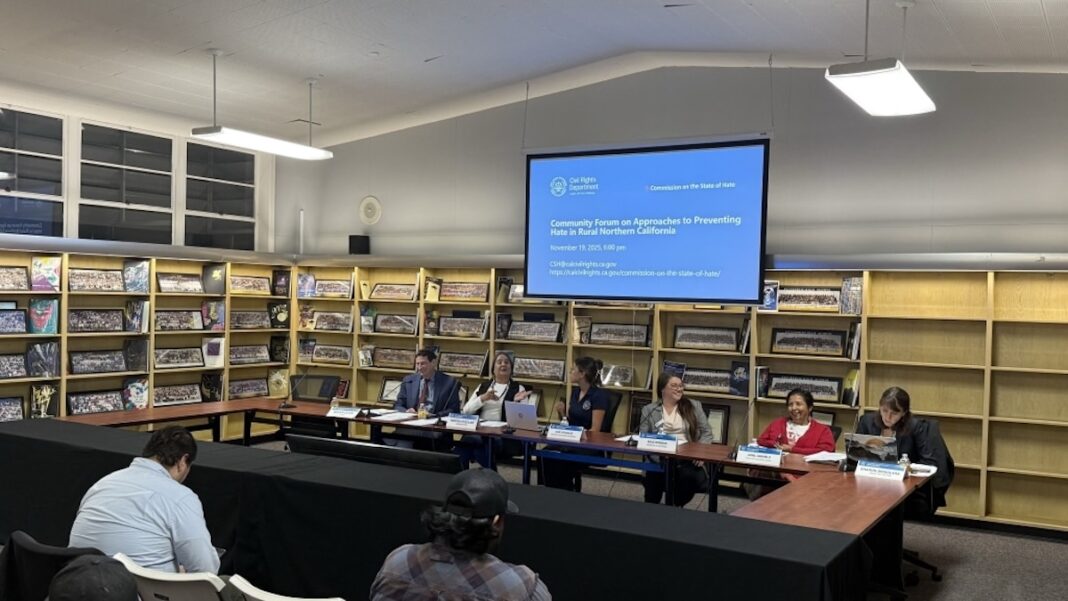
Local NGOs and educators gathered Nov. 19 with representatives from the California Civil Rights Department Commission on the State of Hate (CSH). The statewide group was formed to leverage data on hate crimes and hate incidents across the state.
The Commission on Hate’s most recent report from 2023-2024, reported crimes against trans people, Jewish people, and Black people have all soared in California over recent years. Crimes against Muslims and immigrants have not seen the same sharp rise but the department acknowledges potential blind spots in tracking those crimes due to distrust in law enforcement among those communities.
In an interview with Shasta Scout, the commission’s chair, Brian Levin, and Civil Rights Department Deputy Director of Communications Rishi Khalsa described the nuance with which hate data — which can include both hate crimes and hate incidents — is aggregated by the state.
“A hate crime is an actual criminal event, where law enforcement can respond. A hate incident is a non-criminal event,” Levin explained, noting that while “horrible” statements about racial or religious minorities may be protected by the First Amendment and therefore not illegal, they can still cause harm.
Data on hate crimes is tracked by California’s Department of Justice, the FBI, and the national victimization survey. Numbers of incidents documented throughout California were provided via responses to the California Health Interview Survey — which surveyed about 20,000 households — as well as reports submitted via the CA vs Hate hotline.
For the purposes of the Commission on Hate forum held on the evening of November 19 at Enterprise High School, Levin was joined by his colleagues Alee Gonzalez and Regina Cuellar. Representing the Shasta community were representatives from three primary organizations: the Shasta Equal Justice Coalition (SEJC), the Shasta County Indian Education Consortium, and the United Way of Northern California.
The presentations began with SEJC’s Sharon Brisolara unpacking the organization’s just-released 2024 Shasta County State of Equity report. The findings painted a bleak picture: among other data, people perceived as Black were the most likely to be stopped by police officers in Shasta but were also the least likely of any race to have been found in possession of something illegal.
April Carmelo, the Indian Education Specialist at Shasta Union High School District, spoke next, contextualizing her presentation with an overview of all the anti-Native massacres that occurred in Shasta County — at the behest of state government — over the nineteenth century. Describing state-sponsored genocidal actions, Carmelo noted that “California’s Indian population plunged from 150,000 to 30,000 with the involvement of California state and federal officials and the taxpayer dollars.”
Moving into the present, Carmelo also discussed a growing movement to raise awareness about the alarming number of missing and murdered indigenous people. From the audience, a mother whose daughter was murdered, and a young woman whose cousin is still missing, both shared their accounts of how they believe law enforcement failed to respond adequately to the cases, both in the moment of crisis and later investigations. Upon hearing these stories, Chair Levin made a personal promise that he would make sure their stories are “distributed to every commissioner and to the Civil Rights department.”
The last of the Shasta presenters was the newest CEO of the United Way of Northern California, Kalie Brisbon, whose presentation transitioned from the history and scope of discrimination in Shasta County to how her organization is working to respond.
Brisbon described the United Way’s Building Bridges initiative, which seeks to facilitate safe and open dialogue across a politically divided community. The initiative was in part a response to the increasingly volatile political environment in Shasta County, Brisbon said, noting that “when people check out of civic life, democracy suffers and inequities grow.”
“When was the last time you had a meaningful conversation with someone whose political views are completely different from you?” she queried the audience, explaining that the Building Bridges discussions — which occur in churches, coffee shops, and community centers — are meant to create a nonjudgemental space for anyone on the political spectrum to hash out potentially thorny issues.
Larry Olmstead, former United Way CEO and member of SEJC told Shasta Scout in a follow up interview that everyone has their biases, including those who think of themselves as progressively minded. When triggered, Olmstead noted, anyone can lash out.
Compounding factors that can aggravate the likelihood of hate crimes and incidents, Olmstead suggested, include mental health challenges and addiction — as court documents show appears likely to be the case in the Igo shooting.
Olmstead noted that the words of political leaders can also contribute, creating paranoia that increases individuals’ likelihood of acting out.
“Our elected leaders in Washington saying disparaging things and stoking fear about people of color and our immigrant population, that trickles down,” he said. He stressed the value of local law enforcement’s words as well, noting that the Sheriff’s strong condemnation of recent hate crimes will help to establish a cultural climate locally.
Challenging the notion that hate crime designations themselves are divisive, Olmstead used the metaphor of a home invasion to illustrate the cascade of fear that hate crimes instill in targeted communities.
“If a house on your street is burglarized, the whole street is like, oh, boy, do I need to make sure I lock my doors and lock my windows? When somebody from a racial or a certain ethnic group is impacted” by a hate crime, he said, “then it makes that whole group feel like, oh, I’m a little insecure here.”
The role of California’s Commission on Hate is advisory in nature: hosting community forums, providing resources for local governments and compiling and reporting out data including in rural areas which according to Levin, are subject to underreporting. In Shasta, the commission’s community forum served as a place for state officials to learn more about conditions in the rural North State and point community members toward the resources available to all Californians, including accessible ways to report a crime, receive potential compensation, find a therapist, or even receive free legal help.
The information gathered at these community forums, including the one in Redding, will help inform the recommendations the commission makes in its annual reports produced for the California Legislature and Governor.
If you need to report a hate incident or hate crime you can do so here.
This story is part of “Aquí Estamos/Here We Stand,” a collaborative reporting project of American Community Media and community news outlets statewide. Nevin Kallepalli reports for Shasta Scout as a member of the California Local News Fellowship.