


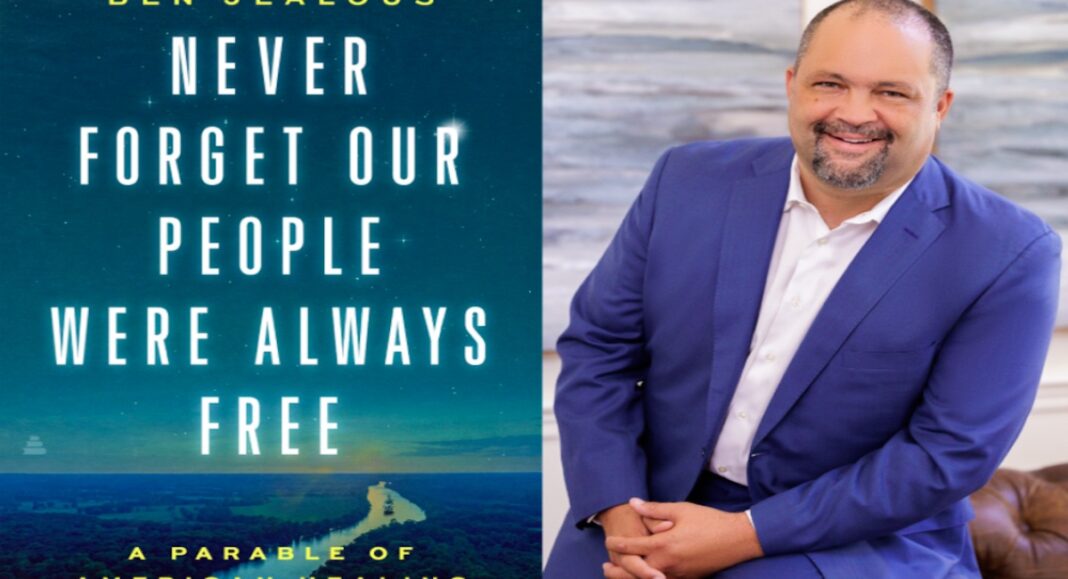
Readers of Ben Jealous’ newest book, “Never Forget Our People Were Always Free – A Parable of American Healing,’’ will grapple with its title’s meaning through the cumulative and very personal American experience of being, at some point, the outsider.
And though now no longer uncommon to hear race referred to as an artificial social construct, we remain bound by simplistically crude dichotomies – white and Black as but one example.
Jealous dissects and exposes aspects of our country’s variegated genetic history that continue to result in disastrous assumptions about the nature and identities of perpetrators of heinous deeds.
In chapter “Serial (Killer) Mistakes,’’ for example, Jealous recounts one of his Washington, D.C. experiences that occurred while working for Amnesty International years before he assumed the presidency of the NAACP.
Chappelle’s take on snipers
Near the U.S. Capitol, “Twelve officers pulled their guns out. Eight Latino Day laborers got out of a van that appeared to have only two bucket seats. They looked totally innocent and completely bewildered.”
The officers were on the lookout for a white van thought to be the vehicle of choice for the presumably white snipers whose D.C.-area shooting spree resulted in three critically wounded and ten dead in the fall of 2002.
But, contrary to popular assumptions, Jealous notes, “My godbrother Dave Chappelle had a different take… The DC snipers, Ben! I figured it out! …. They’re Black!”
The snipers’ car was blue and the Chief of Police in D.C.’s nearby Montgomery County, Maryland, “said that they had stopped these guys almost ten times before they were arrested…. And they never searched the car.”
Jealous posits that “Dave started from the observed behavior and worked his way toward race. In the streets, the police were starting at race and working their way toward behavior…. Then, when it was over, it turned out that Dave was the only person with a microphone in all of DC who had had it right.”
More notable interactions
Throughout the book, Jealous shares vignettes of his interactions with Chappelle and other well-known personalities. Yet his work avoids name-dropping for namedropping’s sake.
His tableau of characters and interactions range from conversations with international figures including Archbishop Desmond Tutu, leaders of labor unions, and aspirants to elected office, to salt-of-the-earth folks from America and abroad.
Jealous’ educational and work experiences and his common-sense instinct to ask the heart-of-the-matter questions were honed, in part, during his time as a reporter for The Jackson Advocate in Jackson, Mississippi.
His book shines the light of day on history, using truth-telling as a reasonable starting point for resolving the enduring conundrum of America’s emotional complexes about ethnic identity.
He is tilting at the windmill of the insanity of race in its long iteration in America — the sordidness of policies that continue to drive mass incarceration, economic despair, thus numbing of the aspirations of generations of American youth regardless of their DNA.
Jealous concludes his odyssey book before his unsuccessful run for the governor’s seat in Maryland.
But as he stated at a press conference following his victory in the Democratic primary, “It wasn’t just Black folks who went through segregation, it was White folks who went through it too. It demeaned the humanity of all of us.”
Those words make a fitting epilogue for this book. For our American children who ponder their future in a country that still treats truth as a carpetbagger, the parable of American healing needs embracing.
Khalil Abdullah is a freelance writer for the Trice Edney News Wire; a contributing editor for Ethnic Media Services; a former managing editor of the Washington Afro-American Newspaper; and a former executive director of the National Black Caucus of State Legislators.