


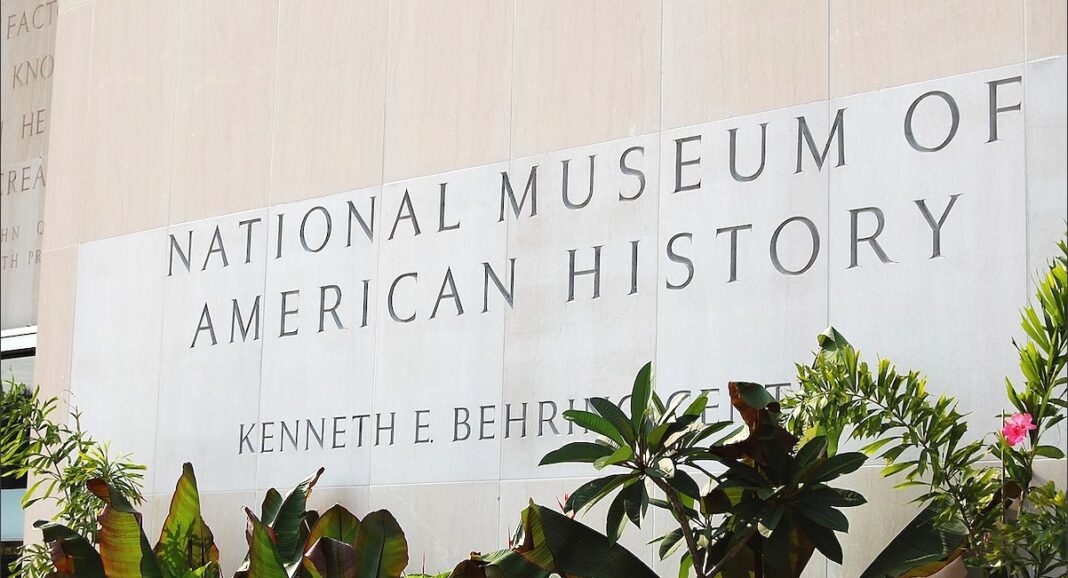
It seems Donald Trump and his platoon of MAGA culture warriors do not like the Statue of Liberty, or at least not the representation of her on display at the Smithsonian Museum of American History.
The White House has singled out the Immokalee Statue of Liberty, honoring farmworkers’ aspirations and dreams of equity, among other works, as being “too woke.”
The paper-mâché sculpture by artist Kat Rodriguez depicts Lady Liberty with a tomato in her upraised hand in place of a torch, a bucket of tomatoes in the other, the phrase “We, too, are American” engraved on her pedestal. Commemorating the 2000 march organized by the Coalition of Immokalee Workers (CIW) in Florida, the sculpture has stood in the museum’s gallery for more than two decades.
In another time, one might have assumed the statue’s affirmation of farmworkers’ hard work, their perseverance, their optimism, their dreams for a better future, might be celebrated as a reminder of what it takes for the United States to move upward. What is more American than believing in hard work and getting ahead and a better life for one’s children?

But now that “Make America Great Again!” and its abbreviated version MAGA, have entered the mainstream of American vernacular, the Immokalee Statue of Liberty is, instead, deemed un-American.
What, specifically, did the MAGA culture warriors see as wrong with the Immokalee Statue of Liberty?
An August 21 post to the official White House website, “President Trump Is Right About the Smithsonian” offers some answers. The post is a bullet-pointed screed against “woke” culture and its supposed influence over the hallowed institution. Alongside complaints about numerous other exhibits in the National Museum of African American History and Culture and the National Museum of the American Latino the memo has the following objection to the Immokalee exhibit.
An American History Museum exhibit features a depiction of the Statue of Liberty “holding a tomato in her right hand instead of a torch, and a basket of tomatoes in her left hand instead of a tablet.”
The irony here should not be lost. The Statue of Liberty, an icon of American heritage, is herself a foreign-born dreamer, conceptualized by French activist Edouard de Laboulaye as a gift to the United States to honor and celebrate the abolition of slavery.
This is, of course, just the point that the Immokalee Statue of Liberty sought to drive home as she accompanied the Coalition of Immokalee Workers on their two-week “March for Dignity, Dialogue, and a Fair Wage,” in the spring of 2000, a march that traversed more than 200 miles from Ft. Myers to Orlando.
Still more disturbing, as evidence of White House ignorance, mutilation of history, and authoritarian efforts to rewrite history is the fact that the Coalition of Immokalee Workers’ decades-long fight for justice resulted in the Fair Food Program, where business and workers work directly with each other to assure decent wages and working conditions. The program is not an example of “big government” intrusion into the private sector, rather a model of skillful and collaborative problem-solving.

Standing there at the Smithsonian, among families and children calmly viewing the work, the lines from Black poet and activist Langston Hughes’ 1926 poem, “I, Too” come to mind.
Tomorrow,
I’ll be at the table
When company comes.
Nobody’ll dare
Say to me,
“Eat in the kitchen,”
Then.
Besides,
They’ll see how beautiful I am
And be ashamed—
I, too, am America.
Do Trump and his cultural cronies know that many of the Immokalee farmworkers were Haitian, Blacks from a homeland Trump referred to as a “shithole nation”?
Did they notice, as museumgoers do, that the Immokalee Statue of Liberty has weathered brown skin?
Did they know that CIW collaborated with the Department of Justice in discovering, documenting, prosecuting, and winning 7 slavery cases where trafficked farmworkers were being held in captivity, and freeing more than 1,500 of them?
Did they know that the tomato bucket in the Immokalee Statue of Liberty’s hand references CIW’s initial campaign for an additional “penny a pound” increase in tomato pickers’ wages? Based on piece rate payment of 50 cents per 35 lb. bucket, the campaign yielded a 70% increase in worker earnings.
Why is this skirmish in ongoing U.S. culture wars worth paying attention to amid the daily whirlwind of headlines? It reminds us that the real and crucial struggle is between narrow efforts to reframe history to please a small minority of narrow-minded voters, and the true mission of government as a collective endeavor to solve problems and actually make progress toward the nominal goal of equity for all.
Language matters as does cultural perspective—especially in public life and policy.
Should the 1 million farmworkers who lack legal status be considered “criminals” and/or “aliens?” Or contributors to American economic well-being and strength? It makes a huge difference in their lives because immigrants branded as “criminals” can be detained and deported without recourse to due process and families branded as “aliens” can more easily be denied health care and education.
The clash over Smithsonian policy and museum exhibits is, most ominously, evidence of an effort to regiment free expression and distort the day-to-day facts of community life in the real world. The authoritarian end goal is to create a future where all hope of unity and justice is lost.
Ed Kissam first got to know Immokalee back in 1979 when he screened his documentary on farmworker pesticide exposure “49 Years in the Land of Plenty” there. He has followed the history of the Coalition of Immokalee Workers since its’ inception and conducted community research there from 1990 through 2010.