


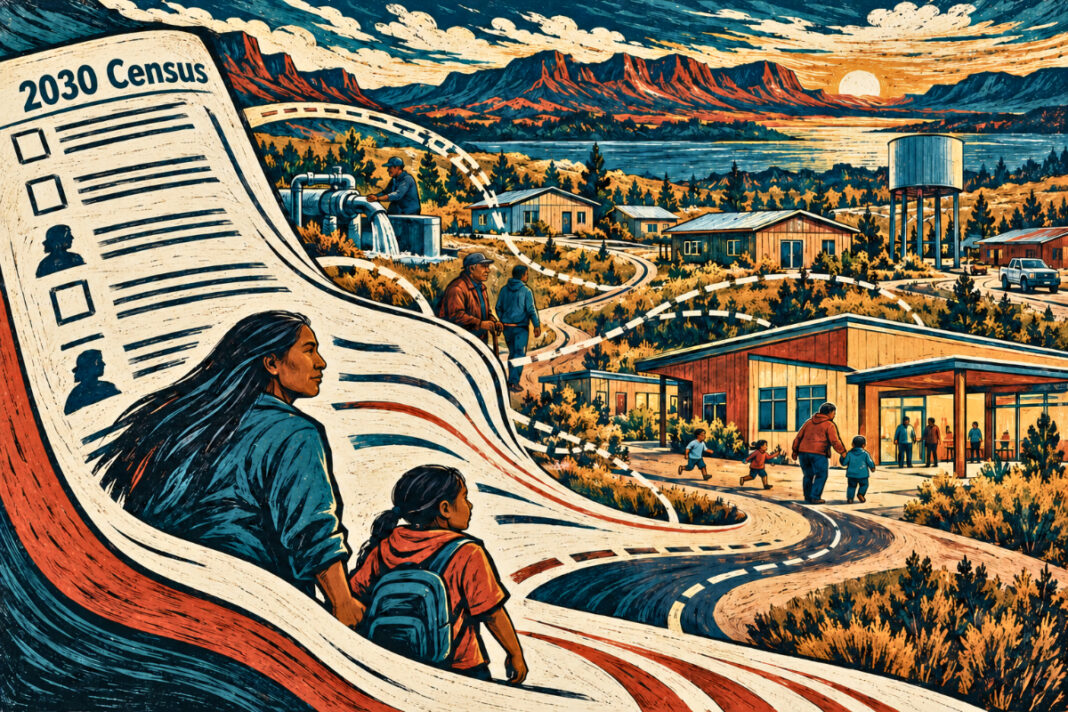

More than 500 tribal leaders joined a recent virtual roundtable hosted by the Department of Commerce and the Census Bureau.
Billed as a “tribal consultation,” the Oct. 2 event was meant to give voice to Native American communities as the federal government considers changes to how they are counted in the upcoming 2030 Census.
Only a fraction of those who attended, however, got to speak before the 90 minutes set aside for public comment ran out.
“Meaningful consultation should be carried out face to face,” argued Peter Lengkeek, chairman of the Crow Creek Sioux tribal council, rejecting the characterization of the meeting as a consultation. “Decisions about how American Indian people are identified and counted have consequences that extend far beyond the census itself.”
The Census Bureau’s proposal outlined in a September Federal Register notice, would redefine residency requirements and bar questions about race, ethnicity and sexual orientation on the main 2030 Census questionnaire. Federal officials say tribal data could still be collected through “other instruments,” but have not said how. Tribal leaders say that leaves them in the dark. Public comments are due Nov 2.
Dan Sweeny, deputy general counsel for the Department of Commerce, told participants that the proposed section 70.2 would prohibit race, ethnicity and sexual orientation questions on the main form but would not stop the Bureau from asking “some sort of tribal question.” He did not offer specifics.
The government wants to prioritize the core constitutional task of counting people for apportionment, Sweeny said. It also wants to reduce the number of questions people are legally required to answer, lower the risk of collected data being accidentally published and make the questionnaire easier to complete, which he said would produce a more accurate headcount. The proposed residency criteria are “neutral as to tribal status or identity,” he added.
“It does not propose residence criteria that would exclude people or treat them differently based on their tribal status or identity,” Sweeny said.
Tribal leaders, including Donna Thompson, chairwoman of the Fort Hall Business Council in Idaho and a lifelong resident of the Fort Hall Indian Reservation, said the call itself fell short.
“In the first census, American Indians were not counted. Subsequent efforts to count Indians were sporadic and unreliable, leading to a lack of representation and disenfranchisement,” Thompson said during her open comments. She warned the 2030 proposal would bring that history back.
In 1880, a federal law authorized a special census of Indians on reservations and in unsettled areas using a 48-question schedule. The 1890 census tallied 248,253 Native Americans, and it was the first attempt to try to count all Native people, whether they lived on reservations or not.
After the Indian Citizenship Act of 1924 and later litigation, all Native Americans and Alaska natives were counted with the general population beginning in 1940. Self-reporting on census forms has driven steady growth in the recorded Native population with each census.
In his comments, Lengkeek underscored the link between census data and federal funding formulas for housing, transportation, infrastructure planning, congressional, and legislative redistricting program eligibility, needs assessments, and federal budget decisions.
He also cited the Native American Housing Assistance and Self-Determination Act (NAHASDA) as examples of programs that rely on census data, as well as Indian Block Grant Resources, Tribal Transportation funding–programs that Natives and non-Natives count on.
“Our roads are used by enrolled tribal citizens, descendants, citizens of other tribal nations, non-native farmers, ranchers, employees, educators, healthcare providers, emergency responders, businesses, contractors, visitors, and people who live and work throughout the surrounding area,” Lengkeek explained, while using Crow Creek reservation as an example.
“Those individuals create real transportation demand, regardless of how they identify on the census form,” Lengkeek continued. “The same is true for housing. A household may include enrolled tribal citizens, descendants, citizens of another tribal nation, and people who are not enrolled citizens. All of those individuals contribute to housing occupancy, utility use, water and wastewater needs, and other community infrastructure demands.”
Joaquin Esquivel, a program coordinator at the Inter-Tribal Council of California’s Childcare program in Sacramento, Calif., is part of a program that is funded by a Block Grant that relies on census data to determine funding. Speaking before the consultation, he told ACoM, “This feels like another way to systematically abandon Indigenous people.”
For Thompson, the issue is plain and simple. Native Americans have a right to be counted.
“For (us), being counted is more than a racial consideration; it is our political and legal identity,” she said.
Sharon K. Sobotta recently joined American Community Media where she helps manage a new Native/Indigenous Voices initiative. She is as an editing fellow with the UC Berkeley California Local News Fellowship.


We see you. Congratulations and best wishes on your new position.