

By Meera Kymal and Anjana Nagarajan-Butaney for Palabra
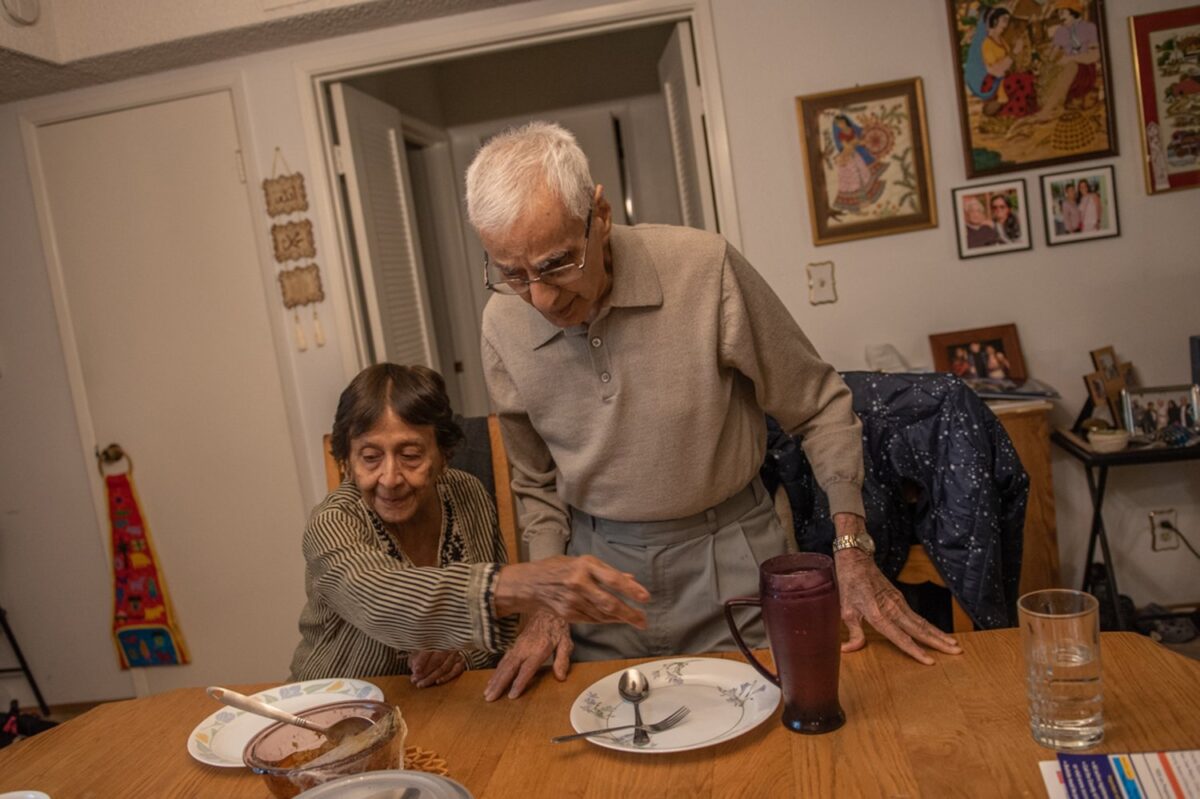
In 2005, Tahera Khalil suffered a heart attack while she and her husband Sabbar were visiting their daughter, Nishrin, in California. Worried that she could not care for her aging parents if they returned to India, Nishrin urged them to remain in San Jose, where she lives.
Tahera and Sabbar stayed, but they did not anticipate the consequences of growing old in a country without universal healthcare.
Today, 18 years later, the Kahlils live in a senior community less than three miles from Nishrin’s home. Sabbar, now 95, suffers from macular degeneration (an eye disease that causes blurred vision) and the side effects of radiation after a bout with cancer. As his eyesight fades, he’s increasingly dependent on Tahera. Sabbar doesn’t yet meet the criteria to receive skilled nursing care, but as his health issues become more complex, the burden on Tahera grows.
Culturally Congruent Care
At 88, Tahera recently had a pacemaker fitted but continues to manage the cooking and housework with Nishrin’s help. The Khalils cannot afford private caregivers. Nor would they move Sabbar to a nursing home even if he qualifies for it, especially not to one that lacks culturally congruent care.
“I can take care of myself and my husband,” says Tahera steadfastly.
In many immigrant families, aging in place in a multigenerational setting is the cultural norm. Nishrin’s abiding commitment to helping her parents is typical of her South Asian roots. But as aging takes its toll on the elderly, family members are left to perform complicated caregiving tasks without support or training, thus placing their own health, finances and well-being at risk.
This trend reflects a nationwide exigency. As more people in the U.S. live longer, a higher prevalence of chronic diseases — ranging from arthritis and chronic pain to hypertension, diabetes and dementia — will fuel the demand for support services.
America is Graying
Approximately 56 million adults age 65 and older live in the U.S., according to 2021 data from America’s Health Rankings, representing just under 17% of the nation’s population. The year 2030 marks a demographic turning point for the country; that’s when all baby boomers will be older than 65. Put another way, one in five Americans will be at retirement age.
The U.S. Census predicts this demographic will reach 77 million by 2034, with older adults outnumbering children for the first time in U.S. history.
Seniors 85 and older — the group most often needing help with basic personal care — will more than double between 2020 and 2040, says an Urban Institute study.
Projections show that Latinos age 65 and older (about 4.6 million in 2019) will grow to just under 20 million by 2060, an increase from 9% to 21% of the older U.S. population.
As the ethnically diverse, aging population grows, so will the demand for culturally competent services to address their growing healthcare needs.
Read the entire story here: https://www.palabranahj.org/archive/to-age-in-place