


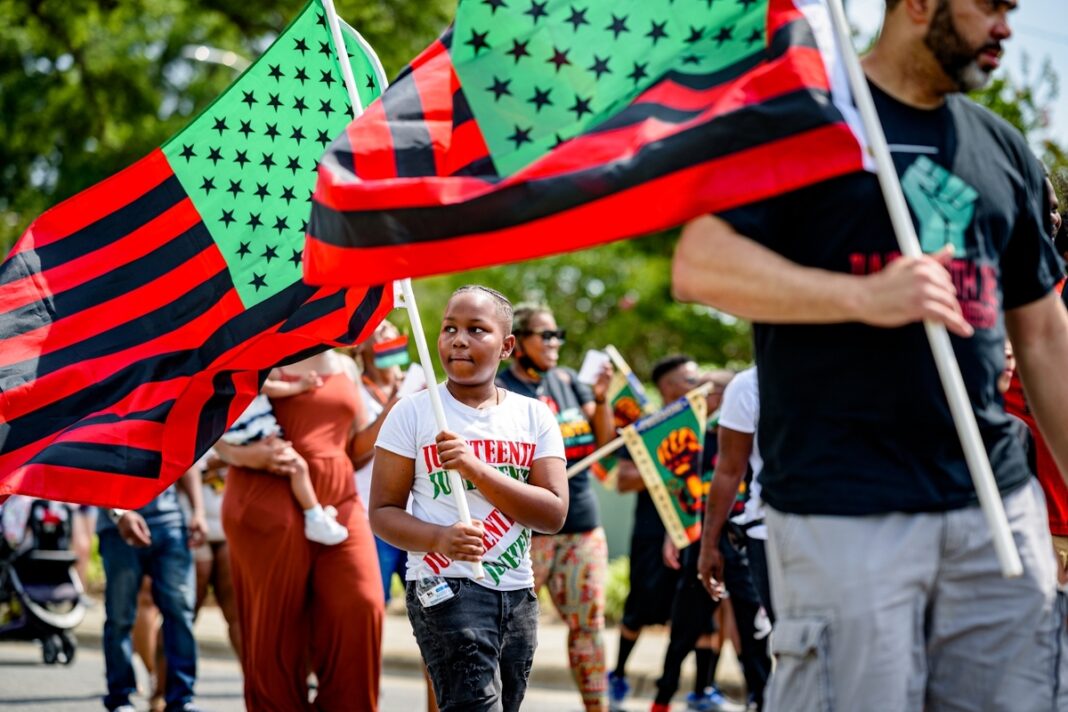
By Edward Henderson | California Black Media
Juneteenth officially became a federal holiday in 2021 when President Joe Biden signed the Juneteenth National Independence Day Act into law.
Even before that national proclamation, Juneteenth had been recognized as a holiday in California.
California Black Media spoke with Ronald Preston Clark, a writer and educator in San Diego. He shared his perspective on the holiday and how, even though he grew up in a family connected to Black culture, he did not really appreciate the full significance of the Juneteenth until he was a student at Hampton University, a Historically Black College and University (HBCU) in Virginia.
“I didn’t start to look into celebrating it until being surrounded by the excellence at Hampton. As I’ve gotten older, and further into my teaching career, I have been more intentional with my celebration and understanding of Juneteenth. I am now sure to educate others on its significance,” he said.
Clark is not alone in his experience. For many Americans – including some Black Americans — Juneteenth was not celebrated in their families or taught in schools. It wasn’t until activists and historians led grassroots movements for decades that the holiday became more widely recognized.
While Clark says he is happy to celebrate Juneteenth with his family and to see the holiday gain national recognition, he doesn’t want it to turn into a commercialized event like other cultural holidays.
“We should always remember that the reason for the holiday is that our ancestors were set free – two years after they should have already been free. And then the years that followed were still filled with violence, hatred and bigotry towards us.”
History of Juneteenth
Juneteenth marks the anniversary of June 19th, 1865, when enslaved African Americans in Galveston, Texas, were notified by Union soldiers that they were free under the Emancipation Proclamation.
Two and a half years earlier, on December 31st, 1862, enslaved and free African Americans gathered in churches and private homes across the country to celebrate what was known as “Freedom’s Eve.”
They were anticipating news that President Abraham Lincoln’s proclamation that ended slavery in Confederate States had become official on January 1,1863.
However, not everyone in Confederate territory would immediately be free. Even though the Emancipation Proclamation took effect in 1863, it could not be implemented in some places in the Deep South still under Confederate control.
As a result, in Texas, the westernmost Confederate state, enslaved people would not be free until approximately 2,000 Union troops led by Major Gen. Gordon Granger arrived in Galveston Bay on June 19, 186B and announced that the more than 250,000 enslaved Black people in the state were free by executive decree.
Last year, Gov. Gavin Newsom issued a proclamation commemorating Juneteenth in California.
“This Juneteenth, I urge all Californians to reflect on the ongoing cause of freedom for Black Americans remembering that, though General Granger’s announcement in 1865 called for “absolute equality,” that vision was, and remains, far from complete.”