


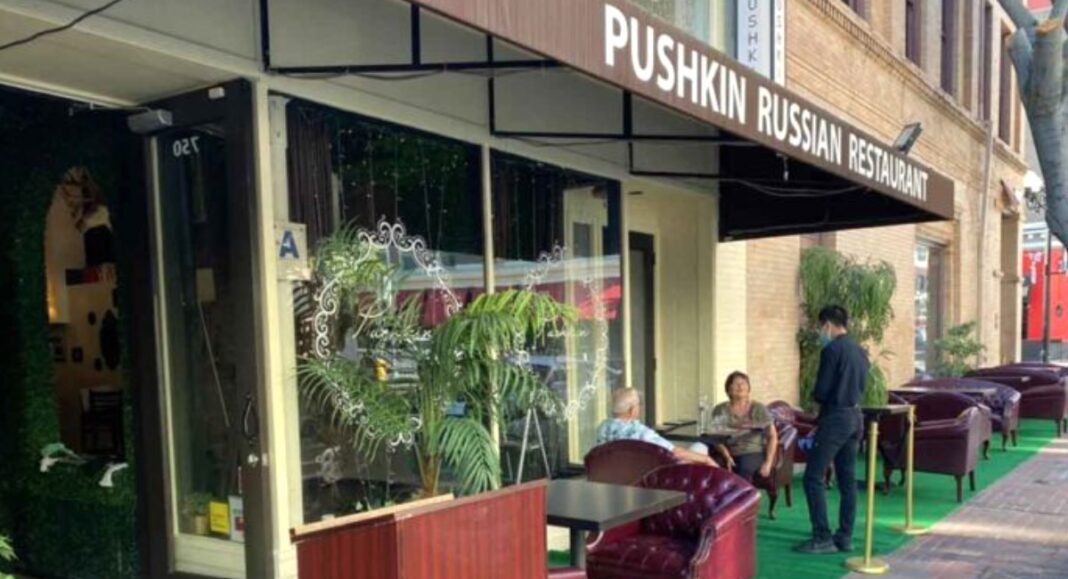
Since its inception in 2015, the Pushkin Russian restaurant has been a venue where emigres can wistfully indulge in culinary memories from the home country: blinis, borscht, red and black caviar, along with geographically-themed libations.
Grocery stores in the neighborhood sell products familiar to the Slavic immigrants, from salo (frozen pork lard), buckwheat, and “herring under a fur coat.” Such stores are always called “Russian” — though business owners could be Moldavians, Ukrainians, or Armenians — because it was clear to everyone, including Americans, that they sell products from Eastern Europe.
For the many immigrants who came to the US in the latter part of the last century from the countries of the former USSR – Armenia, Belarus, Georgia, Ukraine, Moldova, Kazakhstan, and Russia — Russian is the common language of communication.
But after Russia’s invasion of Ukraine on Feb. 24, the situation has changed for the owners of Russian-named businesses: they have become the targets of hate, including physical and verbal assaults.
Read the full story at Slavic Sacramento

This resource is supported in whole or in part by funding provided by the State of California, administered by the California State Library in partnership with the California Department of Social Services and the California Commission on Asian and Pacific Islander American Affairs as part of the Stop the Hate program. To report a hate incident or hate crime and get support, go to CA vs Hate.