


By Matt Mitchell
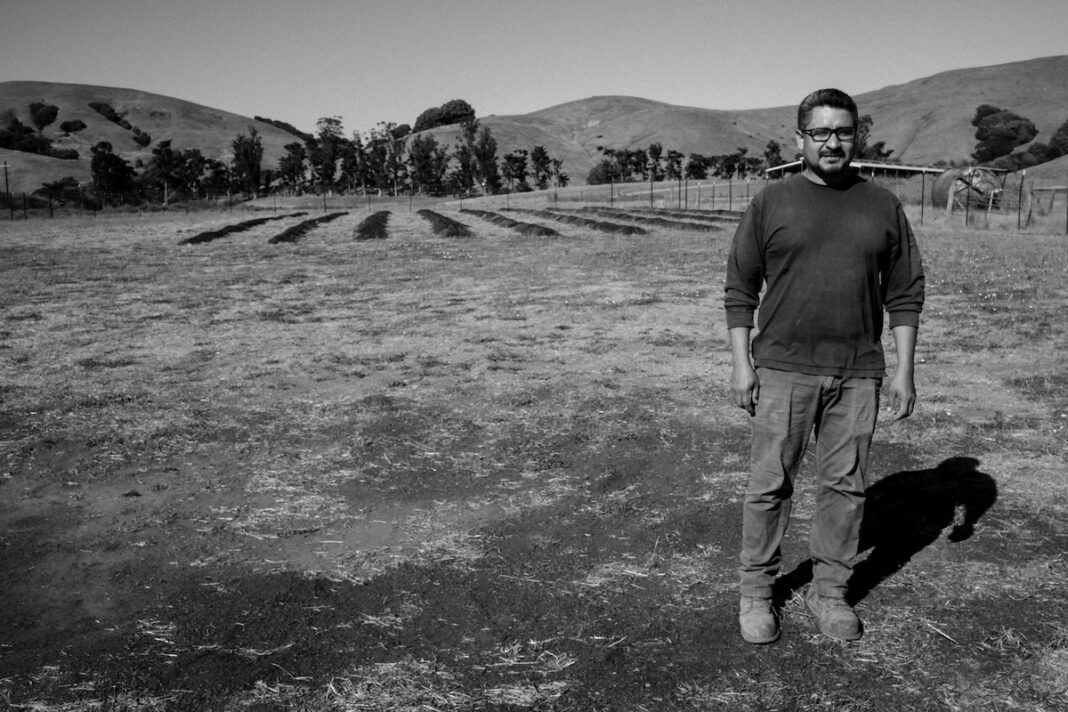
Jorge Martinez is co-founder of Sembrando Vida, “Sowing Life,” a project that supports the cultivation of crops traditional to cultures in Mexico and Central America in West Marin. The project, launched in the past year, comes as Latino farmworkers in this rural stretch of coastal Northern California are being displaced following a settlement with environmental groups that led to the closure of the area’s historic ranches. You can learn more about the displacement of West Marin’s farmworker community here.
A big wind moved through Hicks Valley as Jorge Martinez peeled back a section of the welded wire fence that enclosed his farm. A proper gate had yet to be furnished, so this ad-hoc entrance had to suffice.
Crossing the threshold, he ambled over to the far corner of the property and approached a clutch of starter plants—mostly tomatoes, rounded chili peppers and hibiscus. Their young stalks riffled in the balmy evening air.
“These are ready to go. We’re going to start planting tomorrow,” Mr. Martinez said. “We’re trying to grow plants that would usually be part of the Mexican cuisine.”
For the past year, Mr. Martinez and a small group of volunteers have tended the single acre of land on the Point Reyes-Petaluma Road when they are able, usually on weeknights after work lets out or on weekends. The project is called Sembrando Vida, or “Sowing Life,” and it provides West Marin’s Latino community with a place to sow culturally relevant foods of their own.
Mr. Martinez, who is kind-eyed and affable and works in construction, conceived the idea years ago with two members of West Marin Climate Action, Trinka Marris and Eleanore Despina. The project has been slow to take shape, but this fall, it will finally bear fruit.
After receiving support from Innovative Health Solutions, a Bay Area nonprofit that works to advance equitable and inclusive public health initiatives, and fiscal sponsorship from the West Marin Lions Club, one of the biggest challenges was sourcing arable land they could afford to lease. Much of West Marin is open space preserved with easements to guard against development. For that reason, available parcels tend to be eye-wateringly expensive.
The trio eventually found a willing partner in Blue Marble Acres, a 772-acre property owned by George Gund and his wife, Gloriana Mejia-Gund. Named after Apollo 17’s 1972 photograph of the Earth, the farm is an agricultural incubator, leasing one-acre plots to small-scale farmers and individuals from urban areas who want to connect with the land.
“We went out to Blue Marble Acres and learned about their interest in creating community and being a place where people who don’t have acreage could grow food,” Ms. Despina said. “They gave us really favorable terms, so we started raising money for fencing and making improvements, and that’s been the story of the last year.”
For a mostly self-taught farmer, Mr. Martinez betrays no hints of inexperience—agriculture is in his blood. As a child growing up on the Kehoe Ranch in the Point Reyes National Seashore, his father had him learn how to cultivate tomatoes to stay busy, with few other kids around to cavort with.
Sembrando Vida relies on Mr. Martinez’s knack for troubleshooting, but the project has also introduced him to other Latino farmers, like Zeke Guzman, who runs a community farm called Jardín del Pueblo in Healdsburg.
Last year, Jardín del Pueblo produced 43,000 pounds of vegetables for their local foodbank. “Food sustains us, and I don’t think it’s right that the people who sustain the food system in this country can’t afford to buy the food they produce for everyone else,” Mr. Guzman said. “That is why I do this work.”
After Mr. Martinez reached out for guidance, Mr. Guzman paid a visit to Sembrando Vida and helped install the farm’s irrigation system, a cylindrical water tank fed by distant ponds ensconced in the blond hills adjoining the property.
More support soon followed. John Wick, a Nicasio rancher, donated 60 cubic meters of compost. Ken Otter, an Inverness resident, lent the farm a Bobcat loader to help distribute it. Local nurseries also chipped in, pledging nearly 800 plants for little to no cost.
“All of a sudden, the floodgates opened,” Ms. Marris said. “From about April on, we finally started getting a lot of what we needed, just through networking and connections.”
Sembrando Vida practices no-till farming, a method whereby crops are grown without disturbing soil structures through plowing. Instead of harrowing the ground before planting, farmers sow seeds directly into the topsoil. This type of agricultural practice lessens the amount of stored carbon released into the atmosphere, one of the main drivers of climate change.
For years, agriculture in Marin has been at the vanguard of carbon sequestration. In 2007, Mr. Wick helped launch the Marin Carbon Project, a partnership between researchers and local farmers aimed at drawing carbon dioxide out of the atmosphere and storing it in soils and vegetation. Working with scientists from the University of California, Berkeley, the project has demonstrated that applying a thin layer of compost to rangelands can boost soil carbon storage for decades.
A bevy of farms in the North Bay embrace regenerative agricultural practices, including Singing Frogs Farm, a nine-acre no-till vegetable operation in Sebastopol. Since moving to a no-till system of soil management six years ago, the farm has raised its soil organic matter by more than 400 percent, surpassing even the best organic tillage systems.
Mr. Wick is optimistic that Sembrando Vida can replicate that success. He paid for the group to visit Singing Frogs Farm to study the no-till method, then donated enough compost to ready their acreage for planting. “I’m willing to fund a group of people who are trying to grow food to do the right thing in hopes that maybe it will inform how other people look at the situation,” Mr. Wick said.
The acre leased by Sembrando Vida from Blue Marble Acres sits at the eastern edge of a former Spaletta family dairy that spans six generations and still grazes cows nearby. Decades ago, a milker who now volunteers with Sembrando Vida recalled fellow farmworkers stealing into the hills to avoid immigration enforcement, Mr. Martinez said.
President Trump’s nationwide deportation campaign has resurfaced fears of immigration sweeps among West Marin’s Latino population. Seeking to meet arrest quotas of 3,000 people a day, the administration has directed ICE agents to target immigrants regardless of legal status or criminal history. In other parts of the Bay Area, the risk of arrest has kept some residents from showing up for work, too afraid to leave their homes.
So far, no ICE detentions have been reported in West Marin, but that has done little to assuage concerns. Alma Sanchez, who directs the West Marin Immigrant Rapid Response Network, a hotline for reporting ICE sightings, said the anxiety is nothing new.
“Yes, we are worried, but we live with that fear every day, even if we are legal residents or citizens,” she said. “The color of our skin is the difference.”
Despite the uncertainty, work at Sembrando Vida goes on. Late-summer patches of fast-growing scrub grass must be cut back and starter plants trimmed before they can be set in the ground. Mr. Martinez said there are plans to add a mobile chicken coop, and his father is considering introducing a cow if the farm ever expands.
Harvest is still a ways off. West Marin’s long growing season can last well into September and October, with some crops producing until Thanksgiving. When the time comes, the group hopes to invite community members to the farm to participate.
“A harvest party,” Mr. Martinez said.
This story is part of “Aquí Estamos/Here We Stand,” a collaborative reporting project exploring the impacts of the Trump Administration’s anti-immigrant crackdown on communities across California.