




A Sikh truck driver was stabbed 17 times at a rest stop in south Wyoming in the early morning hours of Sep. 14. The driver, a resident of Sacramento, California and identified only by his last name, Singh, remains hospitalized.
In an interview with NPR, the victim — who suffered multiple lacerations and injuries to his chest and ribs — said that the attack was unprovoked. “ I don’t know why this happened … I don’t know why they attacked me.”
The assailant, another truck driver, was later detained by Highway Patrol and is now in custody.
Attorney Jasjit Singh (no relation to the victim) is director of Legal Services with Jakara Movement, a California-based grassroots organization that works closely with the Punjabi Sikh community. He told reporters the victim’s appearance may have played a roll in the attack.
“How did this individual choose him? In the middle of the night?” he said, referring to the attacker.
“People are not feeling safe“
The incident comes amid a dramatic rise in hate incidents targeting the South Asian American community.
In a survey released earlier this month by Stop AAPI Hate, 48% of South Asian American adults said they had experienced an act of hate during 2025. Eight percent experienced someone attempting to physically harm or make contact with them without succeeding, while 7% experienced a physical injury.
The majority of attacks were verbal harassment.
“People are not feeling safe when they go to the grocery store, when they pick up their prescriptions, when they drop their children off at school,” Manju Kulkarni, co-founder of Stop AAPI Hate, told American Community Media. “These are public settings where they are getting targeted.”
Kulkarni, who also serves as executive director of the AAPI Equity Alliance, said the physical harm and verbal assaults are causing nervousness, anxiety, and depression among South Asian Americans. But, she added, the harm goes much deeper.
“It is a sense of no longer belonging, a sense of being otherized, by neighbors and colleagues,” said Kulkarni, who criticized the Trump Administration for fomenting the hate.
She pointed to blatantly racist messaging coming from the White House, as well as to renewed efforts to scrub demographic data — including questions on race and sexual orientation — from the 2030 census.
“This is really an attempt to create a white supremacist nation, void of people like us,” she stated.
On Sept. 9, DHS posted to the social media platform, X an AI-generated Transformers-themed image. It featured Optimus Prime confronting a bearded man with a head covering. “Get off our roads, you don’t know how to drive Mr. Singh,” read the text.
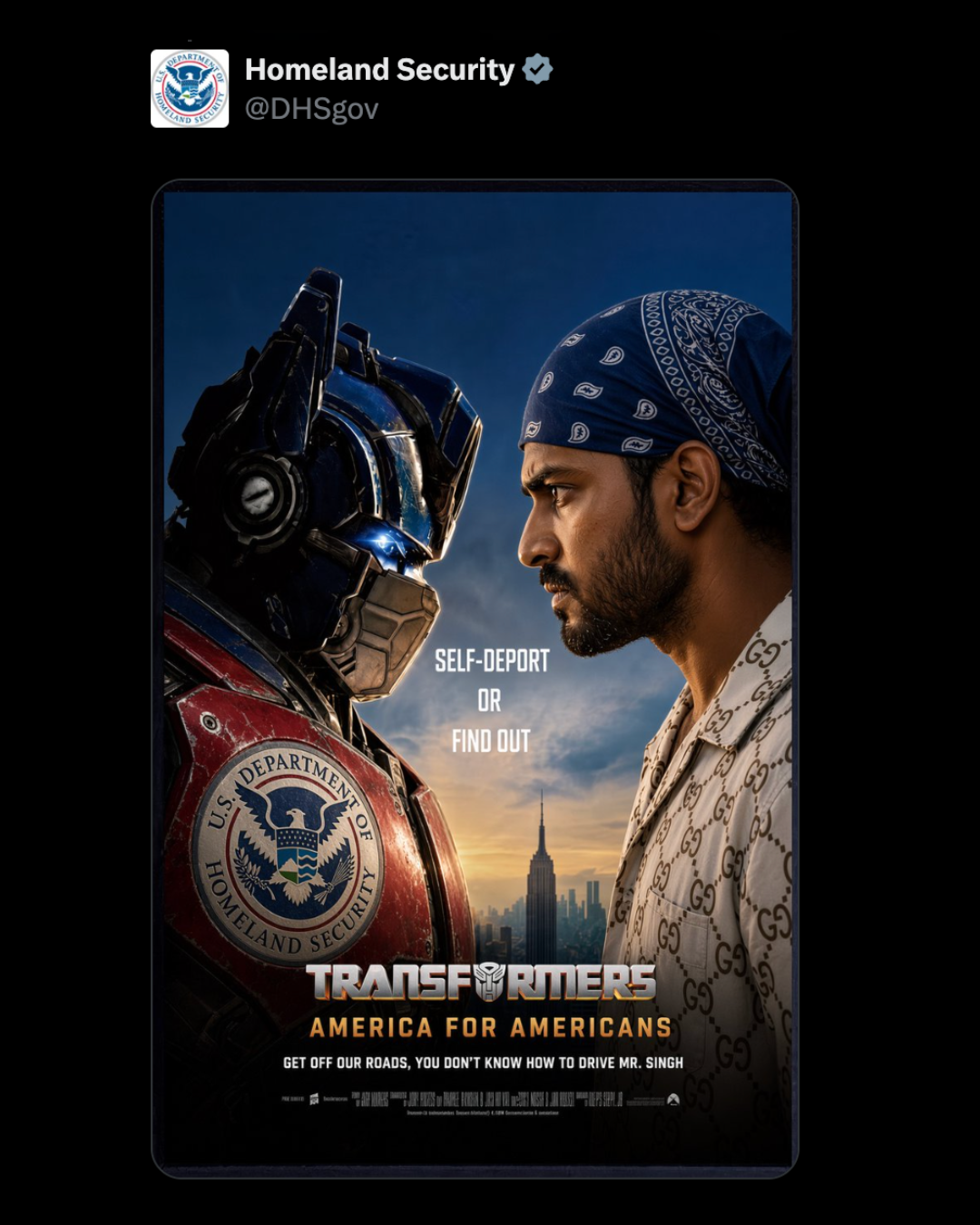
DHS defended the post, saying the driver in the image depicted Harjinder Singh, a truck driver accused of killing three people in a crash in Florida. “Harjinder Singh should have never been in the country,” said DHS, subsequently taking down the post.
Singh has pleaded not guilty to three counts of vehicular homicide.
On its website, the agency announced a new tip line for “reporting commercial drivers’ license fraud.” The announcement features the names and photos of several Punjabi truck drivers, among others.
‘Fueling Xenophobia’
“Those spreading this hate, including officials in our own federal government, need to stop. Those who turn it into violence must be held accountable,” said Rep. Raja Krishnamoorthy, in a Sept. 17 press statement. He also condemned DHS’ social media post, saying it fueled xenophobia against Sikh and South Asian Americans.
Several civil rights organizations, including the Sikh Coalition and the South Asian American Justice Collaborative, condemned the stabbing of Singh.
“Our communities deserve to be safe in our homes, on the streets and at work. When DHS tells Mr. Singh to get off ‘our roads,’ it sends a message far beyond one driver,” Kalpana Peddibhotla, executive director of the South Asian American Justice Collaborative (SAAJCO), told American Community Media. “It says Sikh truck drivers are foreign, suspect, and do not belong. It tells brown people that they are untrustworthy and deserving of suspicion.”
Peddibhotla noted that — while the motive for the attack remains unclear — it occurred just 6 days after the DHS post on X. “The attack came amid open hostility toward Sikh and immigrant drivers — hostility that the government’s own rhetoric reflects and intensifies,” she said.
Kulkarni cited an incident of verbal harassment by Bo French, the Republican nominee for Texas railroad commissioner. In a Sept 13 post on X, French posted a photo of Indian students celebrating at a football game.
“I heard UT graduation this year looked like this. I didn’t believe it. The problem is now obviously far worse than anyone imagined,” wrote French, adding in subsequent comments that the students were “foreigners” displacing Americans.
ICE arrests
The report also pointed to the spike in ICE arrests and detentions targeting South Asian Americans. Among Asian regional groups, South Asians have the highest number of ICE arrests, detentions, and deportations. In the period between Jan. 20, 2025 and Aug. 6, ICE arrested 7,844 South Asians. The agency detained 6,792 people and deported 3,065, according to ICE data submitted to Stop AAPI Hate in response to a FOIA request.
Indians constituted the overwhelming majority of ICE targets. 6,111 were arrested in that same time period, while 5,235 were detained and 2,349 were deported. More than 27% of the arrests were in California, followed by Texas with almost 15%.
Kulkarni noted Supreme Court Justice Brett Kavanaugh’s concurring opinion in the 2025 ruling in Noem vs. Vasquez Perdomo. Kavanaugh wrote that federal immigration officers may consider “apparent ethnicity,” alongside factors like speaking Spanish or being at a day-labor site, to help form reasonable suspicion under the Fourth Amendment.
“And so now really ICE has full authorization to go after anyone who looks brown or appears to be an immigrant or both,” stated Kulkarni. “We have heard of many folks who have status who are being picked up and put in detention facilities for hours or days, regardless of their status.”
“What we are seeing is a trifecta of hate coming from, neighbors, colleagues, and individuals in public spaces. We are also seeing institutional hate come from candidates in the form of racist rhetoric. And we are seeing xenophobic policies that make it difficult for us to live, for us to work and go to school, and for us to thrive.”
“Our parents and our grandparents came to the United States. These are not the values which brought them here,” said Kulkarni.

SUNITA SOHRABJI
ACoM Health Editor Sunita Sohrabji is a veteran reporter, most recently covering the Indian American community for India-West newspaper. She has received 15 local and national awards for excellence in journalism.