



On April 26th, AAPI Congressman, educators, and organizers gathered in front of the US Capitol to launch the Vincent Chin Institute, a network of veteran AAPI organizers fighting against a rise in anti-Asian hate.
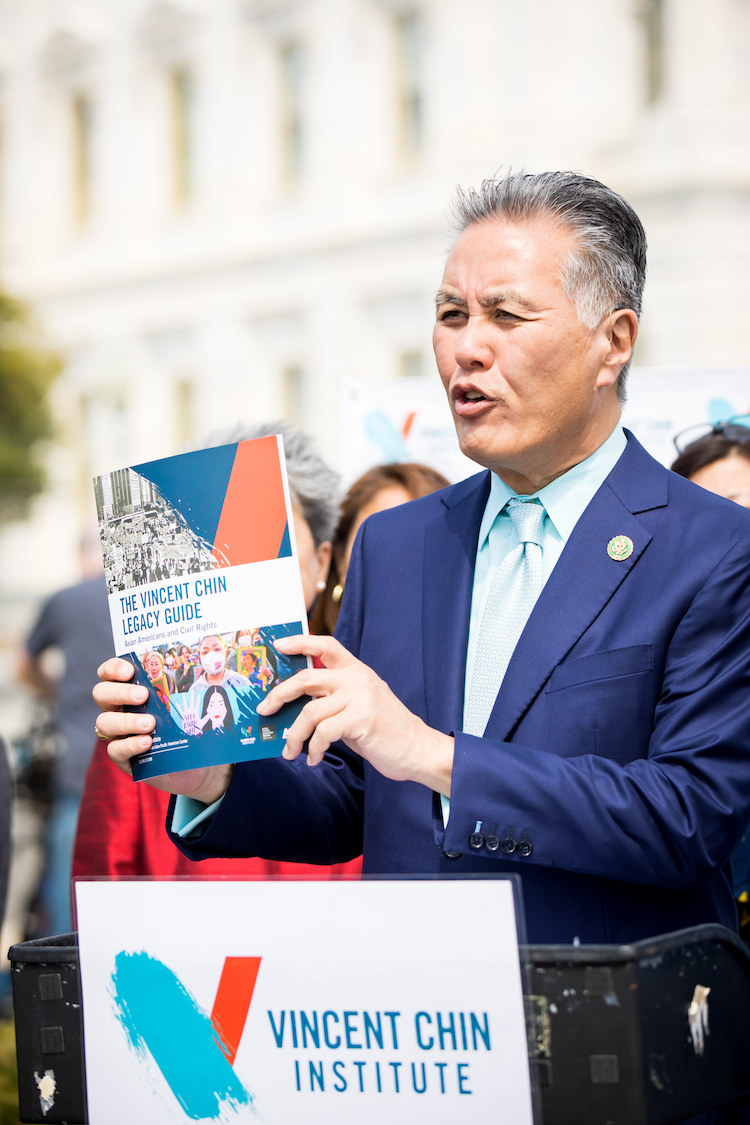
The launch also coincided with the release of the second edition of the Vincent Chin Legacy Guide, co-written by Helen Zia, which provides further education about the history of anti-Asian discrimination and racism in the United States.
The Legacy Guide and Institute are both named in honor of Vincent Chin, a Chinese American man who was killed in a widely publicized hate crime in 1982. Over 40 years later, however, his story remains starkly relevant— especially in an era of sharp anti-Asian racism and Sinophobia.
“The murder of Vincent Chin and the rhetoric that inspired it has been on many of our minds as we continue to see near daily attacks on Asian Americans,” said Rep. Judy Chu, who chairs the Congressional Asian Pacific American Caucus (CAPAC).
“The launch of the Vincent Chin Institute and release of the Vincent Chin Legacy Guide will not only educate Americans about this dark moment in our nation’s history, but will also advance solidarity to fight bigotry and empower underserved communities around the country.”
History repeating
Chin’s murder by two Detroit auto workers, which sent shockwaves through the country, occurred during an era of severe anti-Asian racism. At the time, the economic rivalry between the US and Japan triggered targeted hate against Asian Americans, and was a direct cause of Chin’s death.
At the launch, speakers drew parallels between the circumstances of Chin’s death and the anti-Asian racism today that puts all Asian Americans at risk. They highlighted how Chinese Americans are scapegoated for the COVID-19 pandemic; face proposed discriminatory legislation, such as alien land laws and Trump’s China Initiative; and are routinely suspected of spying for China. Chu, the first Chinese American woman elected to congress, was also recently accused of being disloyal to the US by Texas Rep. Lance Gooden.
These effects, though aimed at Chinese Americans, inevitably affect all Asian Americans. Chin, for instance, was killed in an era of anti-Japanese sentiment — despite being Chinese himself.
“The antagonistic rhetoric around US-Japan competition that surrounded Vincent’s death is a reminder that words have consequences for innocent bystanders,” said Rep. Grace Meng.
“I fear such rhetoric today, if left unaddressed, will cause more harm to our community. We must and we can do better.”
Preserving Chin’s legacy
Given these circumstances, speakers contended that learning from the circumstances of Chin’s death is critical to prevent the same hate from threatening AAPI lives. Yet Chin’s story remains underdiscussed: It is rarely taught in schools, and the historical context surrounding it is often missing.
Chu, for instance, frequently references Chin’s death when opposing anti-China rhetoric in Congress. Yet, she claims, she is consistently met with ignorance from other legislators on his story.
“Each time we take on this fight… I talk about what happened to Vincent Chin. Some members of Congress are shocked because they never even heard of [Chin’s] story,” said Chu.
“Which is why we need the Vincent Chin Institute and why we need the second edition of The Vincent Chin legacy guide. It will be phenomenal in helping all communities learn about Vincent’s story and the consequences of xenophobic rhetoric.”
The Vincent Chin Legacy Guide seeks to rectify this issue by providing an educational overview of Vincent’s life and death, in context of the anti-Asian discrimination prevalent in the US. The 64-page guide is available for free download online in 7 different languages (Arabic, Bengali, Simplified and Traditional Mandarin, English, Korean, Spanish, and Vietnamese). It is primarily intended for K-12 educators, students, and adults.
David Inoue, the Executive Director of the Japanese American Citizens League (JACL), recalled that Chin’s death left a major impact on him as he grew up in the Midwest. He hopes the Legacy Guide will help educate future generations on Chin’s story.
“Through the Vincent Chin Legacy Guide, children like my own, not much older than I was when Chin was killed, can learn about the racism and scapegoating that led to Chin’s murder and how this flashpoint in our country’s history has changed our Asian American community for the better,” he said.
Fighting anti-Asian hate
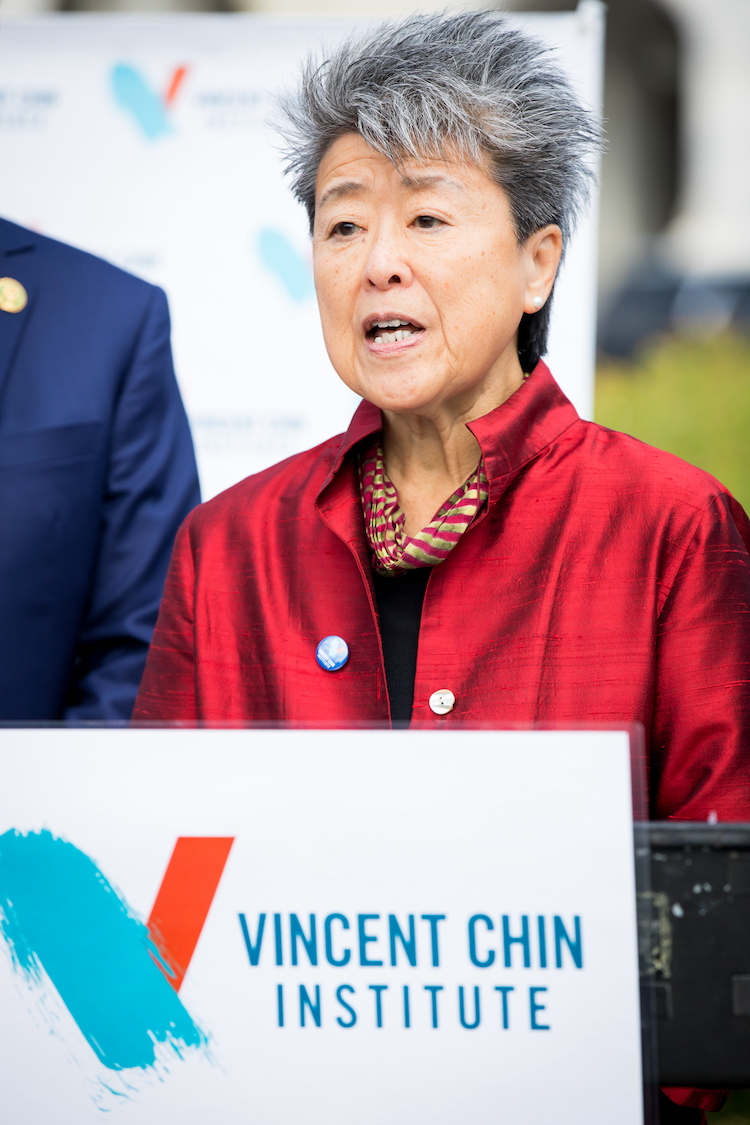
The Vincent Chin Institute aims to fight anti-Asian hate today by continuing the legacy Chin left behind. Chin’s death launched a major pan-Asian civil rights movement, sparking widespread solidarity in the fight against anti-Asian hate.
Today, the Institute’s initiatives include creating a national network of veteran community leaders fighting anti-Asian hate and Sinophobia, and educating about the history of Asian American discrimination, solidarity, and activism through partnerships with the Smithsonian Asian Pacific American Center (APAC), American Citizens for Justice, and other organizations. Finally, it aims to center Asian American communities that are underserved, have unmet needs, or lack existing advocacy structures.
These initiatives are important to build the strong nationwide communities and networks that were critical in the wake of Chin’s death, says journalist and author Helen Zia.
Zia played a central role in mobilizing the Asian American community in response to Chin’s death. Today, she continues her advocacy work, writing the Vincent Chin Legacy Guide, and serving as a central organizer for the Vincent Chin institute.
Zia says that Chin’s legacy can be an inspiring reminder of the unity that is capable of combatting anti-Asian hate.
“The lessons of solidarity that came out of the Vincent Chin civil rights movement showed how people of diverse Asian ethnicities, together with other people of color and people of conscience, could come together for justice and against hate towards any people,” she said during the launch of the Institute.
“Today we honor the legacy of Vincent Chin to launch the Institute in his name as we carry on the important work of ending hate and protecting our beloved communities.”
Image at top: Rep. Judy Chu (D-CA) during the inaugural launch of the Vincent Chin institute in Washington DC. (Credit: Les Talusan)

This resource is supported in whole or in part by funding provided by the State of California, administered by the California State Library in partnership with the California Department of Social Services and the California Commission on Asian and Pacific Islander American Affairs as part of the Stop the Hate program. To report a hate incident or hate crime and get support, go to CA vs Hate.