

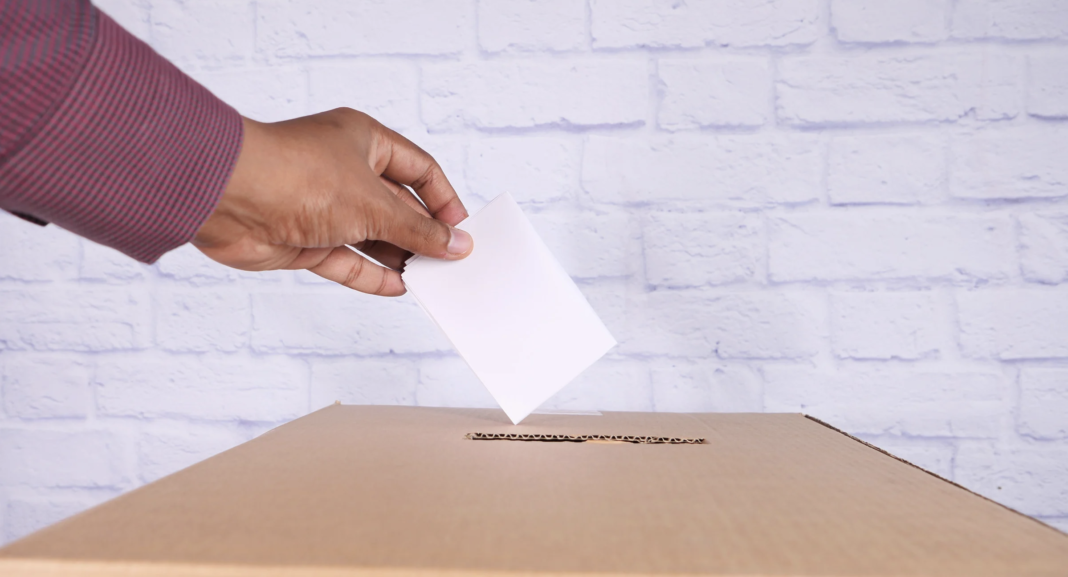
As state ballot measures advancing health access are advancing nationwide, so are those restricting ballot access.
In 2023 alone, 75 bills were introduced in state legislatures to make the ballot measure process harder for voters to use; in 2024 so far, there have been 103 such bills.
“Ballot measures are a form of direct democracy, across party lines. They let voters make meaningful change on issues they care about, even if they’re not being addressed in their state legislatures” — particularly health issues, said Avenel Joseph, interim executive vice president of the Robert Wood Johnson Foundation at a Friday, November 22 Ethnic Media Services briefing about ballot access.
The ballot measure landscape
A recent study by Health Affairs found that, of the 534 U.S. state referenda and constitutional amendment ballot initiatives passed between 2014 and 2023, 63.5% were health care-related, most commonly concerning abortion and Medicaid.
In the November 2024 elections alone, voters in seven states passed ballot measures guaranteeing abortion rights in their state constitutions; voters in Nebraska, Alaska and Missouri passed measures approving paid worker sick leave; Missourians voted to increase the minimum wage to $15 an hour; and measures restricting the ballot measure process failed in Arizona and North Dakota.
“It’s no coincidence that efforts to restrict ballot measure access are increasing while advances for a more just America are passing at the ballot box through policies like paid leave, minimum wage and abortion access,” said Joseph.
“Often, these restrictions are made because legislators say it would protect the state from influence by outside politics or money,” she continued. “But elected officials are often more likely to further corporate or partisan interests than are the communities that they represent, who are coming together to collect those signatures … while efforts to restrict ballot measures frequently come from partisan special interest groups.”
In Florida this November, for instance, although over 57% of voters approved protecting abortion access up to 24 weeks of pregnancy, the measure failed to pass due to a 2004 constitutional amendment, backed by the GOP and supporting business interests, which raised the threshold to pass constitutional amendments from 50% to 60% of voters.
“Whenever we get community voices not only heard but enacted on, there’s going to be creative backlash, like raising the threshold,” added Joseph. “This is because policies directly beneficial to an average person, like the paid leave and minimum wage measure in Missouri, may not be as beneficial to corporate interests.”
Missouri
“The ballot measure process has existed in Missouri for over 100 years, and it serves as a crucial check on our legislature, especially in years when the latter isn’t meeting the needs of our people,” said Richard von Glahn, political director of Missouri Jobs for Justice.
Before the November 2024 passage of Proposition A, guaranteeing paid sick leave and $15 minimum wage by 2026, as many as one in three working Missourians — about 730,000 — lacked access to a single minute of guaranteed paid time off.
“This is part of access to health care, too,” explained von Glahn, who worked as campaign manager for Proposition A. “If you have insurance but you can’t afford to take a day away from work, that insurance isn’t worth anything to you because you can’t use it … [especially if you’re [already] living check-to-check.”
In Missouri, a full-time minimum wage worker currently makes less than $500 a week before taxes — not a living wage in any county in the state, according to the MIT Living Wage Calculator.
To put Prop A on the ballot, nearly 900 Missourian volunteers gathered over 210,000 signatures; in the final 10 days of the election, over 1500 volunteers knocked on over 150,000 doors to tell people about the measure, which passed with a 58% majority.
“A leader of this campaign, a fast food worker named Fran Marion from Kansas City, told a story about when her daughter was sick and staying home from school. She had to leave that child to go to work and put food in the pantry, and her child asked: ‘Why won’t you stay and take care of me?’” said von Glahn. “To feel like you can’t be there for a child in need — no one should have to make those choices.”
Over 500 businesses, mostly small, supported Prop A “because they know that safe, fairly treated workers are what drive economic growth by spending their income back in local economies,” he added. “Nor is it a partisan divide — in rural counties, as many as one in four workers voted both for Donald Trump and Proposition A … Ballot initiatives are synonymous with whether or not we’re placing exploitative profit above the needs of workers in our community.”
Protecting ballot access
“Just because we won something on Election Day, doesn’t mean the work is over, especially in these coming months,” said Chris Melody Fields Figueredo, executive director of the Ballot Initiative Strategy Center (BISC) Foundation, adding that ballot measures, trends and attacks are tracked nationwide through the BISC Ballot Hub.
“While we make sure that these measures are implemented well, we also may face major attacks” through bills raising the threshold percentage needed to pass measures; requiring more complicated language to get the measure on the ballot; or introducing restrictive geographic distribution requirements that make it harder to get signatures, “especially for underfunded grassroots organizations in rural communities,” she continued.
This November, for example, Issue 1 — an Ohio measure which would have created a citizen commission to draw congressional and state legislative districts, thereby making it harder to gerrymander redistricting — failed 46% against a 50% threshold, largely due to confusing ballot language.
Also in this election cycle, Florida used taxpayer funds to oppose an approved ballot measure by sending police to the homes of people who signed a validated petition supporting Amendment 4, a ballot measure which would have overturned the state’s six-week abortion ban; although most voters supported it, the measure fell short of the 60% threshold.
“In any other state, 57% would be a significant majority. They were able to get 1 million more votes than Governor Ron DeSantis,” said Figueredo. “We expect to see pushback like this in other states as well, where many down-ballot measures over-perform elected state officials … because people look at these issues without seeing a party ‘D’ or ‘R’ next to them and think, ‘Yeah, I’m struggling to make ends meet. I want to raise the minimum wage, that’s a no-brainer.”
“It speaks to the distress with government institutions that we have now in the U.S.,” she added. “People trust themselves and their communities first, and ballot measures can be a bridge to restore that trust to our democratic institutions by letting people directly improve the material conditions of their health.”