


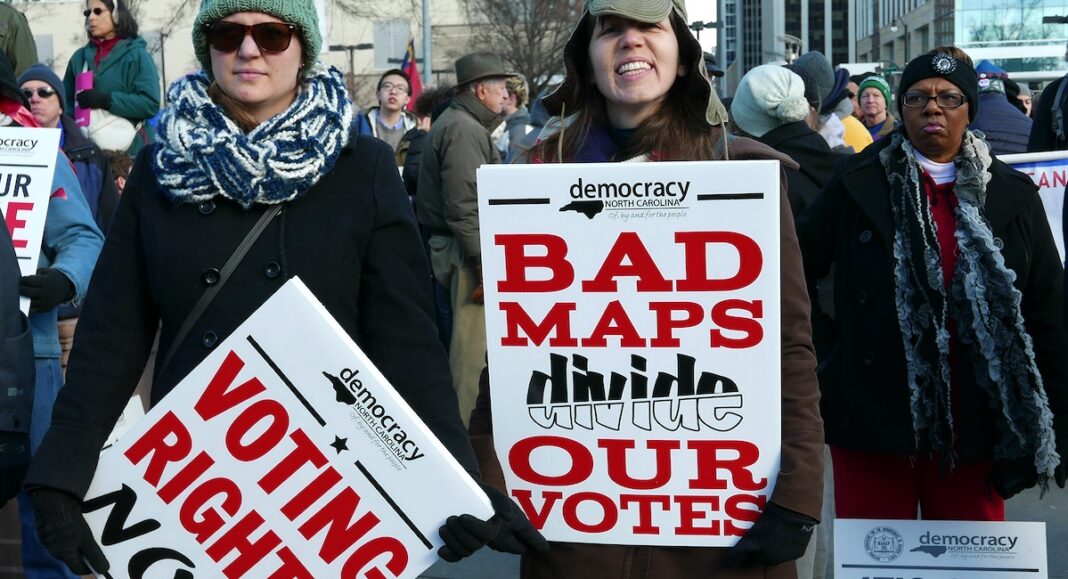
Across the political spectrum, an upcoming Supreme Court case has observers worried about the fate of the U.S. political system.
In the narrowest sense, Moore v. Harper, scheduled to be heard Dec. 7, is about whether or not the North Carolina Supreme Court – or the governor, or anybody else – has the authority to tell the state legislature, currently GOP-dominated in North Carolina, that new political district maps it passed are unconstitutional and need to be redrawn.
But even conservative-leaning individuals and organizations are alarmed by the Moore litigants’ argument that only the state legislature can decide how elections of any kind are conducted in individual states.
If the Supreme Court should rule in favor of their so-called “independent state legislature theory,” said Kathay Feng, national redistricting director for the democracy watchdog organization Common Cause, “we could see 200 years of legal precedent wiped out and federal elections throughout our country upended.”
Feng was speaking at a press briefing Oct. 27 organized by Common Cause with the Southern Coalition for Social Justice. Joining Feng were SCSJ co-executive director Allison Riggs and J. Michael Luttig, a longtime federal appellate judge, popular in conservative circles and appointed by President George H.W. Bush.
The issue, as the speakers described it, is that the case threatens to disrupt the “balance of powers” concept baked into the country’s founding. Having three co-equal branches of government – the executive, legislative and judicial – creates a system of “checks and balances” that keep any one branch from going too far.
Luttig calls it “the single most important case on American democracy, and for American democracy, in the nation’s history since the founding almost 250 years ago.”
The case arose in 2021, when Common Cause and other plaintiffs challenged the North Carolina redistricting results. The state, whose populace is closely divided between Democrats and Republicans, had gained a 14th seat in Congress thanks to population growth documented in the 2020 Census.
But the proposed new political boundaries of those 14 congressional districts, as drawn by the GOP-dominated state legislature, were heavily “gerrymandered,” giving the Republican Party a distinct advantage in 10, the Democrats the advantage in three, and leaving only one likely open to competition.
The North Carolina Supreme Court agreed that the maps should be redrawn.
But the General Assembly – the state senate and house – resisted adopting maps the court found acceptable, instead appealing to the Supreme Court based on the, as Feng referred to it, “lawless legislature” theory of a state legislature having no constraints on its authority over election procedures.
The U.S. Supreme Court did not grant the state’s request to toss the court-approved Congressional district map for this election, but the map for state legislature districts drawn by the state legislature was allowed to stand, and three justices expressed an “interest” in the ISL theory and the court agreed to revisit the matter.
Clarence Thomas did not share his thoughts, but his record in Bush v. Gore and the addition of newly seated Justice Amy Barrett, who did not participate in the decision, has observers concerned about what the court may ultimately decide.
The ruling will come with hundreds of new state voting rules already enacted nationwide, and in time to affect the next presidential election.
“The framers knew that state legislatures only exist because state constitutions created them and that the power to create state constitutions lies with the people,” Riggs said.
To create a “government that would resist authoritarianism, create healthy checks and balances and ultimately be politically responsive to the people itself,” she said, “the ability of courts to check legislative bodies for compliance with the Constitution is a very important part of that.”
But, Riggs said, “This is not a partisan issue” and cited the diversity of 47 “amicus” briefs filed in support of the North Carolina Supreme Court’s role in safeguarding elections.
“I was so filled with awe and gratitude as I looked through the bipartisan list of these amazing, brave individuals, whose commitment and character and dedication to preserving our democracy was what motivated them,” she said.
“All of them to a ‘T’ said that this … theory is not what the Constitution mandates. … It is not good for our democracy, and it’s a dangerous road, should the court go down it.”
Among the “amicus” petitioners:
- A coalition of civil and racial justice groups including the Lawyers’ Committee for Civil Rights Under Law and the Asian American Legal Defense and Education Fund, Latino Justice, NAACP and Native American Rights Fund;
- a coalition of retired four-star admirals and generals;
- a group of former elected and appointed Republican officials;
- current and former election administrators;
- 22 state attorneys general; 13 secretaries of state;
- a group of 20 U.S. senators;
- the ACLU;
- the League of Women Voters;
- Steven G. Calabresi and Peter Keisler, co-founders of the Federalist Society – six of the nine Supreme Court justices are former members;
- former California Gov. Arnold Schwarzenegger;
- prominent Republican election lawyer Ben Ginsburg;
- the Rutherford Institute, a Christian conservative public interest law firm;
- The U.S. Department of Justice;
- Conservative legal scholars.
There were more than a dozen “amicus” briefs filed in favor of denying oversight of state legislatures, including by:
- The Citizens United and Presidents Coalition
- American Legislative Exchange Council (ALEC)
- The states of Arkansas, Arizona, Alabama, Kansas, Kentucky, Louisiana, Mississippi, Montana, Nebraska, Oklahoma, South Carolina, Texas and Utah;
- The Claremont Institute, in a brief written and submitted by Trump lawyer John Eastman;
- The Republican National Committee and others;
- 13 Republican state attorneys general;
- The America First Legal Foundation, led by former Trump staffers Mark Meadows and Stephen Miller.
The ISL theory was argued in challenges to the 2020 presidential election, and was “a centerpiece,” Luttig said, of the argument that state legislatures could override election results and replace the electors whose certifications of the 2020 election results were ultimately accepted by Congress in the early hours of Jan. 7, 2021.
Luttig, who advised Mike Pence on Jan. 5 that year, echoed Riggs’ emphasis on the wide range of people warning against adoption of the ISL theory, despite their otherwise diverse political positions.
Many, he said, are friends of his with decades of legal experience, “rock-ribbed conservatives and scholars of the Constitution. And they’ve come to the conclusion that there’s no such theory that would foreclose state judicial review.”
“We know it’s nuanced and complicated and heavily historical and may not have the snazziest details,” Riggs said as the briefing concluded, “but the issues are critically important to understanding what’s at stake in the courts and the laws that govern them every day.”