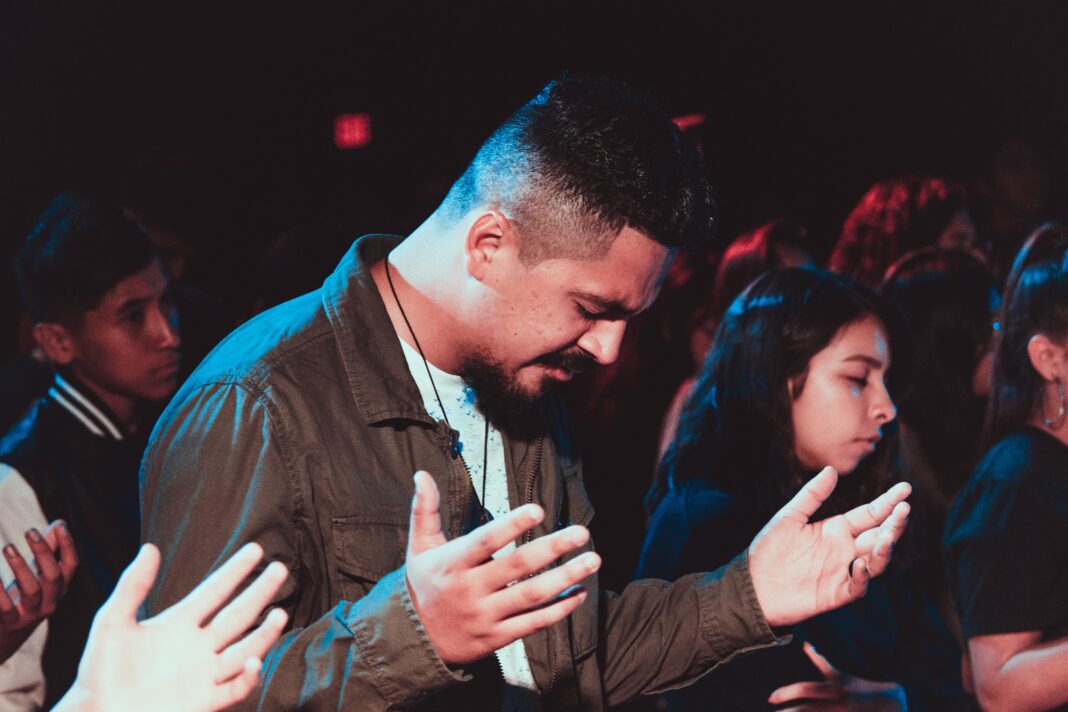
Among developed nations the United States stands unique in the centrality of religion for millions of Americans. And as the population becomes more diverse, interfaith collaborations could be key to reversing the alarming rise in hate-based violence.
About two-thirds of Americans identify as Christians, according to a 2021 Pew Research study. About 6% of Americans are affiliated with non-Christian religions, including Islam, Judaism, Buddhism, Hinduism and other faiths.
Pew’s research also found that 3 out of 10 Americans identify with no religion, but 72% of “nones” still have belief in God or a higher power.
“We are living in a chaotic era. There are conflicts in life, wars between nations and clashes between ideologies,” said Abbot Hui Dong of the Fo Guang Shan Hsi Lai Temple in Hacienda Heights, California. “A good way to stop hateful behaviors and to have happiness and peace in life is not from conquering others, but through love and mutual respect.”
A Buddhist Approach
At the beginning of each year, Abbot Dong’s temple conducts the Prayer for World Peace, which brings together religious leaders from several different faiths. Throughout the year, people from diverse backgrounds come to various cultural events such as the Lunar New Year Celebration, or even to plant trees and clean up beaches.
“These events bridge people from different ethnic and religious backgrounds,” he said. “The best way to solve the problem of hate is to correct it from its root, to seize the causes of hate in people’s minds and change the conditions by switching from a hateful atmosphere to a moral and kind environment.”
Abbot Dong was joined by three other faith leaders at an April 19 news briefing organized by the Act Against Hate Alliance, founded by Mei Mei Huff and her husband, former California State Senator Bob Huff. The panelists focused on the ability of interfaith collaborations to mitigate hate incidents and attacks, emphasizing that people of different backgrounds need to understand other people’s creeds and lived experiences, and to stand up for them when there is conflict.
Religious Pluralism
Colleges and universities are the one place where people from very different religious, cultural, and socio-economic backgrounds inherently come together, said Dr. Dawn Michele Whitehead, Vice President of the Office of Global Citizenship for Campus, Community, and Careers at the American Association of Colleges and Universities, and co-director of the Interfaith Leadership in Higher Education initiative.
“We often see students coming together in intentional activities when we’re talking about race, ethnicity, gender, but we don’t always include religion,” she said. Whitehead’s organization, Interfaith America, looks at ways to help students prepare for interfaith cooperation and interfaith engagement.
“One of the first things we do is we talk about the concept of a world view, a foundational outlook that an individual has on life to help make sense of the world,” said Whitehead, stressing the goal of building a more religiously pluralistic society. “And our goal in our work, not just for our project, but for society, is to really see ourselves in a world where people of differing worldviews and religions can live together in peace and maintain their distinctiveness.”
Intertwined Threads
“The United States may be one of the most religiously diverse countries, but we may also be one of the most religiously illiterate. And this is something that we must acknowledge and offer our students meaningful, intentional opportunities to learn and engage from each other across religious differences,” she said.
Rabbi Sarah Hronsky, President of the Board of Rabbis of Southern California, said: “There is so much benefit to not just stand on one’s religious pulpit to beat one’s theology, but rather to go to the find the bridges and the connections between these religious groups so we can stand united against all hate.”
“As I learned in the Navy, much like threads, when you put nine or ten threads together, when you wrap them together and intertwine them, they’re much stronger than they are singly by themselves,” said Dr. Mohammed Zuhdi Jasser, President and founder, American Islamic Forum for Democracy, who served in the US military.
“One of the best ways for us to do that is to demonstrate what genuine reform within our communities is in combating faith-based hate that might exist within our community,” he said. “One does not build community by demonizing another.”

This resource is supported in whole or in part by funding provided by the State of California, administered by the California State Library in partnership with the California Department of Social Services and the California Commission on Asian and Pacific Islander American Affairs as part of the Stop the Hate program. To report a hate incident or hate crime and get support, go to CA vs Hate.