


ATLANTA, Ga. — Four years ago, a gunman opened fire targeting Asian-owned spas in metro Atlanta. Eight people died, including six women, shocking the city and its burgeoning API community.
While the trauma from that day remains, a memorial for the victims reflects today’s changed political landscape, and growing anxiety in immigrant communities and communities of color.
“It is a really tough day for family members,” says Aparna Bhattacharyya, executive director of Raksha, Inc., a non-profit organization serving Asian American survivors of violence. “You can see there is trauma.”
Bhattacharyya was among those who attended a March 16 memorial organized by the Day of Remembrance Coalition in the Atlanta suburb of Norcross. Earlier in the week the Georgia AAPI Legislative Caucus held a March 13 press conference at the Georgia State Capitol.
According to Bhattacharyya, four years on and many of those directly impacted by the shooting still have not come forward to access available mental health resources. “There is just so much stigma and fear in coming out and discussing the trauma they experienced,” she said.
Victoria Huynh with the non-profit Georgia AAPI Hub described how in past years relatives of the victims would be in attendance, speaking out against anti-Asian hate and calling for tighter gun restrictions. This year many were absent.
“It is hard for them,” she said, echoing Bhattacharyya as she points to the lingering grief many feel. “One of the victim’s sons left the state because he just could not bear to see the news.”
On March 16, 2021, Robert Aaron Long killed four people at Youngs Asian Massage in Cherokee County before driving 30 miles south to Atlanta, where he killed four more people in two separate Asian-owned businesses.
Long is currently serving a life sentence without the possibility of parole for the Cherokee killings. Prosecutors are seeking a hate crimes enhancement and the death penalty in the Atlanta shootings.
The attacks came amid already heightened hostility toward Asian Americans during the Covid pandemic and were part of a broader national trend of anti-Asian violence.
In the immediate aftermath, then President Biden and Vice President Harris traveled to Atlanta to meet with representatives of the Asian community and to pledge support in the fight against anti-Asian hate.
Officials with the White House Initiative on Asian Americans, Native Hawaiians, and Pacific Islanders (AANHPI) consistently sent representatives to attend past memorials, which drew members of Congress, local elected officials, and county school board members.
This year, only State Representative Long Tran and Gwinnett County Commissioner Kirkland Carden attended. Norcross City Mayor Craig Newton made a proclamation, while US Senator Raphael Warnock sent a letter of remembrance, stating, “I see you and will continue to stand with you against hate and against violence.”
The White House was conspicuously absent.
“I worry our communities will not have the same type of attention and support that we used to have under past administrations,” noted Huyhn, a former commissioner of President Biden’s Advisory on AANHPI.
President Trump disbanded the commission through executive order in January.
“The protections and the organizations that were built after the shooting, now there’s a lot of worry,” Huyhn continued. “Will we lose some of these organizations because funding is no longer available, or the support from corporate sponsors and foundations is rolled back because they’re afraid of being targeted for supporting Asian Americans or communities of color?”
Those fears come amid heightened anti-immigrant sentiment, Huynh stressed, as Trump dismantles diversity and equity initiatives while waging a campaign of mass deportations.
“There’s fear that what happened during the pandemic with a lot of the anti-Asian, anti-Chinese rhetoric is coming back around,” she said. “I worry about the discrimination and the bias against our communities.”
Still, while the scars left by the killings remain, the violence of that day also spurred members of the API community to action.
“The shootings motivated me to run for office,” said Michelle Kang, a mother and businesswoman who in 2024 ran for a seat on the Georgia House of Representatives. She lost by just 600 votes.
Kang also helped found the Atlanta Korean American Committee Against Asian Hate, which advocates for the needs and interests of Atlanta’s API communities. She said under the current atmosphere, many in the API community are fearful of engaging in politics. But with key races coming for local and statewide offices, she added, “you’ve got to participate.”
For Huynh, the anniversary is a reminder of what was lost that day.
“We want to make sure that we keep the stories and the memories of those who were tragically murdered alive. We don’t want our communities to forget.”
Remembering the Atlanta Shootings, Even as the White House Forgets
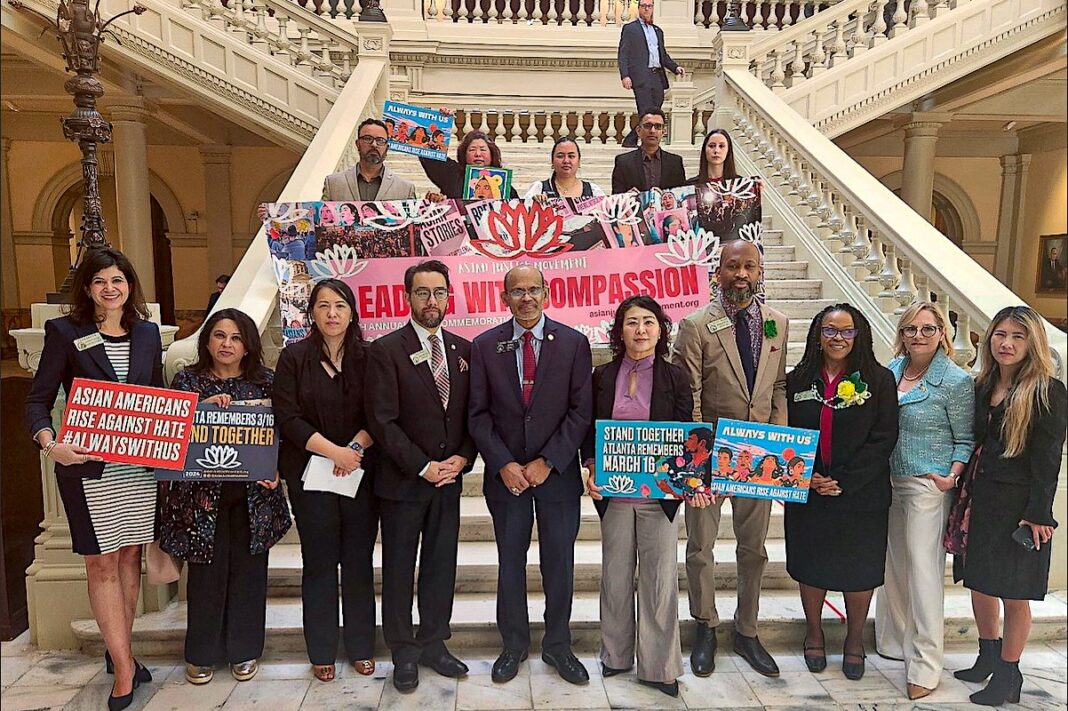
The White House was absent from a memorial marking four years since a shooting spree targeting Atlanta's Asian American community.