


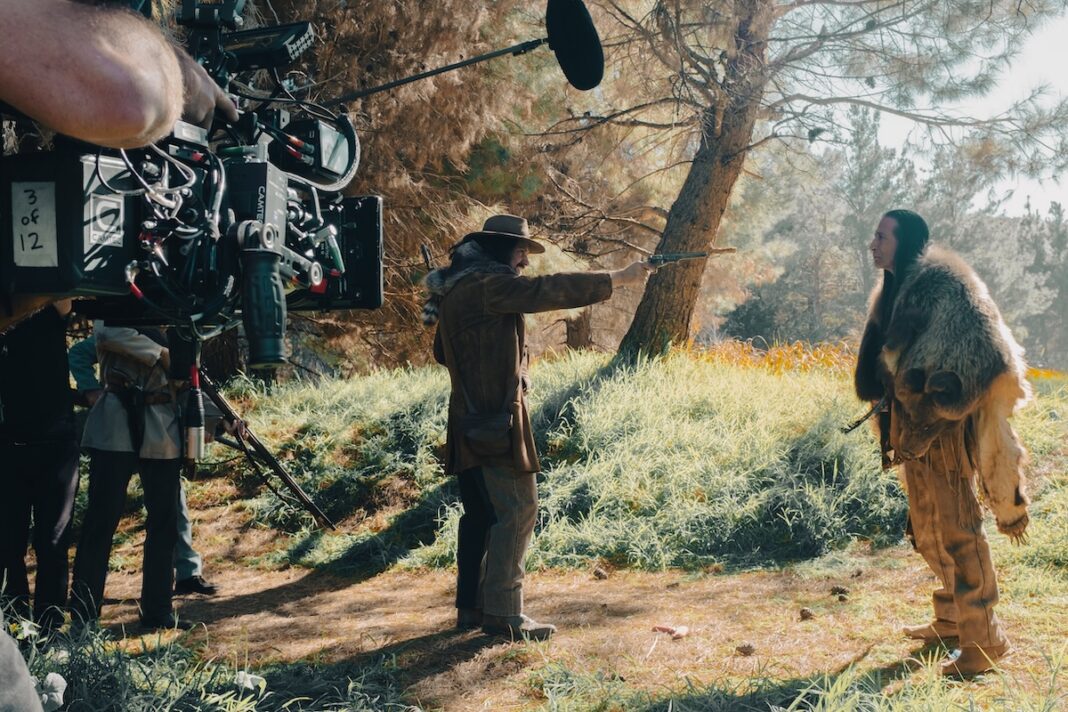

On screen a Native dancer moves his feet to the rhythm of sticks that he clanks together, when he’s abruptly interrupted by the film’s producer. “That’s not what we’re looking for,” she demands. “I really need you to sell that you’re Indian.”
That scene, a reenactment from a 1914 film production, is the opening for one in a new 10-part series filmmaker Brad Munoa calls a “true crime history.”
Munoa, a federally enrolled member of the Pechanga Band of Indians, said he made People of the West in part after realizing his own school-age children were being taught the same sanitized version of history he learned growing up on the Pechanga Reservation in Temecula, California.
“They taught us that the Natives willingly helped build” California’s missions, said Munoa, a father of six, recalling how in the fourth grade he constructed dioramas of those same missions out of sugar cubes. And that “there was a beautiful exchange of knowledge and culture, and everyone loved each other.”
The Missions, a series of outposts that stretch from modern day San Diego to Sonoma County hundreds of miles to the north, were built starting in the mid-18th and into the early 19th centuries by Spanish missionaries exploiting Native laborers under extreme and often coercive conditions.
As Munoa describes it, People of the West presents a far less saccharine accounting of the brutality visited on California’s Native population — estimated in the hundreds of thousands pre-European contact — by successive waves of first Spanish and later American arrivals.
“Natives didn’t know that getting baptized meant that they were committing to a life of servitude to the church,” explained Munoa. “If they tried to leave, they were forced back, tortured,” at times “raped or murdered.”
People of the West is cinematically vibrant. It pulls viewers in for an up-close and personal glimpse of the under-told history of first contact, the proliferation of boarding schools that tore apart Native families while seeking to erase their culture and language, of zealous missionaries and rapacious gold seekers.
The film comes with a PG-13 rating, because, as Munoa explained, some parts of history are hard to bear witness to.
In California, state history is taught in fourth grade. As the son of a fourth-grade teacher himself, Munoa said he understands the argument that some of the history that pertains to Native Americans in California is more than a nine-year old child may be prepared to digest.
“This is why we worked with curriculum experts so that it can be taught in an age-appropriate way,” Munoa said, adding he hopes to eventually see the series available in schools statewide.
He’s also been in talks with major streaming platforms, though he noted he’s gotten pushback from Hollywood producers.
“I’ve been told to come back if I have a true-crime story,” Munoa said. “This is more than 500 years of true crime.”
Frank Blanquet is the station manager at FNX, First Nation Experience, a free app-based platform delivering Native and Indigenous content. FNX is streaming People of the West throughout November.
“It’s a story that has to come out,” Blanquet said. “Western expansion was violent and we should hold ourselves accountable to that.”
People of the West is FNX’s largest acquisition to date. It’s also what moved the network to make its shows and content internationally accessible.
“We exist to educate people on the Native experience,” noted Blanquet, who called the series a “dream come true.” He credited Munoa with taking “the reins … to tell [the tribe’s] own stories and create their own media” at such a high level.
As he works to promote the film, Munoa often thinks back to a period in his own tribe’s history when a mining firm sought to turn a local mountain in Riverside County into a rock quarry.
The mountain, known as Pu’eska to the Pechanga Band of Luiseño Indians, is considered sacred, the site of the tribe’s creation.
During hearings between the tribe and the mining company, Granite Construction, a tribal member presented the Pachanga Band’s creator story.
“We told them how sacred the mountain was to us, but Granite hired a non-Native legal expert who refuted our testimony,” explained Munoa. “At the time, we were all scratching our heads asking why Indigenous wisdom wasn’t being respected.”
In 2012, the tribe purchased the mountain from the company for $3.5 million and an additional $17.35 million to end the legal fight. The settlement ended a years-long battle over the mountain’s fate.
“I can’t help but wonder,” Munoa mused, “if all the people involved in the mining project had the chance to see the film, maybe things would’ve turned out differently.”
People of the West is streaming on FNX until November 30. For more information visit peopleofthewest.org
Sharon K. Sobotta recently joined American Community Media where she helps manage a new Native/Indigenous Voices initiative. She is as an editing fellow with the UC Berkeley California Local News Fellowship.