


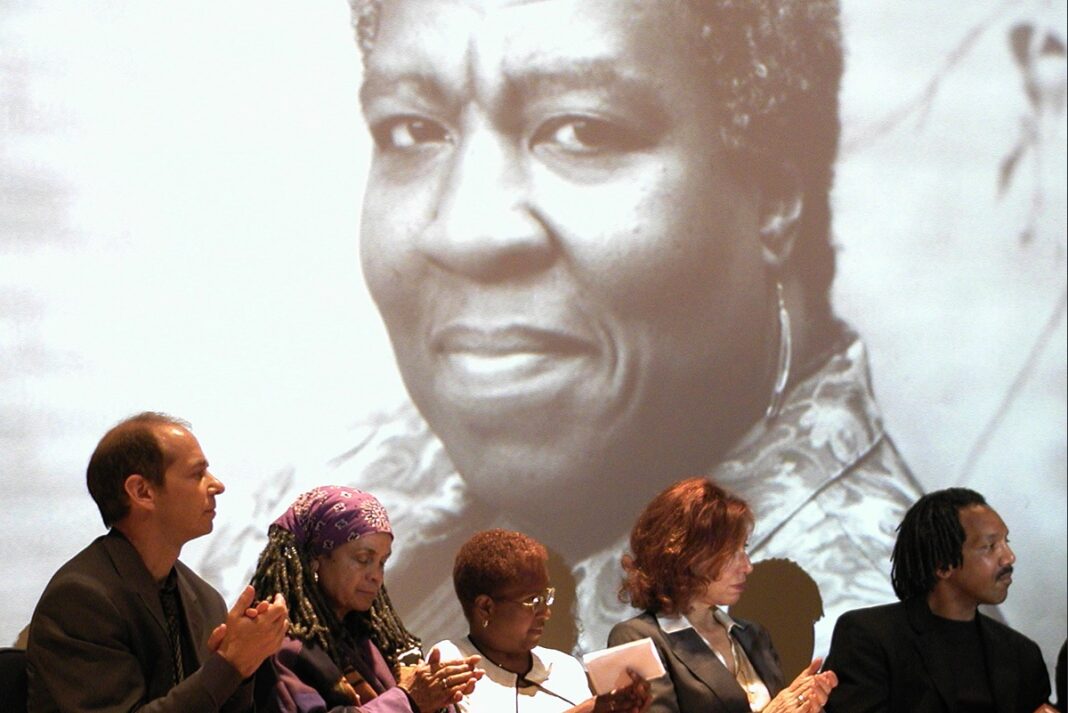
Author Octavia Butler (pictured on screen) during a tribute in NYC in 2006. (Image via Flickr)
It is 2024, and America has collapsed.
A dysfunctional, authoritarian government is unable to reign in rampant unemployment and poverty, skyrocketing drug abuse, and crime. The earth’s temperature continues to climb, while desperate people scramble for food, water, and basic necessities.
This is the world of Octavia Butler’s landmark sci-fi novel Parable of the Sower, which recently celebrated its 30th anniversary, a world that looks all too familiar given our present reality.
Butler, renowned as a groundbreaking Black author and a titan of sci-fi – her numerous achievements include becoming the first sci-fi author to receive a MacArthur “Genius” Grant, and winning major awards such as the Hugo, Nebula, and PEN Lifetime Achievement Award – wrote frankly about social issues like race, global warming, and women’s rights, themes not often found in sci-fi.
A reason, perhaps, why her novels failed to find commercial success in her lifetime. It was only after her death in 2006 that Butler’s works gained popularity, selling hundreds of thousands of copies, and later being adapted into graphic novels, operas, and TV series.
Of her dozen novels, Parable, which in 2020 landed on the New York Times Bestseller list, is especially timely. “Octavia Butler was writing about what were major crises in her time,” says Isis Asare, owner of Sistah Sci-Fi, the first Black-owned sci-fi bookstore in the US. “And those continue to be highly relevant in terms of the ways out or ways to respond.”
The Parable as ‘polycrisis’
These days the term “polycrisis” appears with increasing frequency as world leaders, policy makers, and tech titans alike seek to frame the current moment we’re in, with a rapidly heating climate, global pandemics, wars, environmental destruction, and income inequality.
“At times, one feels as if one is losing one’s sense of reality,” noted historian Adam Tooze, who helped popularize the term.
According to Tooze, the polycrisis is a social issue, and so solutions that ignore systemic social oppressions like race, gender, and class – issues at the heart of Butler’s Parable – are as effective as putting a bandage on burning flesh.
The book’s protagonist, Lauren Olamina, fights to survive in a society pushed to near-total collapse by soaring inequality, environmental disasters, and white supremacy, among other issues. Thirty years after the novel was published, it is still being hailed as prescient, even prophetic.
Still, Butler wasn’t attempting to predict the future so much as offer up a warning of what would unfold should these issues spiral out of control. “I was trying not to prophesize. Matter of fact, I was trying to give warning,” she said in 2004.
It’s a point Asare takes up. “They were problem points then, and they will continue to be problem points now,” she says. “And if we as a society don’t work hard to move very differently, they’ll probably continue to be problem points 30 years from now.”
Beyond despair, a hopeful message
According to Sistah Sci-Fi member Maya Felder, Butler was “not a fan of humanity.” But, she says, the author’s depiction of human suffering and oppression belies an underlying sense of optimism.
“Even though her stories are bleak, and they start out bleak, they always somehow end up hopeful and inspirational,” says Felder.
Asare credits that to the power of sci-fi, a genre that creates space for authors to imagine futures beyond the limitations of our current world. Unlike her contemporaries, who largely focused on the promise and perils of technological expansion, Butler turned her gaze to the social realities of her time, and ours.
“Seeing how Lauren is able to access and create power for herself in a society that would repeatedly tell her that she doesn’t have any power was very enlightening for me,” Asare says of the story’s lead protagonist. “Science fiction as a genre does that over and over again.”
But, she adds, “survival is contingent on your ability to build communities,” a recurring theme throughout the novel where Lauren Olamina pulls together a small group of survivors to form a commune, Acorn, as a refuge from the harsh realities around them.
For Butler fans like Felder, this depiction of how a community can come together, even in the face of disaster, is inspiring. “It was really big for me to read that and then to see possible solutions,” she said.
Parable’s enduring impact
Thirty years after its publication, readers continue to incorporate Parable’s themes and ideas into their own lives.
For some, this includes learning the emergency preparedness tactics Lauren Olamina uses throughout the novel, such as foraging or preparing survival packs, even forming communes patterned after Acorn.
For others, the novel has inspired new approaches to age-old questions of social justice.
“I definitely feel like readers are taking the themes and creating work to expand upon: what is liberation? What is freedom? What does social justice look like for marginalized communities?” says Asare. “And/or using those themes as a spark to think about: How can we rethink gender, relationships, race, in their personal lives, and how they move about the world?”
Tooze writes that the destabilizing impact of the polycrisis threatens to overwhelm society into inaction. But as Parable reminds us, “The only lasting truth is change.” The future is malleable and holds infinite possibilities.
Sistah Sci-fi member Jovita Jacobs says that faith is what inspires her about the future.
“Science fiction has this way of giving you hope,” observes Jacobs. “It’s all wrapped up in these scientific terms and these huge engineering accomplishments. But it’s still all about hope.”
“And so as long as the future still has [this] hope, who am I not to carry hope into the future?”
This story was produced as part of a special EMS reporting series exploring how global societies and diaspora communities in the US are navigating the “polycrisis,” a term increasingly used to describe the confluence of extant and emerging global crises. It was supported by a grant from the Omega Resilience Awards.
EMS print and video coverage is available for syndication or sharing on social media. If you run an EMS story in your media outlet, please forward a link to coverage@ethnicmediaservices.org, and tag EMS on your social media platforms.