


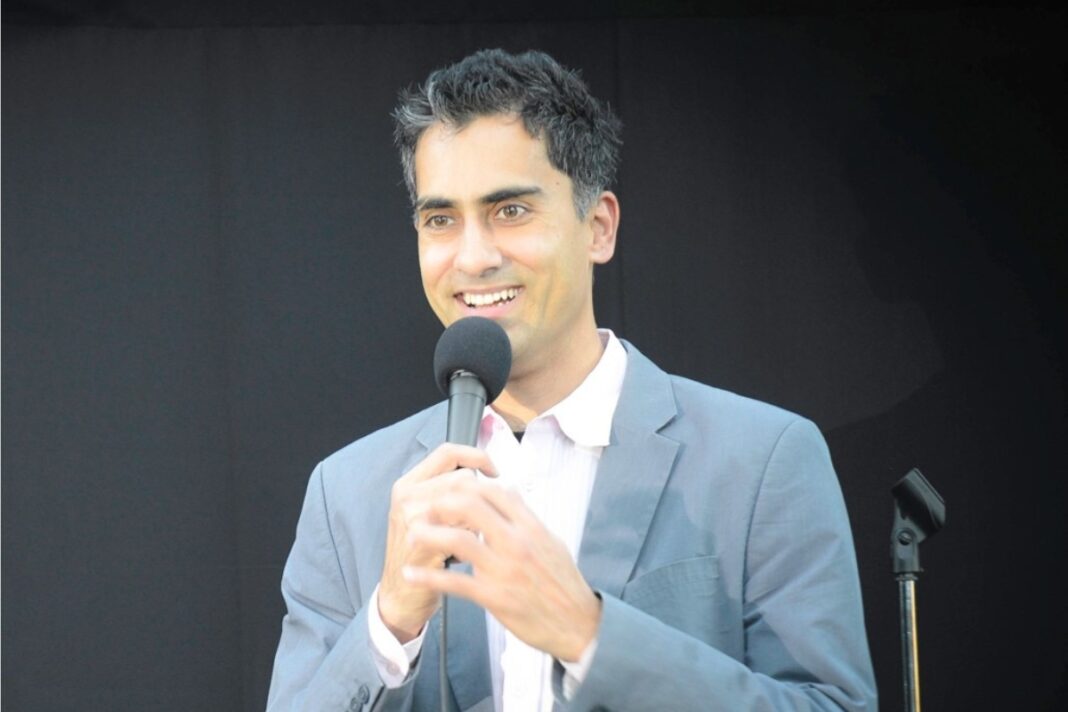
Samson Koletkar, a Jewish Indian American, draws upon his cultural and spiritual background to focus his lens on billboard attorneys, the re-emergence of Christ, and considerate racists for his new one-hour comedy special.
“I know I look ambiguous. And sometimes people say:‘hey man, I don’t like you and I want you to go back to your country.’”
“But I don’t wan’t you to go back to the wrong country and get in trouble. You know where you’re from: just go back to where you come from. Be safe in your own country,” riffs Koletkar in one of the funniest moments of the Mahatma Moses Comedy Tour. “That is a caring, considerate racist. I like that guy.”
Koletkar describes his brand of humor as clean (parents, you can bring your teens!) and unconventional. “I take on the norm and then beat it upside down,” said the comedian in an interview with American Community Media.
It’s the perfect description for a show whose funniest (of many funny) moments include an analysis of roller coaster safety data and a mathematical formula that can assess mothering skills. He also offers insights on the Bay Area’s best billboard lawyers.
Koletkar is also fantastic at callbacks — the art of keeping a good joke running — and draws big laughs with his impressive ability to connect seemingly unrelated moments of his set.
The Mahatma Moses Comedy Tour will run through December, with shows across the Bay Area and in Sacramento. It’s a super fun show from a witty and original comedy voice, who has no less been instrumental in building the Bay Area’s thriving comedy scene.
The former techie, who majored in math, has been a professional comedian for over a decade. He’s toured across the U.S., Canada and India, and appeared at major festivals including SF Sketchfest and Just for Laughs Vancouver.
He’s also a co-founder and producer of the acclaimed Desi Comedy Fest, the largest South Asian comedy showcase in the US, and is the founder of Comedy Oakland, a weekly show that runs Thursdays through Saturdays and features a line-up of comedians performing 5 to 15 minutes sets.
In recent years, the bulk of Koletkar’s comedy work has been behind the scenes. Between Comedy Oakland and the Desi Comedy Fest, which have been going since 2009 and 2014, respectively, his time has been occupied organizing events, running venues and bringing comedians to the stage.
“Samson the performer has been overshadowed by Samson the producer,” said Koletkar. The desire to be writing and back on stage again was, in part, the inspiration for the show. “I need to get my own name and brand out again, and the best way to do that is be on stage in front of people. So that’s where the tour idea came through.”
“The challenge always is, how do I get more people to come and watch?” Pre-pandemic, Comedy Oakland was drawing between 12,000 -13,000 people per year. Since the lockdown lifted, audiences have stalled a bit.
The first year back onstage post-pandemic, nobody was thinking about the money, they just wanted to be onstage, said Koletkar. “It was like get out there, feel good.” After two years of no practice, he and the other comedians were fumbling and flubbing their punchlines, but audiences were enthusiastic and forgiving and it was clear they were also “craving this live interaction,” he said.
While you can find some of Koletkar’s work online, he doesn’t yet have a huge social media presence. Early in his career, he posted a video to YouTube that quickly got thousands of views. But he says the phenomenon of posting comedy online is relatively new and goes against the grain of comedy as an art form.
“In music, in any other art form, like dancing, you watch a routine, then you go watch them live and you want them to do the things you saw. That’s what you like. In comedy, it’s the exact opposite,” he said.
“Comedians were very skeptical about putting their content out because we don’t generate content that easily. It takes time to build a good joke. We spend like a whole year building 20, 30 minutes of content. And if you put it out, the fear was, ‘oh, people have seen it, they may not come back to see me live.’”
The popularity of comedy on social media also reflects a paradigm shift about the artform.
“Comedy traditionally used to be like an underground art. A few comics surfaced up and became popular, but most of it was underground, done in comedy clubs or dingy bars and these little places where normal humans wouldn’t go, because we are saying the things that you’re not supposed to stay in this society, right? So by its very nature, it was a very inside crowd thing.”
The Mahatma Moses shows open with a set from one of Koletkar’s Comedy Oakland and Desi Comedy Fest collaborators. On Sept. 20, it was Vietnamese-Jewish comedian Joseph Nguyen aka VietJew.
Koletkar and Nguyen have worked together for years and share an observational style that finds humor in everyday life. Nguyen had the audience laughing and applauding at jokes about his varsity jacket, back-handed compliments, the science behind ADHD diagnoses and the accomplishments a turtle can be legitimately proud of.