


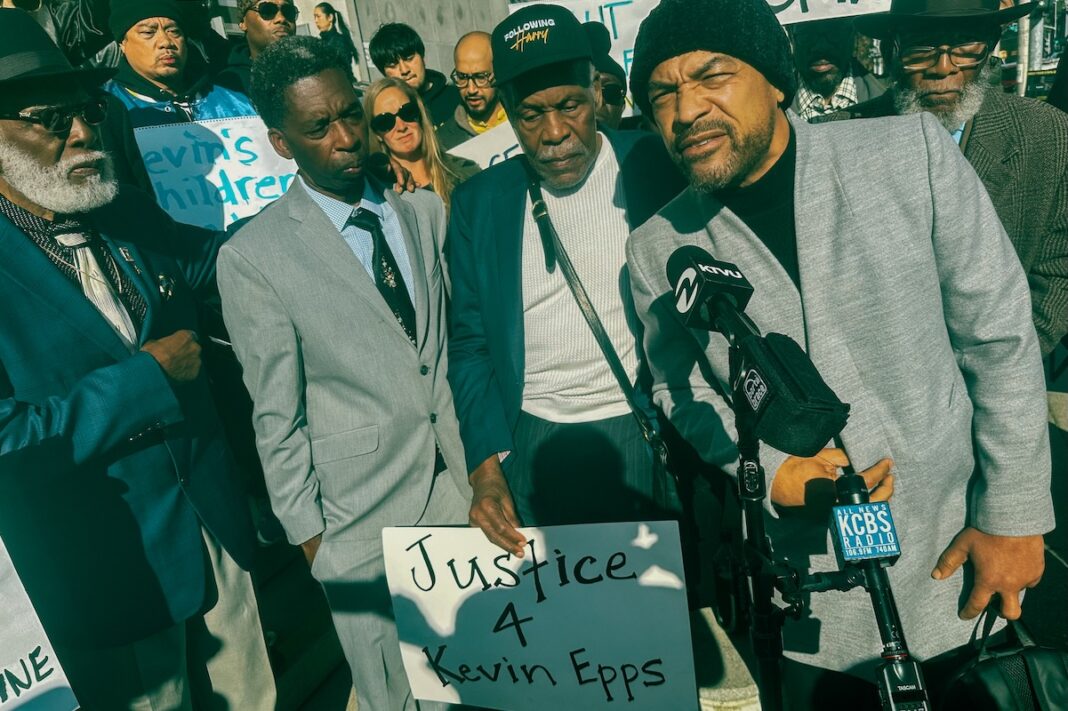
SAN FRANCISCO – As San Francisco-based filmmaker Kevin Epps awaits sentencing for the 2016 fatal shooting of Marcus Polk, his supporters continue to raise allegations of selective prosecution, prosecutorial misconduct, and judicial error in his recent murder trial.
The issues go beyond this singular case, they say, highlighting longstanding concerns about structural inequity and racial disparities in criminal cases involving African American males.
Epps, who claimed self-defense, was acquitted of first-degree murder charges, but found guilty of voluntary manslaughter. A sentencing hearing is scheduled for April 8.
During his trial, dozens of community members – including prominent faith leaders like the Rev. Amos Brown and officials from the San Francisco and San Mateo NAACP – held rallies outside the courtroom steps, demanding justice for Epps.
One key issue is the lack of diversity among the judiciary.
As of March 2026, Black or African American judges represented almost 10 percent of judges statewide. In Alameda County, the percentage of Black or African American judges is more than double the statewide average. In San Francisco County, Teri L. Jackson became the first African American woman Superior Court judge in 2002, and the court’s first Presiding Judge in 2016.
A handful of African American judges currently serve on San Francisco’s bench, including Monica F. Wiley, Murlene J. Randle, Christopher C. Hite, Patrick S. Thompson and Justine Cephus (appointed by Gov, Newsom in March 2026).
Still, despite recent gains, judicial diversity is often cited as a factor in wrongful convictions, overcharging, and sentencing disparities disproportionately impacting Black defendants.
It’s not uncommon,” says retired Judge Brenda Harbin-Forte, for judges to rule on cases involving minority defendants “based solely on stereotypes and not an appropriate reading of the facts on any particular case.”

Harbin-Forte, who is African American, spent more than 20 years on the bench in Alameda County Municipal and Superior Court. Her judicial expertise includes presiding over civil, juvenile, criminal, and drug courts. She has long been a champion for diversifying the judiciary, chairing the State Bar of California Council on Access and Fairness’s Judicial Committee, which was instrumental in the 2006 passage of SB56. The bill increased transparency in judicial diversity data collection statewide.
“It was very important to me to make sure that there was diversity on the bench, that people could walk into the courthouse and see judges who looked like them,” she said.
San Francisco District Attorney Brooke Jenkins, who is also African American, has publicly criticized judges for lenient sentences, which she says don’t do enough to deter violent crime.
Jenkins’ comments came in response to a case that Judge Brian Ferrall – the same judge in the Epps case – ruled on, in which the DA’s office recommended a 23-year sentence for a first-time offender convicted of armed robbery. Ferrall handed down a sentence of 4 years 8 months.
Public Defender Elizabeth Camacho, who had sought probation with no jail time, later accused Ferrall of inappropriate comments and racial bias.
Jenkins herself has drawn criticism for dropping police misconduct cases involving minorities, and was ordered to undergo a diversion program for ethics violations by the State Bar.
Jenkins’ predecessor, Chesa Boudin, attempted to reform the DA’s office, firing numerous prosecutors, including Michael Swart, who reopened the Epps case in 2019. But after Boudin was recalled in 2022, the DA’s office under Jenkins has seen a return to a “tough on crime” hardline, which Harbin-Forte says “too often” results in “overcharging” minorities.
Harbin-Forte chairs the Legal Redress Committee of the Oakland NAACP. She’s been closely monitoring the Epps case “particularly since Reverend Brown and then the San Mateo [NAACP] branch have been in his corner.”
In a lengthy interview, Harbin-Forte returned her own verdict: “(Epps) should not have a conviction on his record. Not under these circumstances. Absolutely not. I just can’t believe how much the prosecution was able to get away with in this case.”
In 2019, prosecutors claimed to have new evidence, which amounted to a digital animation commissioned by the San Francisco DA’s office. When challenged during a 2025 pretrial hearing, the DA withdrew this evidence and sought to introduce another digital animation, which was much more limited in its scope.
“Quite frankly, I’m outraged that the DA’s office decided to charge this case,” said Harbin-Forte, noting the prosecution “did this 3-D animation and everything, and that was the quote-unquote ‘new evidence’ that they had discovered that justified charging Epps?”
The animator, Jason Fries of 3-D Forensic Inc. once claimed “100% admissibility” – his current slogan is “seek and illustrate the truth.”
Public documents show there have been several instances where his testimony and animations have been excluded due to unscientific methodology and/or lack of expertise in forensic pathology. In 2018, Fries made a controversial recreation of Laquan McDonald’s fatal shooting by a Chicago police officer, which contradicted visual evidence from the scene.
During the Epps trial, the defense asked for a mistrial, arguing that the prosecutor, in closing argument, had asked the jury to draw inferences that the prosecutor knew to be false. The defense cited a 2002 9th Circuit Appeals Court ruling establishing that government prosecutors have a “sovereign obligation” to govern impartially: “The prosecutor’s job isn’t just to win, but to win fairly, staying well within the rules.”
The 2002 case – prosecuted by Jonathan Schmidt, then an Assistant US Attorney and the ADA in the Epps trial – has become a textbook reference for prosecutorial misconduct. Judge Ferrall stated that he read the opinion yet ruled that it did not apply.
Harbin-Forte contends that decision was “absolutely judicial error.”
More alarm bells went off over jury instructions. While considering the Castle Doctrine — which allows for use of reasonable, even deadly force against an intruder in one’s home — the judge modified the legal definition of the term, citing ambiguity over whether Epps could be considered a resident if his name wasn’t on the lease, and whether Polk, a frequent visitor, could be considered an intruder.
The defense pointed out that Epps received mail at the residence, and the address was listed on his driver’s license. Multiple witnesses previously indicated Polk was homeless, was regularly refused admittance or told to leave, and had barged into the residence despite being asked to leave on the day of the shooting.
In Harbin-Forte’s view, “Modifying the jury instruction is questionable in itself,” adding that “did seem to change the burden of proof for the prosecution.”
The Castle Doctrine, she said, makes no reference to being a property owner or leaseholder. The legal standard is simply being a resident. By modifying the instruction, the judge “changed the whole import of the castle instruction.”
Another questionable jury instruction was allowing jurors to consider manslaughter charges based on Epps being a felon in possession of a gun.
The California Penal Code defines voluntary manslaughter as an “unlawful killing” committed “upon a sudden quarrel or heat of passion.” The law does not say mere possession of a weapon by a felon meets this standard and is clear that the burden of proof is on the prosecution.
All these red flags had a cumulative effect on the trial’s outcome, says Harbin-Forte.
“There is too much that happened to give anybody the sense that this was a proper prosecution and a proper conviction. They went out of their way and twitched too many concepts and did so much wrong in order to bring this man into the criminal justice system.”
Correction: An earlier version of this story incorrectly stated the number of African American judges in Alameda and San Francisco counties. The error has been corrected.


Excellent!
The box this comes in is 5 inch by 6 mile and weights 15 ton!!