


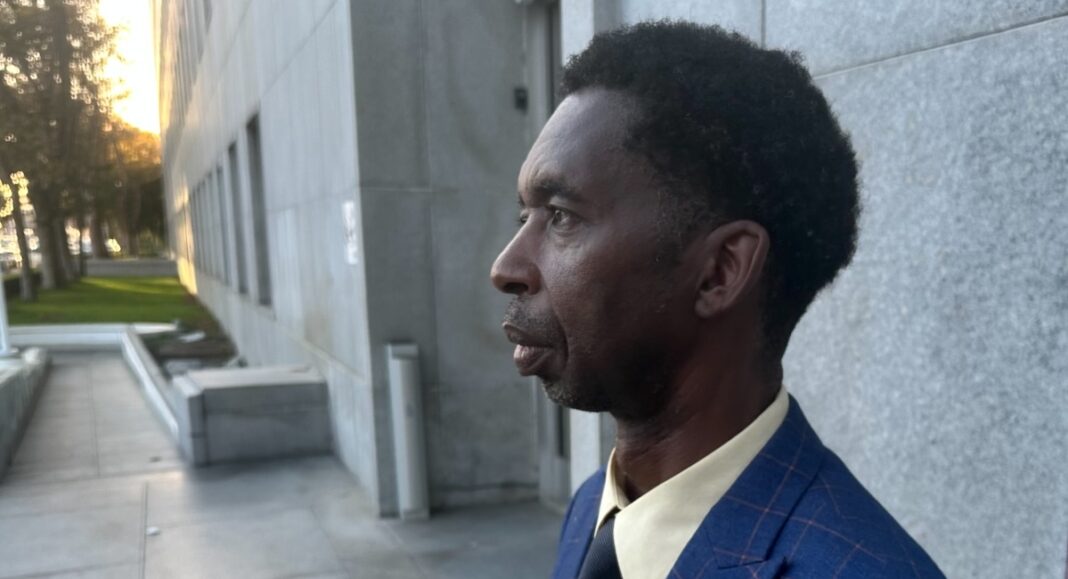
After the jury reached a verdict in the murder trial of Kevin Epps – acquitting the 57-year-old filmmaker of first and second degree murder, but finding him guilty of voluntary manslaughter and being a felon in possession of a firearm – the trial moved into a new phase, as the jury considered aggravating factors that could greatly influence the judge’s sentencing decision.
In this phase, the jury once again heard arguments from prosecutor Jonathan Schmidt and defense counsel Darlene Comstedt. And once again, Schmidt attempted to portray Epps as a violent aggressor, calling him “callous” and “vicious” in the 2016 shooting death of 45 year–old Marcus Polk – despite the fact the jury had already rejected the element of malice in its acquittal on the most serious charges.
But this time, Schmidt may have overplayed his hand. The jury could not reach a unanimous decision on three of the four aggravation charges. Judge Brian Ferrall sent jurors back to the jury room a second time, urging them to reach consensus. They returned a short time later, still deadlocked. Ferrall had no choice but to declare a mistrial on the three charges and dismiss the jury; the fourth charge will be argued during a later hearing without the jury present.
Courtroom observers speculated this turn of events may have reflected the jury’s irritation at prosecutorial overreach in a largely circumstantial case. “When a jury resists pressure… it tells us something essential: the evidence has reached its limit,” journalist Malik Washington wrote in the Davis Vanguard. Throughout the trial, Schmidt “leaned heavily on inflammatory language,” Washington said. “But language is not evidence.”
Attorney Julian Davis, a spokesman for Epps, believes the prosecution “overcharged” the case from the start, engaging in “ethically-dubious” and “improper” actions that continued into the trial’s second phase. “Schmidt once again really crossed an ethical line in terms of how he was presenting to the jury a narrative of events that clearly was not supported by the evidence.”
One of the more extreme examples, Davis said, happened when Schmidt told the jury that following the shooting, “Polk was crawling across the floor. I mean, there was no evidence of this whatsoever.”
In Davis’ view, the jury “weren’t buying the prosecutor’s whole narrative from the get-go. I mean, they weren’t buying murder, they weren’t buying premeditation, deliberation, they weren’t buying any of this. They weren’t buying callous disregard or conscious disregard for the value of human life, all these murder-associated mental states.
“I think this also speaks to the overall takeaways from the trial – Kevin has always claimed self-defense. And I think what we saw here was a clear case of the prosecution failing to knock out certain elements of a self-defense claim.”
Davis conceded the prosecution “actually succeeded with a misleading narrative at knocking out one of the other elements of a self-defense claim.”
However, he said, even the manslaughter verdict may be the result of prosecutorial misconduct and judicial error. The judge may have erred in allowing a jury instruction Schmidt successfully argued for, that the possession of an unlawful handgun by Epps in and of itself amounted to an act of aggression. Case law regarding self-defense doesn’t support that finding, Davis maintained.
Washington noted that “under California law, voluntary manslaughter is not a compromise verdict. It requires proof – beyond a reasonable doubt – of either intent to kill or a conscious disregard for human life. … Where was that proof?”
Jurors did not hear witness testimony conclusively establishing that Epps’ actions were unprovoked. They did hear that Polk had just threatened a maintenance worker and was told to leave before and after barging into the house where the incident occurred. Polk’s own daughter reported hearing a “commotion” prior to the shooting, and that Epps’ own words were “he came at me.”
Schmidt ignored these statements, insisting that Polk was a welcome guest “in his happy place.” That narrative may have stymied a finding of a justifiable homicide instead of a voluntary manslaughter, Davis said, which “precisely has to do with this picture of Marcus Polk as a calm and peaceful guy who’s just minding his own business.” Schmidt “knows this guy just got released from jail, was on methamphetamine, had a prior violent history, multiple felonies, domestic violence, armed robbery, et cetera.”
The prosecution’s approach, Davis said, “was based on either false witness testimony or just papering over facts that weren’t presented at trial and presenting a different narrative in their place.”
Ultimately, Davis said, Schmidt left the jury “without the tools to determine that… (Epps) needed to use deadly force to protect himself against Marcus Polk.”
Davis added that the prosecutor’s alleged misconduct and the judge’s apparent failure to admonish the jury that Schmidt knowingly told them information he knew to be false or misleading, as well as the improper jury instruction, “make strong grounds for an appeal.”
In the trial’s final phase, the prosecution will argue affirmatively for the remaining aggravation charge, for marijuana possession. The defense will present mitigating factors, likely including that the offense was non-violent, happened more than 20 years ago (prior to California voters legalizing cannabis), and Epps has since led a productive life. The defense will also present letters of support for Epps. If Epps’ prior conviction is mitigated, a strike would be removed from his record – mooting the 25-year sentence enhancement on the gun possession charge.
Immediately after this hearing, expected sometime in February 2026, the judge will pronounce the sentence, marking an auspicious moment in a nine-year legal process.
With most of the aggravating factors off the table, there is a real chance Epps may not see any jail time.
Among the possible outcomes: He could be sentenced to probation and not remanded into custody. He could also be handed a term of between three and 11 years. He could receive a sentence and probation. He could also be credited for time served – in that instance, if his sentence is shorter than the four years he spent under house arrest with a GPS ankle monitor, he will be considered to have served his full term.
This story was produced in partnership with California Black Media. Read ACoM’s coverage of the Kevin Epps’ trial here.