


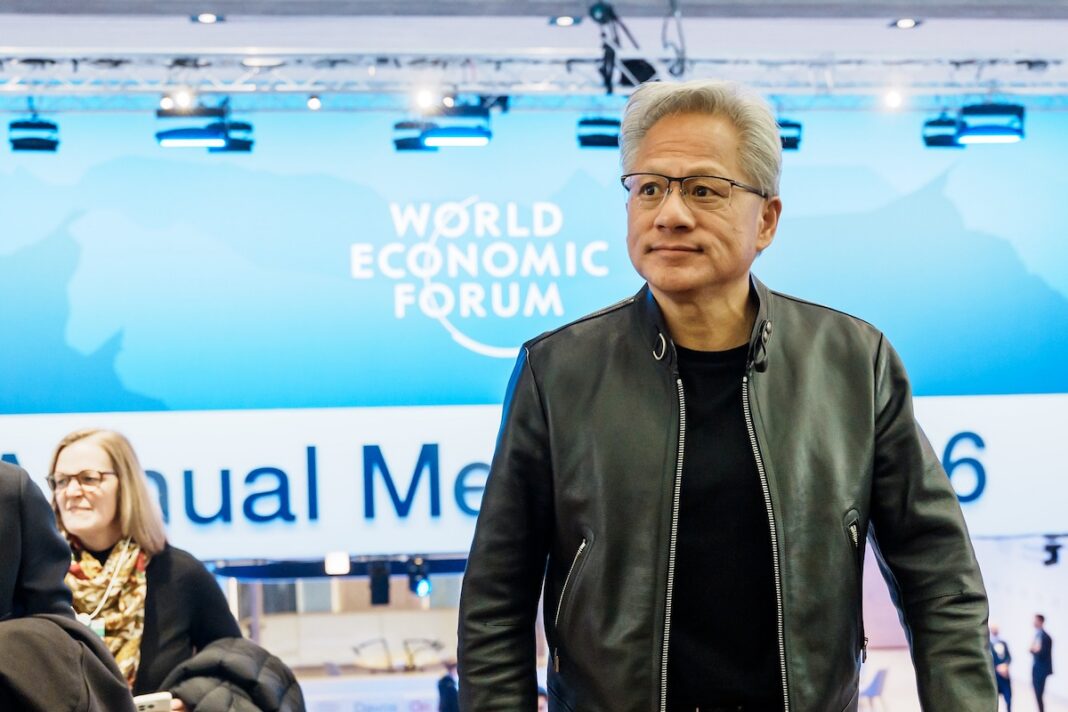

The Nov. 12 resignation of Nvidia co-founder Jensen Huang exposed the vulnerability of an AI boom increasingly dependent on Nvidia’s financing of the very companies buying its chips — while also threatening to stoke suspicions of Chinese espionage.
Huang’s departure followed reports of extramarital affairs with at least two women — including Alice Huang, a Singapore-based executive whom U.S. intelligence suspects of spying for China. A third relationship, with an unnamed Nvidia employee, was reported hours after he stepped down.
The New York Times broke the first report on Oct. 29.
Nvidia’s fall, Huang’s return
Between its Oct. 6 all-time high and the Nov. 20 market close, Nvidia lost nearly half its value — about $2.75 trillion, falling from roughly $5.78 trillion to $3.03 trillion.
Then, on Monday, Nov. 23, Nvidia’s board doubled back: It reinstated Huang as president, CEO and board member, six days after its new chairman, Harvey Jones, told investors the board “does not intend to reinstate Jensen as CEO.”
That same day, President Donald Trump told CNBC he had spoken with the board “directly and indirectly” and that Huang “did nothing wrong,” then wrote on Truth Social that the U.S. government “has no reason to believe” that Huang’s return “poses any risk to national security,” describing him as a “Great Patriot and National Treasure.”
Trump also shared an image of Huang holding a red bra in what appears to be an AI generated replica of a photo of Trump moments after an assassination attempt in Butler, Pennsylvania. In a later interview, the president said of Huang’s scandals, “sex sells.”
Nvidia closed up 31% on the day of Huang’s reinstatement, adding more than $900 billion in market value in a single session — the largest one-day gain for any company on record, according to Bloomberg data.
Also on Nov. 23, the Trump administration added Megaspeed, the Singapore-based Nvidia customer where Alice Huang was an executive, to its trade blacklist.
The Justice Department is now investigating whether the firm shipped Nvidia chips to China in violation of export controls, and three House committees will interview Huang closed-door on Dec. 1 after their chairman threatened a subpoena.
Huang’s return may settle who heads Nvidia, but its questions remain for the AI market’s dependence on one company, the chip trade with China and revived suspicions of Asian American espionage.
‘Circular financing’
Ryan Cummings, Chief of Staff at the Stanford Institute for Economic Policy Research (SIEPR), explains why so much of the AI industry rests on Nvidia and Jensen Huang’s business strategy.
At an American Community Media briefing Nov. 20, the day of Nvidia’s lowest stock close, Ryan Cummings — chief of staff at the Stanford Institute for Economic Policy Research and a former staff economist on the White House Council of Economic Advisers — called the company “the most important financier in the AI buildout, or at a minimum among one of them.”
The AI supply chain runs from chipmakers like Taiwan Semiconductor Manufacturing Company Limited (TSMC), which manufactures Nvidia’s designs, to cloud giants — so-called “hyperscalers” like Google, Amazon and Microsoft that rent computing power and fill data centers with those chips — to labs like Anthropic and OpenAI that build frontier models.
Companies spent more than $1.2 trillion building AI data centers from 2024 to 2026, Cummings estimates, while revenue from businesses and consumers using AI is about $180 billion a year — roughly 15% of that spending.
He estimates that just to break even, the AI industry may need more than $4 trillion in revenue over five years — the equivalent of Google and Amazon each building a copy of themselves.
To fill that buildout gap, Nvidia has acted like a bank, Cummings said, extending about $350 billion to its customers through equity stakes, chip sales on credit and guarantees on their leases and loans.
The company bought up so much of TSMC’s capacity that rival designers like AMD struggled for chip supplies, said Cummings: “They were in effect boxing out competitors,” while Nvidia’s credit pulled forward “demand that wouldn’t have materialized.”
“This system, which has a circularity to it, hence the name ‘circular financing,’ is very fragile,” he explained. If Nvidia stops lending to OpenAI, for instance, OpenAI buys less compute, hyperscalers order fewer chips, and the slowdown “rebounds back to Nvidia.”
“What markets have been effectively assuming is that the absolute best-case scenario is going to happen this year, next year, and every year for the next 10 years,” Cummings continued. “The second you get a piece of information that says actually we might not be in the best-case scenario … that’s enough to cause people to get really nervous and run for the exits.”
‘A climate of fear’
Diana Ding, Silicon Valley media entrepreneur, founder and CEO of the Silicon Valley Innovation Channel — Ding Ding TV, explains why the recent controversy surrounding Jensen Huang could harm business relations between Silicon Valley and companies based in China.
The uncertainty isn’t limited to investors.
Diana Ding, founder and CEO of Ding Ding TV, has spent years connecting entrepreneurs in Silicon Valley and Asia through forums and festivals. A chip design founder with a team in California and suppliers in Taiwan, she said, may now wonder: “Will people ask questions if I go to mainland China for a regular business meeting, and immediately question my loyalty?”
Ding, who was in China when Huang resigned, said users on the Chinese social platforms WeChat, Weibo and RedNote were disappointed by the stock drop, and widely skeptical of allegations that Alice Huang was a spy.
“The person with the most power has the biggest responsibility,” she said of the reported affairs. “A CEO can influence who gets promoted, who gets the next opportunity, and who gets fired. So it can be very hard to say no, or even to speak up afterwards, when the CEO has that much influence over your future.”
“So many people in tech want him back, but the board has made a different decision,” she said three days before the board reversed this, adding that in China, “people recognize what he built, but still expect him to take the responsibility. … What worries me is how uncertainty changes every day business decisions.”
A ‘thousand grans of sand’
“What went through my mind immediately was, ‘Here we go again. We are jumping right into another spy frenzy,’” said Helen Zia, a journalist and civil rights activist who co-wrote “My Country Versus Me,” the memoir of Los Alamos scientist Wen Ho Lee, who was charged with mishandling classified nuclear information in 1999. Lee pleaded guilty to one count but the other charges were dropped, with the presiding federal judge apologizing.
“I wondered ‘Why now? What does the timing of this have to do with anything?’ It’s clear that people have known about these affairs and these issues for a long time,” she continued, adding that the resignation left her with “the sinking feeling that there is a political agenda behind it.”
Helen Zia, journalist and Asian American civil rights activist, discusses the China Initiative, Trump’s campaign against espionage that targeted Chinese Americans, and how the Jensen Huang scandal could worsen discrimination and racially motivated allegations against prominent Chinese Americans.
Zia noted that recent coverage of espionage allegations against Alice Huang has also revived what’s known as the “thousand grains of sand” theory — the idea that China gathers intelligence through many ordinary citizens abroad, each informally collecting a small piece of information, rather than relying on traditional professional spies.
“It’s the same idea, that no matter how far back you go, whether you’re a high school student, whether you’re a physician, you are collecting a tiny grain of sand that could be intelligence, and that every one of us ants will take it back to the mother ant hill, and then it will be assembled into some larger, insidious danger to American national security,” she explained.
“This really leads to a climate of fear,” Zia added. “Ask who is benefiting from this.”