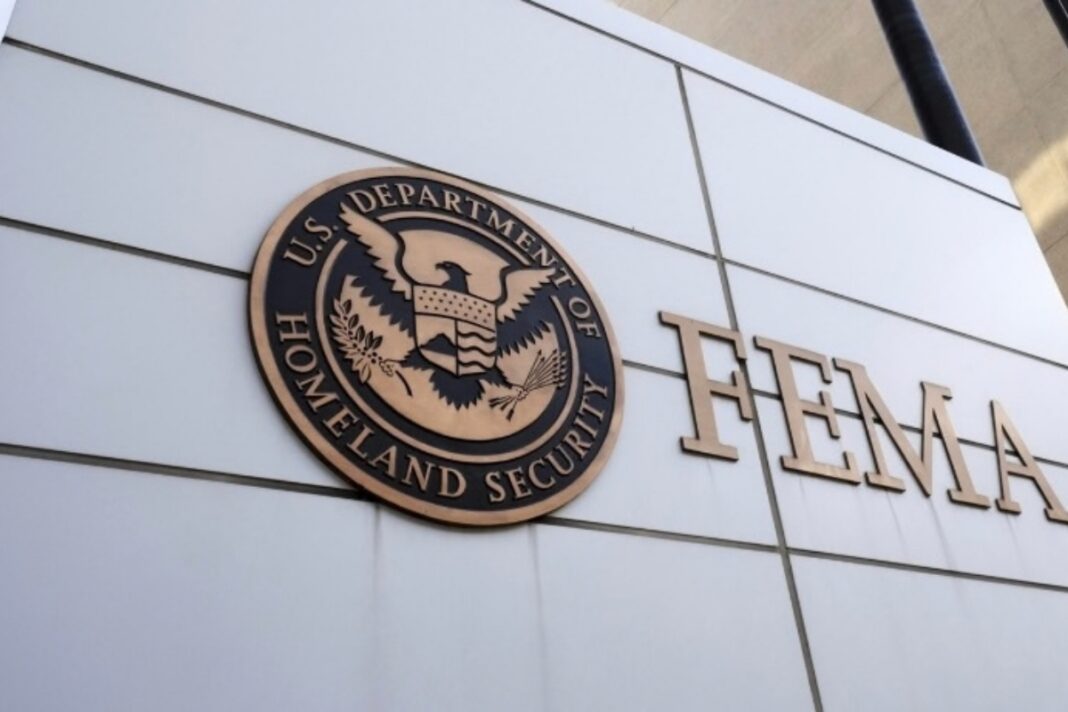

WASHINGTON — The Department of Homeland Security has been using federal office buildings in several cities to operate as makeshift immigration courts, with judges deciding cases via Zoom video, according to the American Immigration Lawyers Association.
Two such courts have been confirmed in Washington, DC and in Manhattan, New York. Additional locations are being considered in Chicago, Illinois; Miami, Florida; Denver, Colorado; San Antonio, Texas; and Los Angeles, California. Notably, the two pop-up courts in Washington DC and Manhattan bear no signage indicating they are immigration courts. And — in violation of existing policy — the courts are not open to the public or attorneys.
Immigration courts and courtrooms are generally open to the public, without prior registration.
In response to American Community Media’s emailed request for information, DHS said it began using the FEMA Headquarters Conference Center to conduct “critical operations,” beginning Sept. 8.
“This arrangement does not impact FEMA’s workforce or disrupt any of FEMA’s normal operations. FEMA has previously supported Department and interagency activities in the designated conference space. No FEMA personnel or operational resources are being diverted to support the DHS activities,” said DHS in the statement to ACoM.
The agency noted that immigration court hearings are administered by the Department of Justice’s Executive Office for Immigration Review.
Congressman denied access
Rep. Greg Stanton, D-Arizona, and the the ranking member of the House Transportation and Infrastructure Committee, which has oversight over FEMA, said at a Sept. 29 AILA press briefing that he arrived at the DC FEMA office building Sept. 23, expecting to conduct congressional oversight.
Instead, the congressman — who had brought along staff from his committee and staffers from the office of Senate Minority Whip Dick Durbin, D-Illinois — found himself standing outside an unmarked set of rooms that had been converted into an immigration court. He was told by officers at the building that he could not enter.
“I indicated that I was a member of Congress, and I was here to provide oversight and to enter and to see this series of rooms,” said Stanton. “They said no, I was not allowed to enter. They handed me a small piece of paper that indicated an email that I should use if I had any questions about the policy. Obviously, that was completely and totally unacceptable.”
Judge says courts must be open to the public
”We were working the phones for several hours, trying to get access,” said Stanton, noting that he and congressional staffers called all the agencies involved, including FEMA, ICE, the Department of Homeland Security, and the Executive Office for Immigration Review.
“I was shocked because each agency blamed the other,” Stanton said. “It’s FEMA’s building, it’s happening in their office, but FEMA said they had no authority to dictate who could enter into the impromptu courtroom area. Same thing with ICE, same thing with EOIR.”
Eventually, a DHS official determined that Stanton could enter — but that Congressional staff could not.
The following morning, Stanton returned. This time, he was permitted to enter more quickly, although congressional staff again were barred.
In its statement to ACoM, DHS confirmed that Stanton was able to enter the makeshift court in DC, but noted further: “Access to EOIR hearing spaces is governed by EOIR policy, applicable federal requirements, and facility-specific security procedures.”
Remote hearings
Inside the court, Stanton said he found a waiting area and a conference room where immigration judges appeared by video. On the first day, he said, no one appeared for court during the 20 to 30 minutes he was inside. On the second day, there was a list of people scheduled for hearings — but none of them appeared. Stanton questioned whether those in deportation proceedings had been sufficiently informed of the change of venue.
The congressman said he watched several hearings remotely conducted by judges and heard attorneys arguing cases. At one point, someone told the judge that a congressman from Arizona wanted to observe the proceeding.
The judge’s response, Stanton said, was unequivocal: A member of Congress — like any member of the public — should be permitted to observe. “The judge verbally indicated that there should be no stopping citizens from entering this courtroom,” said the congressman. “Which I found very interesting in light of how incredibly difficult it was for even me as a member of Congress to get in.”
ACoM asked Stanton whether the people adjudicating cases remotely in the DC pop-up courtroom were actually judges or DHS staff. “I can only speak to what I saw myself. In the time I spent in the room in which I saw the judge interact with other attorneys, it was clearly an immigration judge. I believe he was robed as a judge.”
But he said he could not speak to whether other types of adjudicators were presiding over proceedings at the pop-up locations.
‘Why the hell is a FEMA building being used for this?’
Stanton and Rep. Jamie Raskin, D-Maryland — ranking member of the House Judiciary Committee — have since written to federal agencies, including DHS, USCIS, and the Justice Department. In their Sept. 28 letter, the two congressmen asked why a FEMA facility is being used for immigration proceedings and whether people are receiving adequate notice of hearings.
“Why the hell is a FEMA building being used for this, at a time when we’re still in hurricane season, at a time when natural disasters are a real problem, and all of a sudden, FEMA now has all sorts of extra office room for this procedure?” Stanton queried at the AILA news briefing.
Greg Chen, AILA’s senior director for government relations, said immigration hearings are also being conducted in DHS-controlled space on the third floor of the federal building at 26 Federal Plaza in New York, rather than the traditional immigration courtroom on the 12th floor.
Rep. Dan Goldman, D-New York has conducted regular visits to the 12th floor courthouse. But he was blocked from entering the third-floor space, according to Chen. “These dramatic policy changes are creating chaos, threatening due process, and are making significant impacts on people’s lives, and it’s happening in secret,” he said.
DHS appears to be targeting people without attorneys
The lack of transparency is particularly troubling because the unusual courts appear to be handling large numbers of people who do not have attorneys, said Kel White, associate director for public education and training at the Acacia Center for Justice and chair-elect of AILA’s Washington, D.C., chapter.
“We only found out about these hidden courts because attorneys in our chapter were mistakenly sent those notices,” White said. “Had those errors not occurred, many members of our community here would not have known that these proceedings were even taking place.”
White said that was a sharp departure from the way new immigration court locations historically have been established — with stakeholder meetings, advance notice and information about which cases would be assigned to which court.
Instead, she said, attorneys and immigrants are struggling to find the new locations and, in some cases, even determine when their hearings are taking place.
The ‘Where’s Waldo’ of immigration courts
At the FEMA site, Google Maps directed White to a different building. There was no signage identifying the immigration court.
“For me to find that court itself was like playing hide and seek or the Where’s Waldo of courts,” White said. “But that’s a children’s game, and this is life with real consequences to the people who are entering that court, where failing to appear can mean deportation. And for many people, that can mean life or death if they’re applying for asylum or any other form of fear-based protection.”
White described one couple who had driven from Baltimore to Washington for a hearing. The judge appeared by video from Baltimore, while the immigrant appeared in Washington DC.
White was unable to enter the courtroom to provide representation. Instead, she sat with the person’s spouse at a McDonald’s while they waited.
“She’d been in this country for over 10 years, and had suffered all this hardship, and here we were sitting, waiting to see if her partner was going to come back out of that courtroom,” White said. “It’s not even absurdity anymore. It’s starting to become cruelty.”
Disappeared in the detainee locator
The hearings are unfolding alongside another change that immigration attorneys say is making it increasingly difficult to represent detained clients: ICE’s online detainee locator system is no longer reliably disclosing the whereabouts of some people with final deportation orders. Those with final orders of removal waiting for travel documents may not appear in the detainee locator.
Moreover, the ICE detainee locator has not listed the US among its drop-down list of countries of origin. Theoretically, ICE would not detain US citizens. But a ProPublica investigation released Oct. 6 found that 506 US citizens have been detained by ICE since President Donald Trump took office. 70 of them were children. 36 US citizens were detained for over a day, without the ability to contact their family or an attorney.
‘Where is my client?’
Ruby Powers, founder and managing attorney of Powers Law Group in Texas, said attorneys depend on the locator to find detained clients, communicate with them and determine where to file legal challenges.
“If one of my detainees gets moved from, say, Conroe, Montgomery Processing Center, that’s Southern District. But if they get moved to El Paso, that’s Western District,” Powers said. “We can’t file a habeas if we don’t know where they’re detained.”
Powers described a recent case in which a client disappeared from the locator system for several hours. She eventually learned the person was still detained — but was effectively “off the record.”
“It was extremely confusing,” she said. “In fact, even the judge thought that the client was no longer detained and made a ruling based on the judge not being there. So this is basically a violation of our ability to represent our clients.”
“These policies are deeply unfair, and they should frighten Americans,” said Chen. “ICE is disappearing people in the detention system. Hearings are being held in unmarked, hidden locations out of view from the public and from Congress.”
“And importantly, the people being harmed are certainly not the worst of the worst. They increasingly include people who already have an application pending for legal protection, might be asylum seekers, might have a work permit, and are going through the proper application process that Congress set forth in law,” he said.

SUNITA SOHRABJI
ACoM Health Editor Sunita Sohrabji is a veteran reporter, most recently covering the Indian American community for India-West newspaper. She has received 15 local and national awards for excellence in journalism.