




Asian American and Pacific Islander voters emerged as a potential ‘movable middle’ in the 2026 midterm elections, shifting toward Democrats in significant numbers but demonstrating that their votes are tied to issues rather than party preference.
”Both from the data and also from our folks on the ground, what we are hearing is that it wasn’t necessarily that people were so excited about Democrats. They really felt like they were given a vision that they wanted to vote for,” said Mary Lou Akai Ferguson, executive director at the Asian American Power Network.
“We are feeling a lot of pain, we are feeling a lot of attack, and we know that we need to stand up and exercise our right to vote. We’re seeing a lot of motivation to vote, but it’s not necessarily to vote for a specific party or a candidate just yet,” she said, at a Nov. 4 post-election press briefing, jointly organized by American Community Media and AAPI Data.
Partisan swing left
AAPI voters registered a nine-point partisan swing toward Democrats between the 2024 presidential election and the 2026 midterms, the second-largest shift among racial and ethnic groups, according to the 2026 mid-term election poll released Nov. 4 by 15 organizations, including Asian Americans Advancing Justice-AAJC, APIAVote, and UnidosUS. In House and Senate races, AAPI voters backed Democratic candidates by a 63-32 margin. And in governor’s races, AAPI voters supported Democrats 61–34.
Similar findings emerged of preliminary data from the Civic Health and Elections Project by NORC at the University of Chicago. Karthick Ramakrishnan shared some of the findings, noting that AAPIs were underrepresented in polls used by mainstream news organizations.
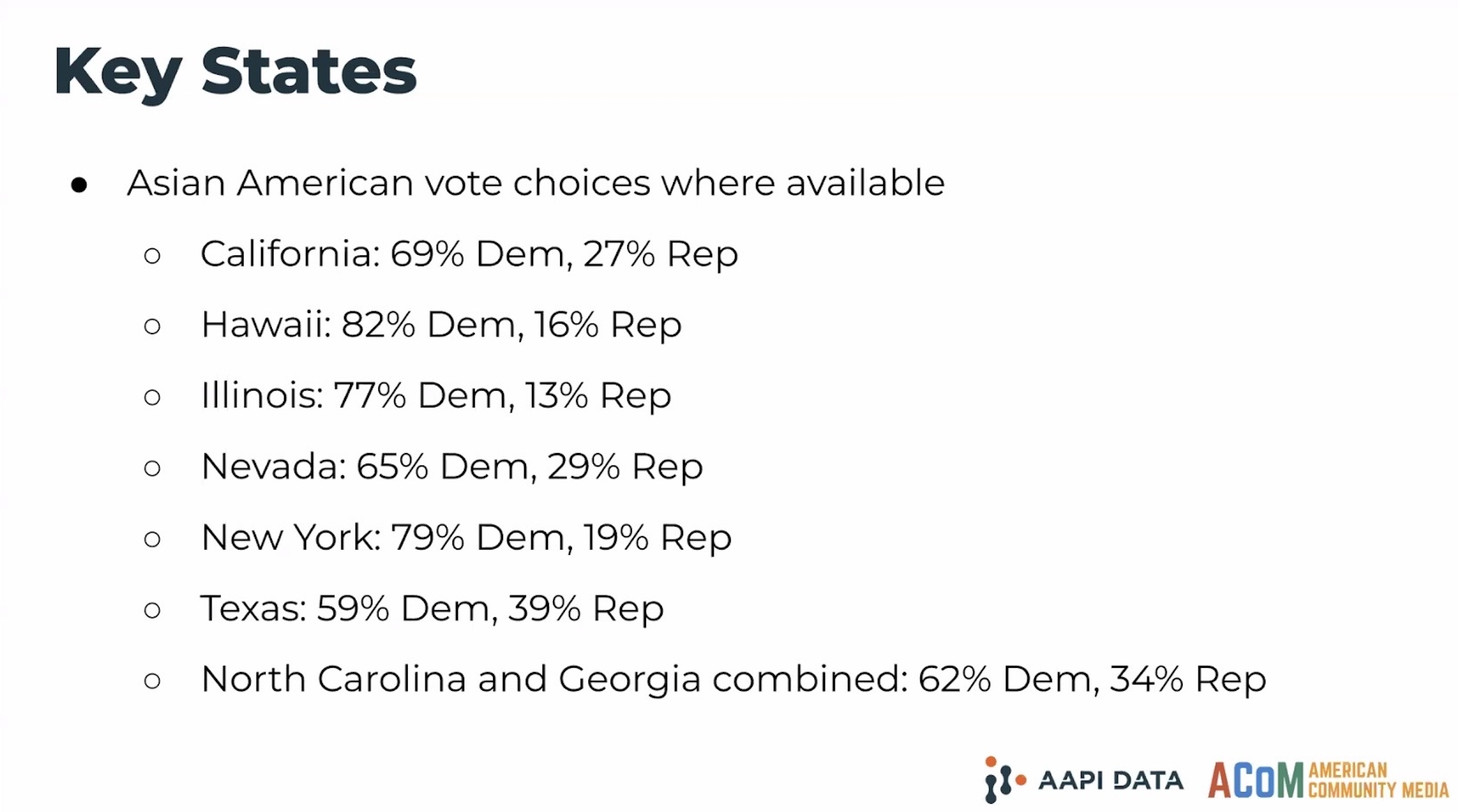
Roughly 70% of Asian Americans voted for a Democrat for the US House of Representatives, according to NORC data, which sampled 3,000 Asian Americans and 200 Pacific Islanders. For Pacific Islanders, 49% voted for Democrats. “This is a fairly long-standing pattern we see in Pacific Islander vote behavior, where it’s more split than the Asian American community, which historically has voted about a two to one ratio Democrat over Republican. In certain elections, including Obama’s historic 2012 election, it was a three to one ratio,” said Ramakrishnan.
AAPIs 18-29 years old and those over 65 overwhelmingly said they planned to vote for Democratic candidates, said Ramakrishnan, noting there was no gender gap.
Republican disapproval of Trump
2026 saw a big decline among AAPI self-identified Republicans in terms of President Donald Trump’s handling of the economy and foreign policy, moving from 80% to 58% among AAPI Republicans, according to NORC data.
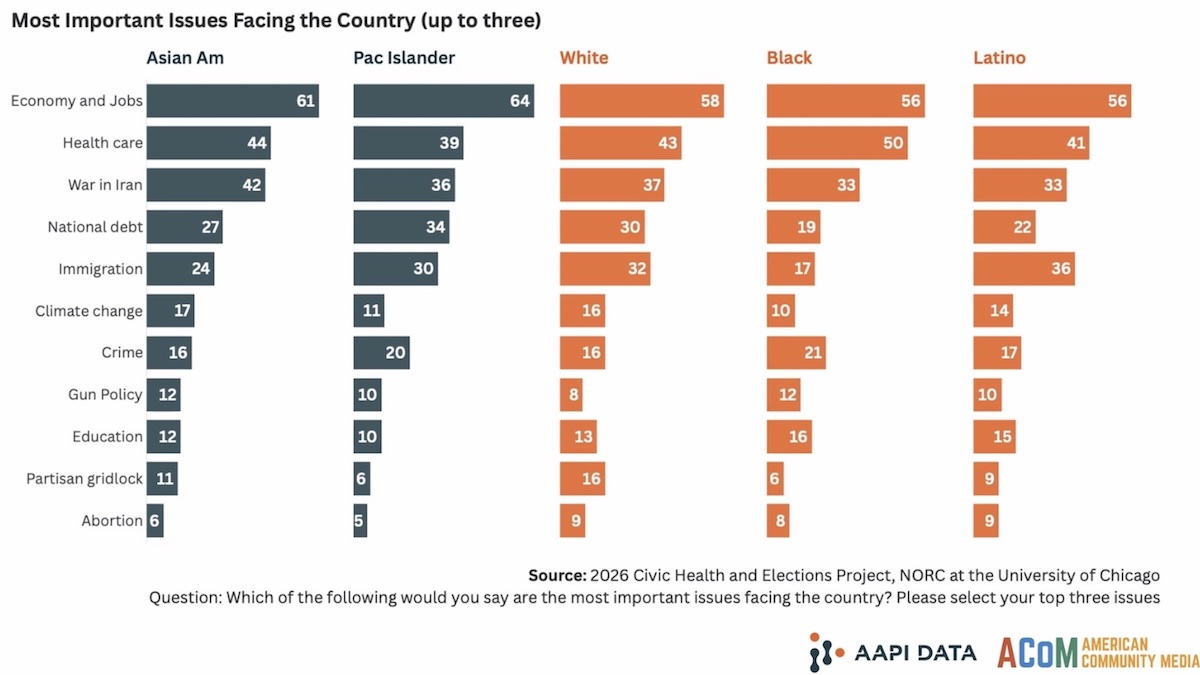
Improving the economic well-being of Americans is the top priority, for AAPIs, while healthcare is a strong number two, said Ramakrishnan. “Protecting individual rights from government overreach seems to be a slightly stronger priority among White voters than it is among Asian American voters. But it was also flagged as a priority among Pacific Islander voters as well,” he noted.
”Asian Americans are not ‘coming home’ to Democrats; they didn’t go to the Republicans in 2024,” said Kevin Hirano, deputy director of APIAVote, during a Nov. 4 press conference hosted by American Community Media and AAPI Data.
“They voted on the fact that they didn’t get the needs for their family and their communities: getting food on the table, getting their kids to a good school, and access to healthcare,” he said.
Both parties must recognize that AAPI voters are not automatically aligned with one political camp, said Hirano. “Asian Americans are not tied to one party or another. They’re tied to the issues that matter to them most. We are the movable middle; it’s going to be incumbent on campaigns to recognize this fact.”
Consistent voter engagement
Stephanie Cho, director of the Asian American Texas Action Fund, Chany Chea, program director of the Asian American Advocacy Fund, and Shruti Parekh, director of Education and Political Engagement at North Carolina Asian Americans Together, agreed that the 2026 results reflected the outcome of massive organizing and consistent engagement with voters.
Chea noted that 1/3 of the AAPI population in Georgia lives in Gwinette County. She believes the community — which has 300,000 eligible voters — helped to flip two seats in the Georgia House: District 99, where Democrat Michelle Kang beat out Republican incumbent Matt Reeves; and District 105, where Democrat Farooq Mughal bested Republican incumbent Sandy Donatucci.
”We focused on voters who have been historically overlooked,” said Chea.
Fighting back against racist rhetoric
Cho said federal candidates in her state largely overlooked the AAPI community, but down ballot candidates made significant inroads. AATAF volunteers, including 75 youth leaders, knocked on 50,000 doors. US Senate candidate James Talarico prevailed over Ken Paxton — Texas’ Attorney General, endorsed by Trump — to become Texas’ 1st Democratic senator since the late Lloyd Bentsen, who represented the state from 1971-1993.
“The challenge was the intense anti-trans, anti-China, anti-Muslim rhetoric that was sweeping throughout the South. It really soured, because it was too extreme. Most people don’t wanna hear that,” said Cho. “The extreme racism, the extreme rhetoric really backfired,” she added.
Parikh said AAPIs are the fastest growing electorate in her state, with about 150,000 registered voters. This year, their participation at the polls nearly doubled, with a lot of early voting, noted Parikh. “We had wins from the top of the ticket down to the state and local races, and that was very exciting for us.”
NCAAT focused on training youth leaders and registered first-time voters. “We helped people understand that democracy is not something you participate in every two to four years, but it’s a consistent habit that we need to develop,” said Parikh.
Historic gains for AAPI candidates
The midterms also produced historic gains in AAPI political representation. Four new AAPI members were elected to the House: Pia Dandiya, the first Indian American woman to represent Florida in Congress; Dan Koh, the first Korean and Lebanese American elected to represent Massachusetts in Congress; Alicia Garrido Limtiaco, the first CHamoru woman elected to represent Guam in Congress; and Dr. Richard Pan, the first Chinese American elected to represent California’s 6th Congressional District. Amish Shah also won Arizona’s 1st Congressional District, becoming the first Indian American to represent the district.
In Los Angeles, Asian Americans will hold all three citywide elected offices for the first time. Mayor-elect Nithya Raman ran a tough race to beat out incumbent Mayor Karen Bass. Angelenos also elected City Attorney-elect Marissa Roy and Controller Kenneth Mejia.
Significantly, Rep. Ted Lieu, a Democrat who has represented California since 2015, is positioning himself to become chair of the House Democratic Caucus. If successful, he would become the highest-ranking Asian American lawmaker in House history. The House is expected to vote on several leadership positions on Nov. 18-19.

SUNITA SOHRABJI
ACoM Health Editor Sunita Sohrabji is a veteran reporter, most recently covering the Indian American community for India-West newspaper. She has received 15 local and national awards for excellence in journalism.