


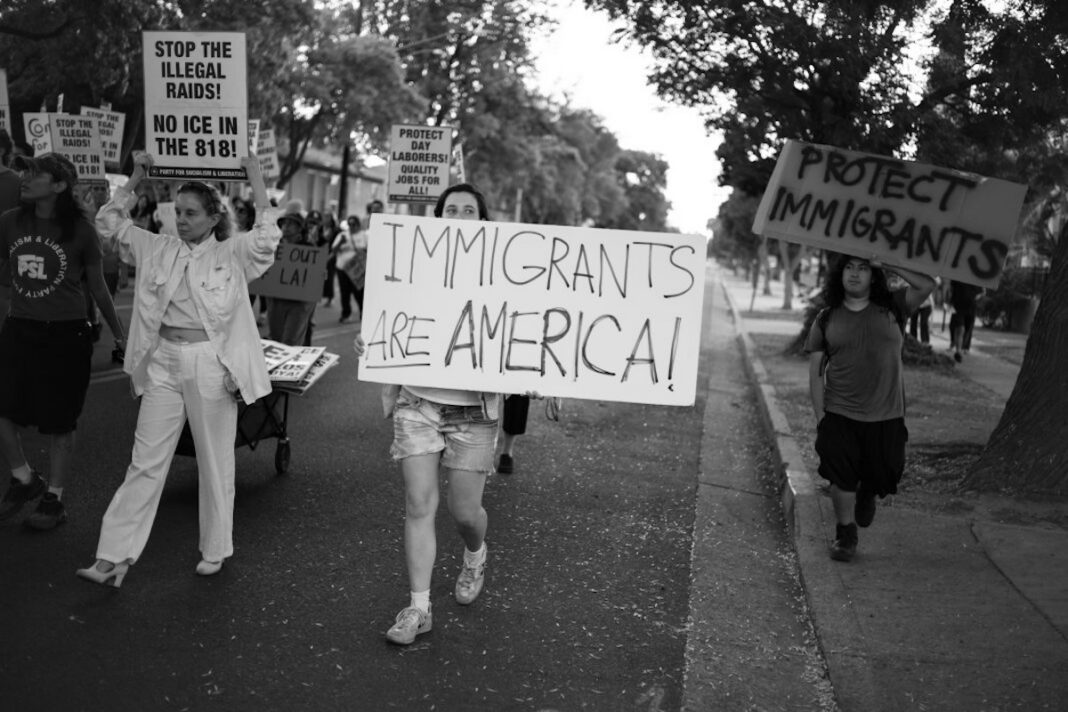

A recent YouGov survey of 5,000 registered voters conducted just prior to the midterm elections shows American voters’ attitudes on immigration are shifting, in part due to the extreme policies of the Trump administration. Last week’s election results, which delivered a historic “rebuke” of the president and his policies, are a case in point, says Ernesto Castañeda. Castañeda, director of the Center for Latin American and Latino Studies and the Immigration Lab at American University, says the administration’s unprecedented — and often violent — campaign of mass detentions and deportations on its own “would have been enough to turn the Latino vote,” and possibly the election for the Democrats. This is the first in a series of conversations with experts and activists on where the country goes from here on immigration. (This interview has been edited for length and clarity.)
How do you interpret the midterm results through the lens of immigration?
We see a rebuke of Donald Trump in general, and the MAGA project. Part of it is the economy, that it didn’t deliver. But, would we have seen these same results if the economy was better, if we didn’t have the war in Iran, or the tariffs? Would ICE alone have been enough? I think there’s many indicators that is the case. One example is in Houston, where people are putting “I Voted” stickers on the site where ICE killed 52-year-old Lorenzo Salgado Aurajo. Same with Alex Pretti and with Renée Good in Minneapolis. A lot of people voted in their name or in their memory. That was explicit. And it’s something that to a large degree helps explain the Latino vote. The excesses of ICE alone, I think, would have been enough to turn the Latino vote.
And what a turn. According to a recent Pew poll, just 24% of Latino respondents approve of Trump’s performance today, compared to 48% approval just two years ago.
Yeah, because now they’re being targeted themselves. It doesn’t matter if you’ve been in the country 30 years or if you have papers or not. If you’re in a state like Texas or Florida, the police may stop you and ask you for your papers… the goal of Stephen Miller is to get rid of as many people of color as possible. So if you’re brown, you’re guilty.
Do you think what’s happened with immigration enforcement under Trump has changed how immigrants see themselves here?
Two years ago there were a lot of people in the immigrant community who didn’t understand the benefits that immigrants produce. “We’re here. We’re settled. We don’t want the new people. They’re gonna ruin our reputation. They’re gonna create problems for us. They’re gonna compete with us.” There was a lot of that. The last year and a half showed that saying, “Oh, but I’m different. I’m exceptional,” may work with your boss, or with the people that know you. But when you interact with police officers, with ICE, with federal agents, it doesn’t matter.
And one more point. We interviewed Venezuelan asylum seekers and recent arrivals in Washington and New York. They were given work permits. Many worked the gig economy. And they made this argument, saying, “They shouldn’t take away our papers. They shouldn’t deport us… because we contribute to the economy. We make the U.S. economy grow.” Many of them came right after the pandemic when, in many places, there were help wanted signs. “We need dishwashers, waiters, construction workers,” the signs read. There weren’t enough people. So the Venezuelans, the Ecuadorians and the Chinese, the many people that came in that wave understood… the labor force wouldn’t have grown, and the economy wouldn’t have grown. And they know that.
Yet despite all you’ve said, it seemed a lot of Democratic candidates were afraid to touch the issue during the midterms.
Republicans kept scaring people with the specter of immigration. Trump said, “Oh, if you elect the Democrats, we’re gonna be flooded again by the third world.” The replacement theory was very alive in speeches by JD Vance. So the negative aspect of it was there. But you are right. The positive aspect of, we need immigration reform, or we depend on immigrants… yeah, that wasn’t made by the central Democratic National Committee (DNC). That wasn’t the line of the party.
But Gina Hinojosa, being who she is, where she’s from, it’s very hard to disentangle. Bobby Pulido going to the quinceañeras, he was going to parties where a big percentage of the people were probably undocumented. And they are Latinos. Hinojosa’s mom, a first generation immigrant from Mexico, is from San Luis Potosí.
Then you have Talarico, who in his acceptance speech said something to the effect of, “Everybody in Texas is our brother. I’m gonna work for everybody.” He didn’t have to say the word undocumented… He is your senator. And I think that was very clear for the Latino community in Texas.
What did the YouGov survey uncover about views of ICE and calls to abolish the agency?
In our survey, we asked, “If [a candidate] talks about defunding ICE, are you less likely or more likely to vote for that person?” And the majority was more favorable… for independents, it was a good thing. For Democrats, it was a good thing. For Democratic Socialists of America (DSA) members, it was almost like a requirement. So saying you’re gonna abolish ICE was more helpful than hurtful, campaign-wise. Even Republican candidates were not going out of their way to say, “I’m with ICE.” Because they know that across the country, most people are against ICE.
Trump clearly linked immigration and immigrants to crime. Do you think that message has run its course?
Not fully. A neighbor approached me the other day. He is a Republican, older, conservative, white. He said, “Ernesto, I know you studied this. Is this true… that the majority of the people that ICE has detained and deported have no criminal record?” And I’m like, “Yeah, yeah.” He sighed and said, “They just detained this neighbor who was a coach, a Venezuelan guy. He was a baseball coach. He was great. It’s not fair.”
Only then did it click for him. But it was so hard for him to believe because this is not new. It’s been with us since I’ve been studying migration for 23 years, this idea of illegal equals criminal. It’s gonna be very hard to break that stereotype. But, again, the fact that a lot of the deportations… a grandma, a Cuban that has been here for 30 years, a business owner, your landscaper, your nanny, your teacher’s friend, the mother of your friend at school, that is gonna change the perception of a lot of people.
We talked about the term “abolish ICE.” What about the term “illegal.” Has it lost some of its bite?
When Biden was president, he instructed the government not to use the term illegal alien. Then it became politicized. Banning it, while well-intentioned… maybe did more damage. When Trump came back to power, he said, “No, no. We’re gonna stop banning the word ‘illegal.’” And they have used it openly since, including the website about aliens. White House social media accounts have been filled with this anti-immigrant propaganda focused on Mexicans, on Somalis, on Indians, on people with work visas, et cetera. And it backfired. It was too much.
But, rather than policing language, we should provide programs that help everybody. It’s not enough to police language if people are underemployed or underpaid, or they cannot afford housing, right? Spending on education, more programs, more infrastructure, more jobs where the government is actively participating in creating them is a winning proposition for Democrats.
So a true economic populism, in other words.
Yes. It’s very progressive. It was also the hook that drove a lot of working-class folks to vote for Trump.
You wrote the YouGov survey results point to a nuanced middle ground on immigration. What does that look like in practice?
It doesn’t benefit anybody to have a semi-closed border where people are passing through the desert or something like we had for many years. It’s dangerous. When you don’t have legal pathways for people to come, you incentivize organized crime to get involved. It doesn’t mean that people don’t keep coming. The reality is the pressures and the needs for people to come, and the needs for us to receive them are going to continue. So a precursor is that we need ways for people to come legally. As for people who are already here… amnesty is popular, with 70% support in our survey. We need to find a way to regularize the people that are here. And then we need to find new ways for people to come legally. It is a problem that is completely solvable if there’s political will, and we may get that in 2028.
Read the full 2026 American Voters Preference Survey here.