


There is a video circulating widely on social media in which a man is seen holding a bottle of water to the camera. Inside the water what appear to be tiny worms wriggle, the man’s face and orange jump suit visible in the background.
The video, first published by the news site LA Taco, was shared by lawyers for Carlitos Ricardo Parias, a Los Angeles resident who has spent months detained at the privately-run Adelanto detention center north-east of the city. According to Parias, this is the water detainees are given to drink.
California is home to eight privately-run detention centers across four counties, including the center at Adelanto. The facilities — which some liken to modern day internment camps — are part of a growing national network of such prisons designed to house the mounting number of immigrants caught up in the Trump administration’s deportation dragnet.
More than 65,000 people are currently being held in any one of some 200 or more such centers nationwide. In California that number tops 6,800. At least 22 immigrants, including six in California, have died while in ICE custody this year.
Reports of squalid and overcrowded conditions as well as spoiled or otherwise contaminated food, and refusal to provide needed medical care abound.
Meanwhile, the companies behind these private prisons — Core Civic and Geo Group prominent among them — have raked in a cool $2 billion in revenue since Trump returned to the White House.
“The CEOs are celebrating,” said Masih Fouladi, executive director with the California Immigrant Policy Center. “This is profiteering off of human suffering.”
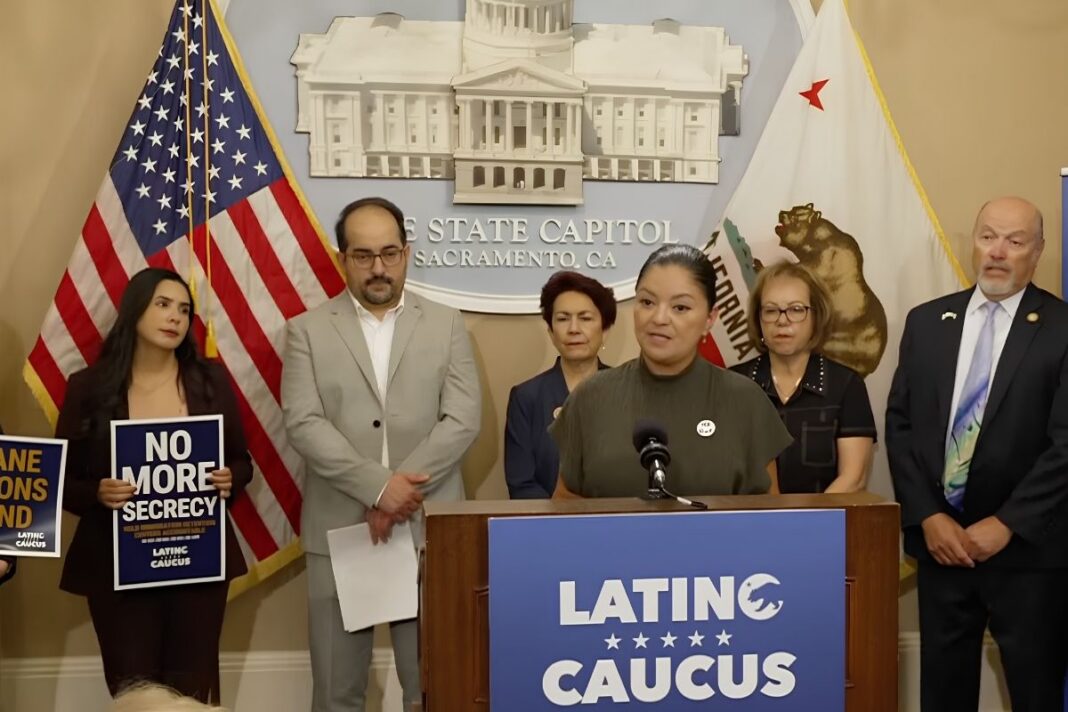
Fouladi spoke alongside prominent members of California’s Latino, Black and AAPI legislative caucuses during an August 5 press conference in Sacramento where the lawmakers presented a raft of bills squarely aimed at what they describe as rampant human rights violations inside centers like Adelanto.
“No more secrecy,” said Senator Lena Gonzalez, chair of the California Latino Legislative Caucus, who noted the administration has detained some 650 children, 100 of them age five and younger.
Gonzalez is the author of SB 423, which would require the release of all 911 and emergency call records coming out of private detention centers in the state. The bill, co-sponsored by the First Amendment Coalition, comes following reporting by Cal Matters around reports of sexual assaults at the Otay Mesa detention facility in San Diego.
Calling conditions inside these facilities “inhumane,” Gonzalez stressed lawmakers are “working to strengthen state oversight and provide California with additional tools to hold immigration detention facility operators accountable.”
Other bills presented during Wednesday’s press conference include SB 995, or the Masuma Khan Justice Act. Authored by State Senator Sasha Renée Pérez (D-Pasadena), the bill is named for Masuma Khan, a survivor of the Altadena fire in Los Angeles in 2025 who was detained by ICE during a routine appointment.
“She has no record,” said Pérez introducing the bill. “She was denied access to an attorney, to medical care. She was given moldy food and dirty water.”
If passed, SB 995 would require private facilities to comply with the state’s rigorous health and safety laws.
SB 942, the Civil Detainees’ Bill of Rights, would establish clear standards for humane treatment, medical care, and safety for detainees, as well as accountability mechanisms for operators.
“An individual that has been detained for a civil matter, such as immigration, is not serving a criminal sentence,” said Senator Anna M. Caballero (D-Merced), who authored the bill, “yet the conditions in these facilities are dangerous and inhumane.”
SB 1399, authored by Senator María Elena Durazo (D-Los Angeles) and co-sponsored by California Attorney General Rob Bonta and Immigrant Defense Advocates, would prevent the sunsetting next year of the state’s current oversight framework.
Together, the bills highlight the steps California is taking to reign in abuses across privately run centers in the state.
Asked whether California has the authority to enforce these regulations, Gonzalez pointed to a recent suit by San Diego County, which sued operators at the Otay Mesa facility for access rights. A judge in that case upheld the county’s claims.
“That suit itself proves we have the ability to provide oversight,” insisted Gonzalez. “These are corporations operating inside our state.”
Assemblymember Isaac Bryan, vice chair of the California Legislative Black Caucus, told reporters, “When human rights are being violated… it is not just a Latino issue. It is a human issue, a Black issue, a California issue. It should be an American issue.”
This story was produced as part of “Aquí Estamos/Here We Stand,” a collaborative reporting project of American Community Media and community news outlets statewide.

