


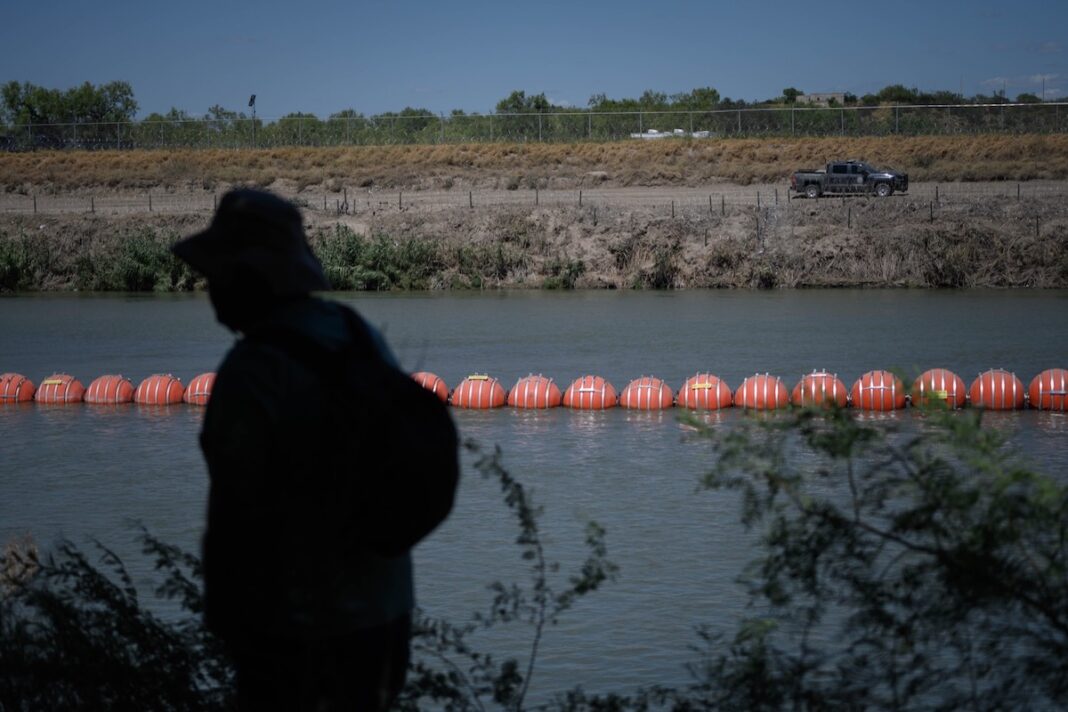
The border at Eagle Pass, Texas, has razor wire and a 1000-foot line of big round buoys. The floating barriers are meant to deter migrants looking to cross from the city of Piedras Negras, on the Mexican side of the Rio Grande River.
For journalist Manuel Ortiz, they are part of what he says is a more militarized atmosphere along this stretch of the U.S.-Mexico border.
“This is the first time that it seems to me like a war zone,” says Ortiz, founder of Peninsula 360 Press, who has covered the border off and on for decades. Driving southwest from San Antonio, he describes helicopters overhead and military vehicles along the road.
Last week, state troopers found a body stuck to one of the border buoys.
Texas Governor Greg Abbott began Operation Lone Star in March 2021 in response to rising border crossings. In May of that same year, Abbott issued a disaster declaration, later sending National Guard troops to the border. Two state agencies, the Texas Department of Public Safety and the Texas Military Department are in charge of the operation. When 16,000 migrants suddenly arrived in Del Rio in November 2021, Abbott sent 10,000 guardsmen to the border in response. Del Rio is about 55 miles north of Eagle Pass.
“The only winners from Abbott’s actions seem to be the human traffickers,” said Ortiz during an EMS media briefing. Speaking to migrants, he noted human smugglers, called coyotes, used to charge $500/per person to get across the border. The price has gone up to $1500, he says, after the floating barriers were installed.
On the other side of the border, Ortiz noted Mexican authorities appear to be “doing nothing against the smugglers,” adding there are unverified rumors that local officials there may in fact be involved in the trafficking.
A ‘glitchy app’
The Trump administration essentially stopped processing asylum claims along the US southern border during the pandemic by invoking Title 42, a public health order that allowed for the immediate expulsion of migrants.
That program ended in May. The Biden Administration subsequently announced that would-be asylum seekers would now be required to first schedule an appoint with Customs and Border Protection through a mobile app prior to their arrival at the border.
Gianna Borroto is the head litigator with the American Immigration Council (AIC). It’s an impossible situation,” she says, describing the CBP One app as a “cruel measure” designed to limit who can seek asylum in this country.
AIC and its partners filed a class action lawsuit July 27 in the district court for the Southern District of California over the CBP One app. The lawsuit challenges the Biden administration’s policy of turning away asylum seekers at ports of entry who didn’t make an appointment. The suit names ten plaintiffs who claim they couldn’t.
Besides a smartphone you need internet access to use the app. Many migrants are living in encampments without electricity or water, much less internet service. Borroto says many migrants don’t have money to buy minutes for their phones because they need what they have to buy food.
She also cited a number of problems with the CBP One app. One man couldn’t get tech support, just lines of code; one woman tried every day for months but couldn’t get an appointment; the app has just three languages but border migrants speak 20 or more, so unless they speak English, Spanish, or Creole, it’s useless; the app doesn’t upgrade easily and freezes a lot.
“Access to asylum simply cannot be restricted to a glitchy smart phone app lottery,” Borroto says. A recent ruling in a similar 2017 case gives her hope. A previous version of a turn back policy that limited access to asylum at the border was declared unlawful and in violation of the U.S. Constitution.
Borroto says AIC filed suit to protect the fundamental right to seek asylum which is enshrined both in US and international law.
A history of racism
Professor and author Cal Jillson is a recognized authority on Texas politics and the politics of the US southern border. “The current situation at the border has been replayed many times over the course of American history,” Jillson said.
America has always been racist, and that racism has long informed attitudes toward migration, he said.
“Benjamin Franklin said terrible things about the German immigrants to Pennsylvania in the 1750s. The Irish were treated badly in the 1840s and 1850s. Asians were excluded completely from the 1880s well into the 1950s,” Jillson said.
He noted that in the 19th Century, the thinking of the dominant white majority in the country was effectively ‘If you’re white, y’all come’.
“But even in the early 20th Century, when the American economy was strong and labor was needed, there was a welcoming of people across the border from Mexico into the United States on the presumption that they would work cheap and go home when the work was completed.”
Beginning in the 1950s, migrant workers started staying year-round.
“I see the current events at the border as part of an American—particularly white American—ambivalence about immigration, specifically of immigration of nonwhite people… and it has ever been thus,” he said.
When it comes to immigration as a political issue, Jillson believes Republicans have the advantage. Their message is simple: we oppose illegal immigration, and we are worried about legal immigration. “That’s a kind of bumper sticker slogan,” he said.
Democrats, meanwhile, are hoping immigration will not become the driving issue in the upcoming presidential race. They have a tougher sell, said Jillson, with a more complex coalition, some of who “recognize that the Republican charge that Democrats stand for open borders is a political killer.”
It’s Republicans who are setting closed border policies, Jillson noted, and it’s likely to remain that way for some time.