

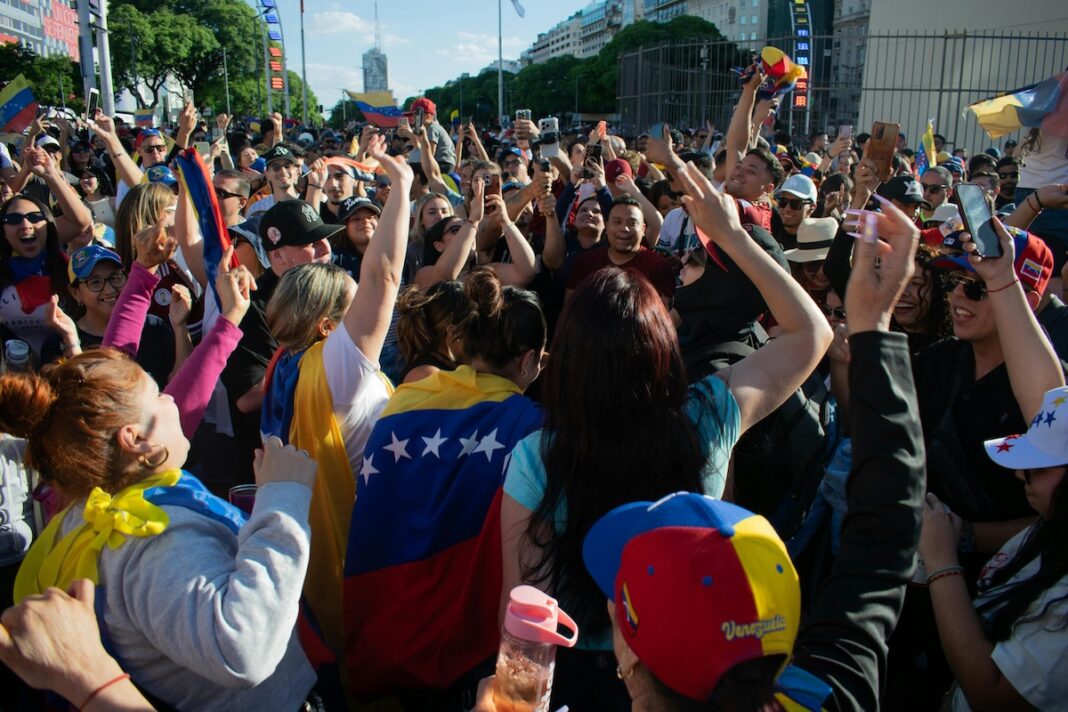
ACoM Associate Editor Pilar Marrero, who was born and raised in Venezuela, says the U.S. assault on Jan. 3 that ended in the abduction of Venezuelan leader Nicolas Maduro was the first sign of change, and possibly hope, for the country in decades.
For many Venezuelans, inside and outside the country, the operation was met with a mix of shock and relief, yet any hopes for a restoration of democracy were dashed as Pres. Trump announced hours after Maduro’s capture that the U.S. would govern the country indefinitely. Reports are emerging of growing repression within Venezuela, as the governing institutions that underpinned the Maduro government remain largely in place.
Marrero spent three decades as a journalist with La Opinión in Los Angeles, where she covered a range of issues impacting Latin America and the Latino community. She sat for an interview with ACoM reporter Christopher Alam to share her thoughts on the U.S.’s unprecedented assault on Venezuela.
What was your initial reaction when you learned of the U.S. capture of Maduro?
It was intense. I haven’t felt this Venezuelan in a long time, because I’ve been gone for so long. I’m not a nationalist per se… but since this happened, I’ve been feeling so Venezuelan. It’s been so long that we’ve had this regime and it never delivered. So I felt like, wow, finally something happened. I think that’s the feeling of a lot of Venezuelans. We didn’t stop to think about how it happened, who was doing it. Yes, of course we knew it was Trump, and a lot of us don’t agree with Trump on most policy issues, or almost anything. But it seems that a lot of the international community had abandoned Venezuela a long time ago. With the U.S. operation, at least something was finally happening. There was hope. Of course it’s become more nuanced since then.
Statements from Trump make clear the assault was about capturing Venezuelan oil. What’s your take on that?

I don’t care about the oil, to be honest, and I don’t think most Venezuelans do, because we’ve never controlled the oil. We already gave the oil to the Cubans, to the Iranians, to the Russians. The Venezuelan government has used the country’s oil as a currency for their own power since forever. What I care about and what Venezuelans care about is whether this is going to lead to a transition to democracy, which we had from the mid-50s until the end of the century when Hugo Chávez took over. Venezuelans are pragmatic. They say, okay, this guy (Trump) is going to take the oil, but will he push a democratic transition? This is what I’m hearing from 90% of my fellow Venezuelans.
Do you believe Trump will push for a democratic transition in Venezuela?
Trump doesn’t care about democracy. I think we should agree on that. But if we do eventually get a democratic transition and we get elections then this will all have been worth it. The problem is that I don’t trust Trump. A lot of us don’t trust him, we are listening to Marco Rubio for the most part, because Marco Rubio is the one that is talking about a transition, that is talking about different steps to a transition. He’s the one that I think cares the most about this transition. He thinks Cuba is going to fall after this because Venezuelan resources subsidize Cuba. So I do believe that he cares a little bit about democracy. He has to manage Trump, though, and Trump is obsessed with his own ego and with oil.
Oil is becoming a way for the U.S. to pressure the Venezuelan government because there’s a blockade. They can’t get the oil out, so they have to sell it to Trump. They’ve already signed an agreement to sell to the US. So this is something that they know they have to do. And regardless of whether it’s good, it’s bad, fair or unfair… if it gives the US and Marco Rubio the leverage to push for a democratic transition, yes, it will be worth it, in my opinion.
Trump has shown no inclination to support the opposition leader and Nobel laureate, Maria Corina Machado. Who is there to lead that transition?
The people that are left in government are Chavistas for the most part. Delci Rodriguez, who is the president now, was the vice president. Diosdado Cabello is the enforcer. He took to the streets this week and started arresting people that were celebrating Maduro’s ouster. Cabello is the one that is in charge of the paramilitary armed colectivos. He has significant power.
The problem is Trump’s dismissal of Machado. Apart from her, the country’s opposition leaders are all out of the country or they are discapacitated by the government. Many Venezuelans have rejected them. Machado is the only one that still has some legitimacy. When the Maduro government disqualified her candidacy in 2024, her chosen proxy, Edmundo Gonzalez, won handily. He should be the one taking power now. And in future elections, Machado could run, and I think she would win.
International security experts predict the Maduro government could remain in place long term. Do you agree?
It’s possible that the regime would want to do that, but I don’t think it’s something most Venezuelans would support. This is a criminal government, you know. The transition to democracy we’ve seen in countries like Chile, Argentina, Uruguay, you had to have an agreement between non-democratic and democratic institutions, and you had to have some kind of amnesty for the people that committed crimes. That probably needs to happen in Venezuela, too.
But the reality is that there’s no way to take these people out unless there’s some negotiation where they’re going to get something in return. And I don’t know if this U.S. administration is willing to do the serious work that it takes to do that. Or will they want to keep these guys because they know they can manipulate them? I think that’s Trump’s thinking. ‘I would rather have these bad people stay and be able to manipulate them than have an independent democratic Venezuela.’ That’s Trump’s thinking, I think. I don’t think that’s Rubio’s thinking.
Many on the left have denounced the U.S. invasion as a violation of international and U.S. law. That it was illegal.
I understand the position that this was illegal. It was a kidnapping essentially. For most Venezuelans – we don’t care. We really don’t. That’s for someone else to figure out. Because we feel that for all these years, especially over the last 10 or 15 years, nobody has really paid attention to our plight.
And I have a personal issue with progressives. I consider myself a progressive, but I have a personal issue with the extreme left who prefer to choose things like defend Maduro and say that, oh, Maduro needs to be let go. I never see any of these progressives arguing for Venezuelans, their human rights, against torture, against political prisoners, against the destruction of institutions. I’ve never seen any of them attack Venezuela. In fact, I see many of them defend these regimes because they’re supposedly of the left. I would argue that they’re not really left. They’re actually authoritarian.
What do you say to those who argue this paves the way for future aggression by the U.S., China or Russia?
I think that risk was already there. Look at Russia and Ukraine. Look at Israel and Gaza. They’ve committed all the crimes imaginable and unimaginable and the U.S. has supported it.
What are you hearing from Venezuelans still living in Venezuela? Are they tense, scared, hopeful?
I have a brother there who told me he couldn’t talk because they’re checking phones on the street. They were doing that in the days after they took Maduro. The regime sent paramilitary groups out and they were checking phones. They were actually arresting people who were seen celebrating. My brother told me, “I’m going to hold my opinions until I see more.” People don’t believe anything now. It’s hard for them to believe that something’s going to change for the better.
What role do you see at this moment for the millions of Venezuelans outside the country, including in the U.S.?
As Venezuelans, I don’t think we need to trust the Trump administration. We need to advocate for what we want to see. And we need to be loud. I know Venezuelans who love Trump and who say, oh, just trust him. No, hell no. Not gonna trust this guy. I think we need to be aware and just push for whatever it is we want. I know Venezuelans inside Venezuela can’t do it. We have to do it, we are outside, we have to do it.
Chris Alam is a California Local News Fellow with the UC Berkeley Graduate School of Journalism.