


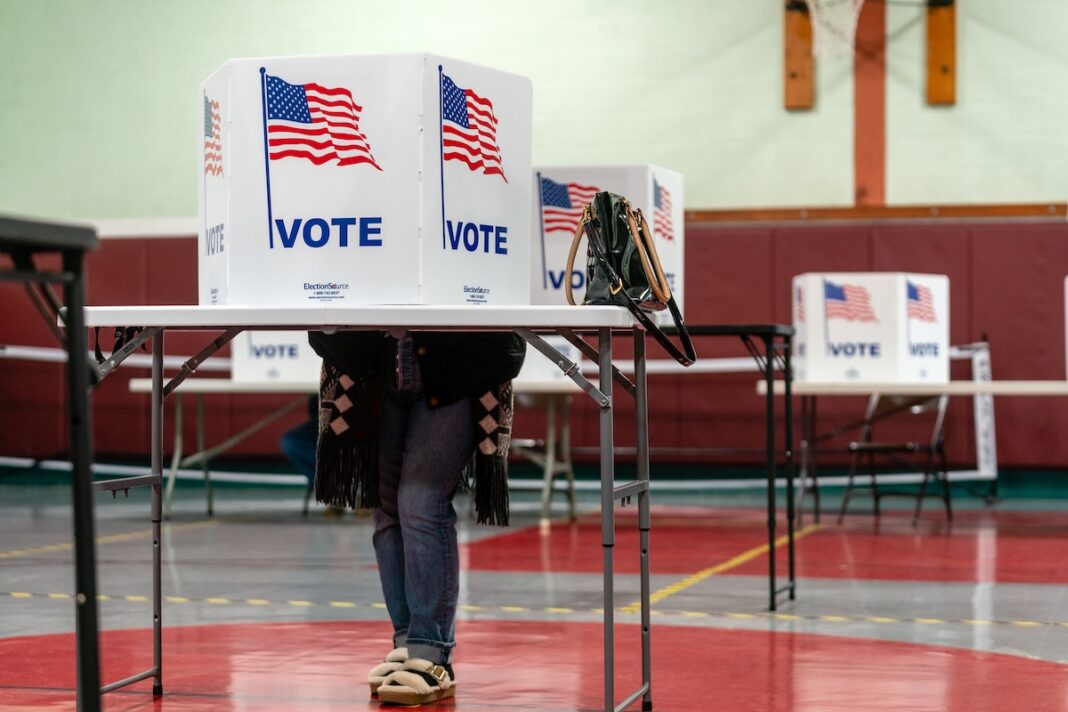

A federal judge has blocked the Department of Homeland Security (DHS) from investigating likely U.S. citizens as part of voter-fraud operations in nine states. The ruling limits what the agency calls its Unlawful Voter Initiative through Election Day.
The Oct. 21 preliminary injunction, issued by U.S. District Judge Araceli Martínez-Olguín of the Northern District of California, bars DHS from conducting voting-eligibility field investigations involving people the agency knows or suspects are citizens. The order also bars operations based only on records from DHS’s voter-vetting system.
The block, covering the nine states DHS directed agents to prioritize for voter investigations — California, Connecticut, Georgia, Missouri, Nevada, New York, Pennsylvania, Washington and Wisconsin — expires when polls close Nov. 3.
More than 10 million naturalized citizens of voting age live in these states, according to Census data — more than two in five of all naturalized voting-age citizens nationwide.
Although the order allows DHS to continue targeting alleged noncitizens, it notes that the agency’s policy targets naturalized citizens whenever its data review process suggests they voted before becoming citizens — a process the federal court found that, “(e)ven under the best conditions,” carries a “high likelihood of error … because there is no federal database containing citizenship status of U.S. residents.”
The order also cites an Aug. 28 internal DHS memo directing agents to document findings in a “Criminal Voter Fraud Initiative Portal” outside the agency’s normal process so that the records, including photos and videos, can be used by the agency’s staff in “(m)edia and (r)eporting.”
In the lawsuit — filed by the California Nurses Association, National Nurses United, the Voto Latino Foundation, the City and County of San Francisco and Santa Clara County — Martínez-Olguín, citing DHS’s own internal memos, said the agency “surveils, covertly infiltrates, and interrogates the staff of nonprofits and churches conducting voter engagement,” and has targeted nearly 150 such organizations as of July 2026.
The Unlawful Voter Initiative
Martínez-Olguín’s order limits the Unlawful Voter Initiative, which was announced by DHS Sept. 1, following President Trump’s March 2025 executive order directing states to vet voters using DHS’s SAVE system.
DHS describes the initiative as an election-integrity effort — but its citizenship verification process, which matches voter registration records against U.S. Citizenship and Immigration Services records, are error-prone, the order finds.
A week after DHS announced the initiative, a whistleblower disclosed that agents were directed to prioritize cases involving recently naturalized citizens.
According to the whistleblower, a USCIS trainer used the phrase “supplemental magic” to describe additional information that reached agents from sources they sometimes could not identify.
On Oct. 26 this month, the Justice Department announced charges against 48 noncitizens with election-related crimes in California, Florida, Nevada, New York and Pennsylvania; 47 were lawful permanent residents.
State records reviews and election official surveys have found noncitizen voting to be extremely rare and uncoordinated.
Nor have previous administration claims of widespread noncitizen voting held up.
In July, DHS told Nevada as many as 15,903 noncitizens could be registered to vote there, then narrowed its list in August to 185 people after a manual review. In a Sept. 23 letter, Nevada found that all 185 were U.S. citizens.
In October 2025, the Texas secretary of state’s office checked the state’s 18 million registered voters against SAVE and sent counties a list of 2,724 potential noncitizens. Of the 578 since confirmed to be U.S. citizens, 506 were flagged only because of a passport data lag.
Los Angeles County, opposing a Justice Department suit to force California to set aside ballots cast by people on that list until their citizenship is verified, reviewed a preliminary sample of 200 of the 7,035 people on the DOJ list who had county addresses. The county found that more than one in four sampled records listed a U.S. birthplace, more than half of the registrations had already been canceled or were inactive, and about 70% of the people sampled had never voted.
With Election Day a week away, federal courts have paused or blocked the administration’s election-related efforts at least 34 times, according to a Brennan Center report. The rulings include blocks on Trump’s March 2025 executive order requiring proof of citizenship to register to vote, and blocks on the Justice Department from collecting states’ full voter roll data.
‘A lens of fear’
Still, residents and advocates in California’s Coachella and San Joaquin valleys say that the initiative, amid ongoing Immigration and Customs Enforcement (ICE) surges, has already deterred some naturalized citizens from the polls ahead of the midterms.
Josefina, a naturalized citizen in the Coachella Valley who asked that her last name be withheld, has already voted — by mail, because she was afraid to go to a polling site.
She said many people in her community know about the DHS initiative and see it as part of broader immigration-related intimidation, including ongoing ICE arrests.
ProPublica documented at least 506 cases of U.S. citizens detained by immigration agents between January 2025 and September 2026 alone — a number that the outlet calls an “undercount.”
“Lots of people say they don’t want to go to vote at all,” Josefina said. “They understand they could put up a legal fight if they were wrongly accused of being an illegal voter, but they say, ‘It would cost a lot of money, take lots of time. They would put me in detention, and it would be terrible for my family.’”
“Others are worried that the government doesn’t respect court decisions,” she continued, “so that even if they defended themselves, they could be put in detention and mistreated there, and then be deported.”
Naturalized citizens’ family situation also impacts their willingness to vote, Josefina added: “The people who are most worried are those who live in a household where not everyone has papers. They worry that ICE could take their phone and get information on the people in them and go after them.”
Even in her own extended family, where 12 people are naturalized citizens and the rest are U.S.-born, she expects a fairly even split between those who vote and those who don’t, though relatives in small, rural farmworker towns, where ICE has been less present than in her own community, may be more likely to go ahead and vote.
Jesus Martinez-Saldaña, executive director of the Fresno-based Central Valley Immigrant Integration Collaborative, has no way to know for sure whether the campaign targeting naturalized citizen voters in the San Joaquin Valley is working, but like Josefina, he thinks it has a significant effect regardless.
“When my staff are re-contacted by newly naturalized citizens they have helped with the process, they are excited about exercising their voting rights in the U.S.,” he said. “But throughout the community, everyone sees everything in day-to-day life — going to work, sending their children to school — through a lens of fear.”

ED KISSAM
Edward Kissam has conducted and published research on migrant and seasonal farmworkers and immigrant integration in the U.S., as well as educational initatives in Afghanistan. Edward has worked on issues of differential census undercount for three decades and published papers on farmworker undercount and coverage measurement in the 1990, 2000, and 2010 decennial censuses.