


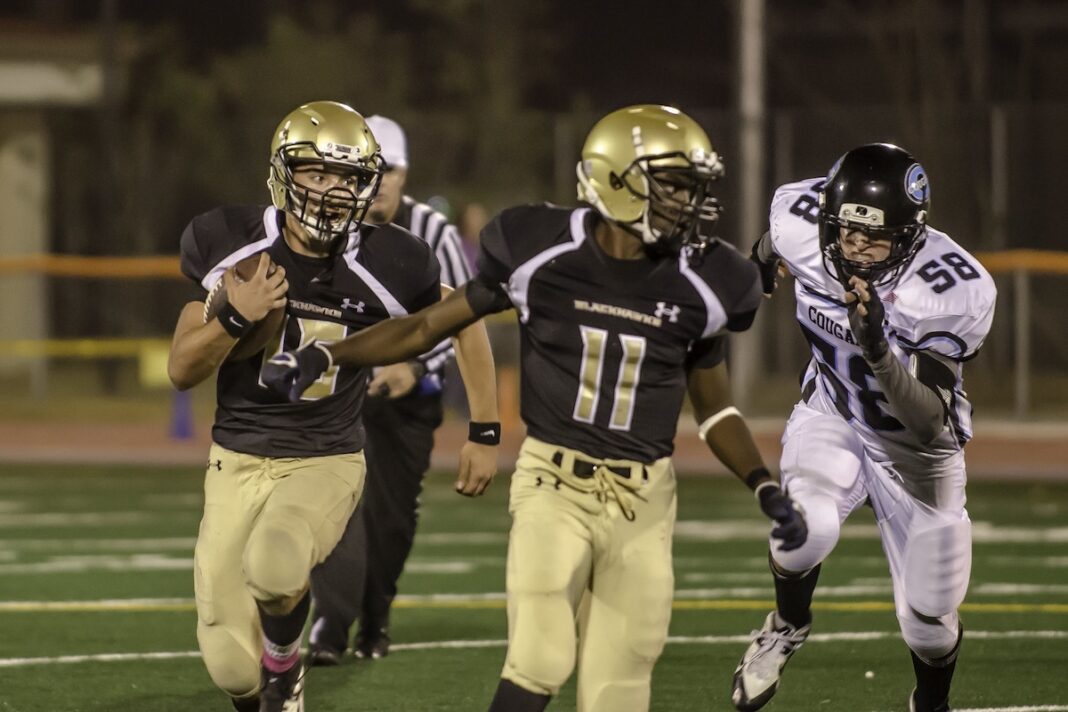
A new study reveals an alarming rate of CTE, or Chronic Traumatic Encephalopathy, among professional football players. One in four of the 900 NFL athletes examined in the study who died from 2016 to 2021 had CTE, according to the findings. The degenerative brain disease is caused by repeated blows to the head and is linked to worsening mental health and motor function, as well as dementia. The report adds to the ongoing debate over the risks associated with America’s most popular sport, especially among younger players. Still, writes ACoM contributor Sophie Martin, many say they plan to keep playing.
Billy, an 11th grader at Belmont Hill School in Belmont, Massachusetts, has played football since he was 12 years old and says he’s never “had any really serious concussions.”
But, he adds, head injuries are a normal part of his surroundings.
“I definitely know one of my good friends isn’t allowed to play contact sports anymore because of how many concussions he’s had from football specifically. It’s super sad,” said Billy.
A new study published in the medical journal The BMJ finds that “at minimum, nearly a quarter of all former NFL players who died during 2016-21 had CTE neuropathology at death.” The authors — who examined the brains of 338 deceased athletes — warn the rates could be as high as 93% if the trends they detected hold constant across all players.
For young athletes like Billy, the findings underscore the risks associated with a sport that is surging in popularity across the US and globally.
“Those numbers don’t shock me at all,” says Billy after learning about the findings. “Football is a super physical sport; on every play you’re getting hit, or the other player’s getting hit in the head. So even if you don’t have a full-on concussion, those minor head injuries stack up.”
Still, he adds, he “would never consider giving it up” even knowing the sport’s inherent risks. “I think the experiences and the fun you have with the sport outweigh the risk, honestly.”
Sam is an 11th grader at The College Preparatory School in Oakland, California. Like Billy, he’s familiar with the risks of head injuries as an aspiring kickboxer and prospective football player. And while he admits he was surprised at the high level of risk cited in the study, he’s also not ready to turn his back on the sport.
“Going into football, I don’t think [there is] anyone [who] doesn’t know that concussions are a risk,” he says. “But I also think everyone assumes it’s not going to happen to them.”
Sam’s mom, however, is worried. “[She] saw a CTE post on Facebook, and that’s why she never let me play football when I was young.”
Those same dynamics appear to be playing out across the country as parents grapple with mounting evidence showing the lasting harms caused by participating in football — especially for those starting from a young age — versus, as one mother in Texas told the New York Times, fears of social isolation if they forbid their kid’s participation.
That dilemma is pronounced in communities where football takes on outsize importance. Think Texas, parts of the deep South or the Midwest. But even in places like Marin County, California students say they’re having to wrestle with their desire to play the sport and their parents’ concerns.
“Freshman year I didn’t play because [my parents] were worried about the head injuries,” said Pontus, a high school junior who plays football for a Marin County high school. “They’re definitely cautious about it.”
Pontus’s high school team has invested in new resources for head protection. “We just got the guardian caps this year… right now they’re not mandatory for games, but there might be a chance that if people knew more about those statistics, they’d make them mandatory,” he said.
The caps, which add a layer of protection over the traditional hard-shell football helmet, are allowed but not required by the National Federation of State High School Associations, which writes the rules for most high school sports nationwide. In most states the decision is left to individual school districts.
Pontus acknowledges the study would probably alarm his parents, who he says would “be more concerned about it and want to talk to me.” But he, too, says football is too special to him to quit.
“As a junior, it feels special, too, being more of a role model to some of the younger guys and learning with them and working hard. I think that’s what really makes it worth it for me,” he noted.
That determination to continue the sport despite the risks is echoed across all the young people interviewed for this story.
Tanner is a 9th grade cornerback from Glencoe, Illinois who hopes to eventually play in college.
“I love football, so I’m not going to quit,” Tanner said. “Football builds something in you. I don’t know how to explain it, but in 7th grade, something changed inside me from playing a real contact sport, and that was one of the best feelings I’ve ever had.”
He acknowledged the very real possibility of brain injury and what it could mean for his future. “But I don’t really think about it in the game — I just play.”
Sophie Martin attends The College Preparatory School in Oakland, California. (Class of 2028). A section editor of her school newspaper, she loves writing and aspires to become a journalist.
Feature image published via CC License 2.0