


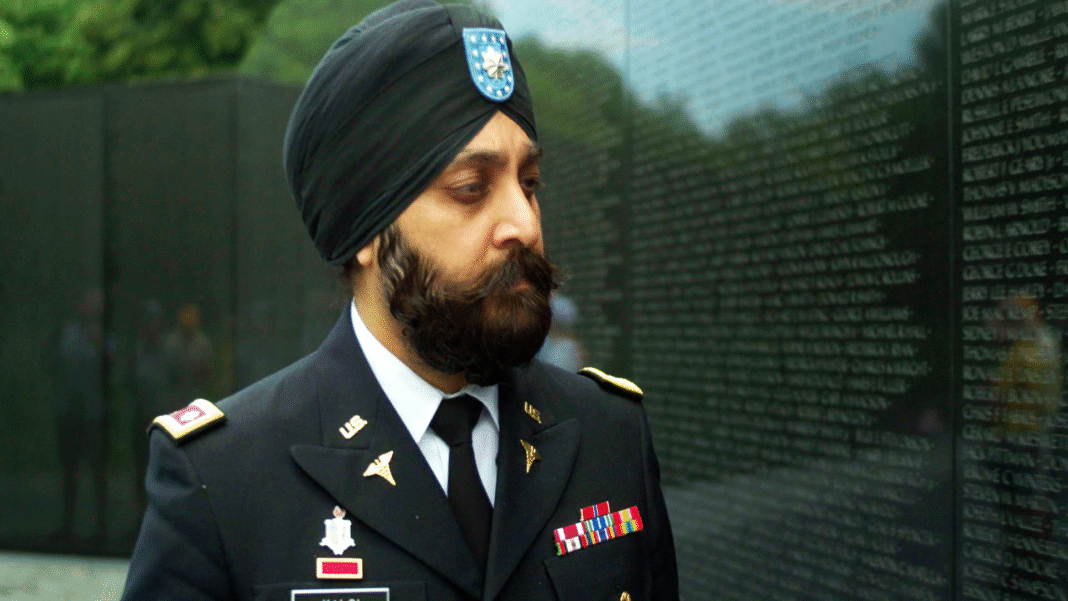
Beards, turbans, yarmulke, and hijabs may no longer be acceptable in the US Military, according to a new policy memo, which rolls back several decades of religious and medical accommodations.
Facial hair waivers will generally not be given, noted the Defense Department in its Sept. 30 memo. Those who do receive them will serve in non-deployable roles, it clarified.
“Uniform grooming standards are not about appearance: they are about survivability, interoperability, and mission execution. Consistent enforcement ensures personnel can operate protective equipment, meet deployment requirements, and support combat and emergency operations,” noted the Defense Department.
Sikhs
That policy impacts hundreds of Sikh American servicemen who have fought since 2008 to serve in the US military with their articles of faith. This includes uncut hair which must at all times be covered by a turban.
The policy memo was unclear as to whether head coverings — which are also currently allowed via religious accommodation — would be banned. But Defense Secretary Pete Hegseth has stated he wants a more “professionally groomed” military force, suggesting head coverings would also no longer be acceptable.
At press time Oct. 4, the Defense Department had not responded to an ACoM request for clarification on whether the policy would be applied retroactively and if it would also ban turbans.
Short-Sighted Policy
Lt. Colonel Dr. Kamal Kalsi, who has spent 2 1/12 decades in the US Army with his turban and beard intact, says the new policy is shortsighted. Kalsi was awarded a Bronze Star for his work as an emergency physician on the front lines in the Helmand Province, Afghanistan, one of the deadliest regions in the country. In an Oct. 4 interview with American Community Media, Kalsi noted that his turban and beard have never impacted his ability to serve the US.

“We have at least a few hundred Sikhs across multiple branches of the military, men and women. But we have tens of thousands of Jewish and Muslim soldiers that also rely on these religious accommodations,” said Kalsi.
“More than that, though, it’s our African-American brothers that will really be affected by this beard ban,” said Kalsi. Many Black men have a skin condition known as Pseudophiliculitis barbae, which causes an itchy skin irritation and pus-filled bumps. Over 60% of military medical accommodations are currently given to Black men with Pseudophiliculitis barbae.
Manpower Shortage
Black men currently make up more than 25% of the military force. “In these times when the military is struggling to meet their manpower mandate, meaning they just don’t have enough people to fill all the slots, you’re going to push good people away, people that are willing to fight and die and serve their country just because just because you can’t give them a beard accommodation,” said Kalsi. “I think that that’s sort of short-sighted.”
Religious and medical accommodations for facial hair are currently allocated on a case by case basis, with a strict review process.
Religious Freedom
When Kalsi first joined the US Army in 2001, he was not questioned about his turban and beard as he prepared to become a physician. But when he went on to active duty, there was concern about his ability to fit a helmet over his turban and to get a tight seal on a gas mask because of his beard.
With the help of the Sikh Coalition, Kalsi fought and received bipartisan support. “The Republicans seemed to be more concerned about religious freedom and our democratic politicians were more concerned about diversity, equity, inclusion.” In 2010, he was the first Sikh service member to receive religious accommodation. Since then, numerous others have also been granted religious accommodation to serve with their articles of faith intact.
Adhering to Standards
The policy memo was released Sept. 30, on the heels of Hegseth’s speech to joint chiefs, generals, admirals, commanders, officers at Quantico, Virginia. “This administration has done a great deal from day one to remove the social justice, politically correct, and toxic ideological garbage that had infected our department, to rip out the politics.”
“No more identity months, DEI offices, dudes in dresses. No more climate change worship. No more division, distraction or gender delusions. No more debris,” stated the Defense Secretary, as his audience looked on stoically.
“No more beards, long hair, superficial individual expression. We’re going to cut our hair, shave our beards, and adhere to standards,” said Hegseth, who has rebranded his agency as the “Department of War.”
In 2024, the British Army lifted its century-old ban on beards in the military, and also allowed turbans. Even before the ban was lifted, turbans were allowed for Sikhs, Muslims, and Rastafarians.
Canada has allowed turbans in the military since 1986. Thousands of Sikh soldiers have served in World Wars 1 and 2, with turbans and beards.
“This beard ban will do nothing more other than to undermine our operational effectiveness. It’s going to reduce the number of troops that are available to fight. And ultimately it’s gonna make us weaker as a nation. It’s going to put us at risk,” said Kalsi.
Kalsi is the founder of the Sikh American Veteran’s Alliance. He also served on the White House Asian American, Native Hawaiian and Pacific Islanders Commission in the Biden Administration.