


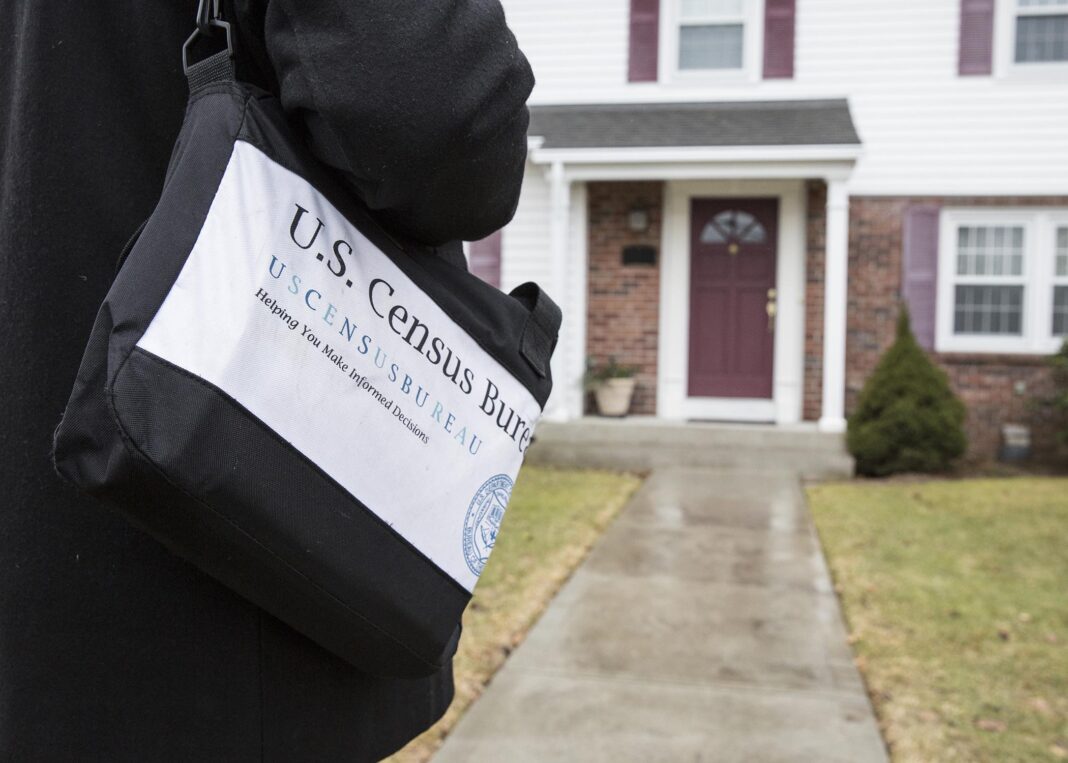

A Trump administration proposal to overhaul the 2030 census would exclude undocumented immigrants, eliminate race, ethnicity and sexual orientation questions and overhaul residency proof used to allocate congressional seats and federal funding.
The Department of Commerce published the federal notice of proposed rulemaking for the decennial census Sept. 10, with a 33-day public comment period ending Oct. 13.
The move drew criticism from civil rights advocates who argue the proposed rule bypasses the oversight typically accompanying methodological adjustments, instead seeking to change who is counted, how residency is defined and what data the government can collect — with direct impacts on congressional apportionment and distribution of federal funding.
In early 2025, a Trump executive order disbanded the three Census Bureau advisory committees that had vetted such changes, including one committee dedicated to race and ethnicity data.
“To be clear, from our perspective, this rule is unconstitutional,” said John Yang, president and executive director of Asian Americans Advancing Justice (AAJC), at a Sept. 18 briefing held by The Leadership Conference on Civil and Human Rights and Census Counts.
“It’s contrary to existing federal legislation and would have dangerous ramifications for how we understand America and how power and resources are allocated. It’s not an understatement to say that this is contrary to two centuries of census practice in the United States,” he continued.
Who gets counted?
The rule would limit the decennial census count to citizens and green card holders, excluding undocumented immigrants and potentially other categories of legally present immigrants.
Yang argued this provision would contradict the Constitution’s requirement that the census count the “whole number of persons” in each state for congressional apportionment — a standard the Supreme Court has repeatedly declined to limit to citizens alone.
While the rule does not specify how the exclusion would be implemented, Yang highlighted the first Trump administration’s Supreme Court-blocked attempt to add a mandatory citizenship question to the 2020 census as a potential model.
Although no such question appeared, so many U.S. residents feared filling out the census form, likely due to deportation fears, that it led to the largest Latino undercount rate in history: 4.99%, or roughly one in 20 missed — more than three times the 2010 undercount rate.
An estimated 14 million undocumented immigrants lived in the U.S. as of 2023 — part of an estimated total of 26 million people living in mixed-status households, representing 5.6% of households nationwide.
The risk of “an overall immigration status question” now, Yang said, means that not just undocumented immigrants but also residents in mixed-status households — “households that have citizens, permanent residents, some undocumented residents” — would likely undercount themselves.
How is residency defined?
Proposed changes to how residency is defined would compound these barriers to an accurate count, said Jeanine Abrams McLean, president of Fair Count.
The rule would replace the decades-long standard of counting once where a person “lives and sleeps most of the time” with a three-part method, she said, using a 90-day enumeration period, from Jan. 3 through April 1, rather than the legally mandated April 1 census date.
The “three-month lookback picks January 3rd as the start date not because of how people actually live, but because it lines up with the congressional calendar,” McLean continued.
A person would count as having spent a day present somewhere if they physically spent as little as one hour there, as they were “lawfully present” — “a phrase that has not appeared in any census” before, she added.
The rule also relies heavily on tax records, such as 1040 returns and W-2 forms, despite research showing they are unreliable indicators of where people actually live.
Census data reveals that 45% of young adults aged 18 to 24 don’t live with their parents, making them far more difficult than any other age group for surveys and mailings to reach.
Another Census report shows that agreement between census respondents’ reported moves and their IRS records was just 57.5% among household residents aged 20 to 24, compared with 90% among those 70 and older and 90.1% among all homeowners.
This disparity owes partly to the fact that many low-income individuals and non-filers are not required to submit a federal return, and partly because “tax returns only require a mailing address, not a physical residence,” explained McLean — a mismatch especially pressing for military families, whose W-2s typically list a duty station rather than the home where they “live, sleep, shop and send their kids to school.”
“Changing the very definition of ‘usual residence’ breaks the comparability that makes the census valuable in the first place,” she said.
What data is excluded?
The third part of the rule would prohibit all questions about race, ethnicity or sexual orientation from census questionnaires — a first since the government began the decennial count in 1790 — and end the requirement that respondents answer demographic questions at all.
“This would be a violation of federal law, which requires the public to answer the census,” said Arturo Vargas, senior advisor to the NALEO Educational Fund.
The change would reverse a process of data stratification that took the Office of Management and Budget and the Census Bureau decades to build, including a 2024 update to federal race and ethnicity standards adding a new “Middle Eastern or North African” category.
“Removing race and ethnicity questions entirely has never been tested and has no precedent,” Vargas said, noting that his organization and others have already requested the public comment period be extended to 90 days.
“The decennial census is the denominator of data for virtually all measures” of disparity in American life, from maternal mortality, infant mortality, disaster response, disease prevalence and vaccination coverage, he continued.
He cited the COVID-19 pandemic as one example: Census race and ethnicity data showed Latinos were contracting the virus at disproportionately high rates, and public health agencies used this data to direct vaccine rollout to communities that needed it most.
“Inaccurate data will be relied on by policymakers to make decisions about where to deploy resources and services and how to allocate federal funds across the board,” Vargas added, encouraging the public to review the proposed census changes and submit comments. “Everybody suffers when there is inaccurate data.”
RELATED
The Staying Power of Native Identity

SELEN OZTURK
ACoM editor and research director Selen Ozturk was born in Istanbul and raised in the Bay Area. She holds a philosophy degree from UC Berkeley. Her work has been published in the San Francisco Chronicle, SFGATE, Bay City News, PopMatters, and Senses of Cinema, among many other outlets.