


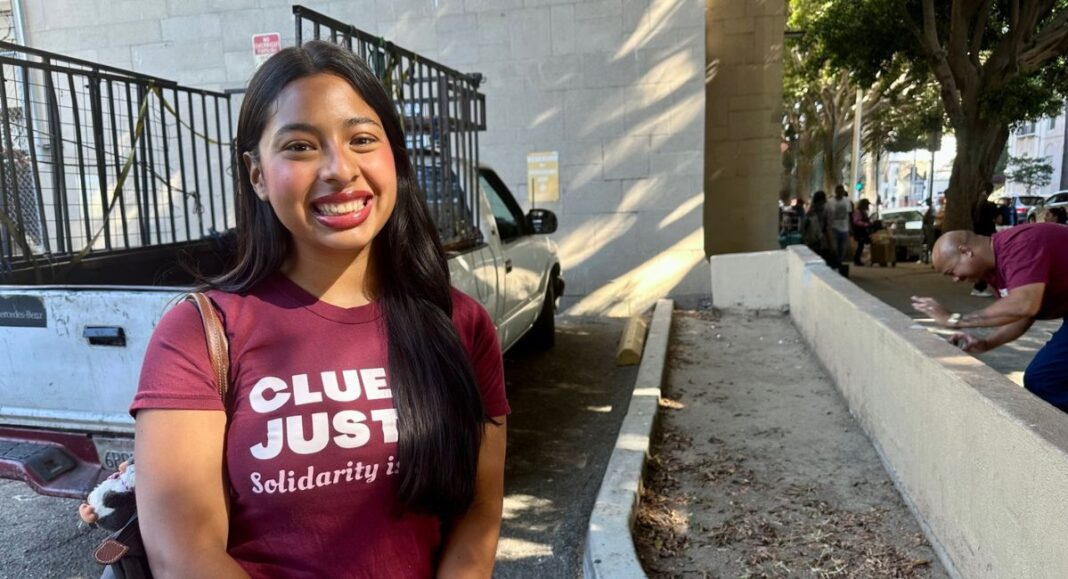
Above: Genesis Méndez is a volunteer with CLUE Justice, which delivers food to immigrant families in Los Angeles who are afraid to leave for fear of being detained by ICE. (Credit: Araceli Martínez)
LOS ANGELES — For years, Génesis Méndez worked two jobs while studying biology at Biola University, a Christian school near Orange County. Once she’d reached her goal of buying a new car, she quickly put the new ride to use.
These days, Méndez does food deliveries to families too afraid to leave their homes amid ongoing Immigration and Customs Enforcement (ICE) raids.
“I started delivering food about two months ago. It’s been really beautiful to help people,” said Méndez.
Families were suspicious at first, she explained, but have gotten to know Méndez and now await her visits with anticipation.
“In one of the homes that I deliver to, there’s always a little girl who comes out to greet me,” said Méndez. “She always thanks me enthusiastically. It’s a blessing.”
Méndez is part of the group CLUE Justice, whose volunteer members use their own vehicles to deliver food twice a week to immigrant families and asylum seekers in Los Angeles. The acronym stands for Clergy and Laity United for Economic Justice.
For many families, the deliveries have become a lifeline.
“I would say I bring food to about five or six families twice a week. I like it because the food is fresh and it helps keep families healthy,” Méndez explained.
Every week a long food line typically forms outside a church in LA’s Koreatown as people come to pick up donations. Many in line are often immigrants and refugees. Their numbers have recently fallen.

“Before Trump, we would distribute food to between 500 and 800 families on Wednesdays and Thursdays, but after the ICE raids began people stopped coming,” noted Sithy Bin, an organizer with CLUE Justice. “There’s been a dramatic decline. Barely 200 people came, and we have a lot of food left over.”
Bin, a Cambodian refugee who himself faced the threat of ICE deportation earlier this year before being pardoned by California Governor Gavin Newsom, also serves as a minister and youth counselor. He said many families that once came regularly to pick up food donations are now afraid of being detained and are therefore staying off the street.

“Many of these people have family members that have been detained by ICE,” said Bin.
CLUE Justice began deliveries after receiving calls from residents asking if there was any way to bring food directly to their homes because, as Bin explains, they are too afraid to come out.
“’We need food. My dad was detained and deported,’ they would say,” said Bin. “Hearing this broke my heart. So, we began calling members of the faith community, neighbors, to see if we could bring a group of volunteers together to pack and deliver food to these families.”
That was when CLUE was born. The group is composed of people from multiple denominations.
“We brought around 20 volunteers together to distribute bags of food to homes, but because of the fear in these families, some of them did not want the food brought directly but asked to meet in areas where they felt it was safe to come out,” said Bin.
Deliveries typically include fresh vegetables, fruits, eggs, rice, milk and other staples. All the food comes via donations through the Los Angeles Regional Food Bank.
Bethany Fox is a Presbyterian pastor and has been a volunteer with CLUE for two weeks. “With everything that has happened, it is very easy to feel overwhelmed and a little impotent. But I committed myself to doing small things to try and help those who are having a hard time.”

Fox spends a few hours each Thursday, her day off, delivering food to families. “I believe they are grateful. Neighbors come out to pick up food from boxes I bring to a common area, like a community center. It’s very organized, with neighbors letting others know when it’s safe to come out.”
More than 4,000 people have been detained in raids across Southern California since enforcement operations began earlier this year, according to Department of Homeland Security data. A SCOTUS ruling this past week lifting restrictions on ICE from targeting individuals by race and ethnicity is certain to only fuel fear and anxiety.
Comments asking whether there are safe places to pick up donations are increasingly common on Spanish language social media platforms.
“We live in such a rich place, with so much food. The problem is not that there isn’t enough,” said Fox. “This is one small way we can ensure those who are going hungry can get food.”
Many households, meanwhile, have seen incomes reduced or disappear altogether as family members stop going to work for fear of being caught in a raid.
Vanessa (not her real name), a mother of five, says she learned about CLUE through an Instagram post from a friend who lost her job after her employer told her they were worried about being targeted by ICE.

“It has been a blessing and a huge help financially. Every piece of food they bring us helps, whether its meat, peanut butter, cereal, prepared meals, vegetables and fruits,” said Vanessa.
She added that things would be much worse without these deliveries.
“Finding a program that offers food deliveries to your home is an opportunity. Our lives would be much more difficult without this, especially with the newborn,” said Vanessa. “We would probably have to find other resources and that would expose us.”
Vanessa is also looking for help finding other groups that provide things like diapers, hygiene products and laundry detergent.
Bin says that as a person of faith, feeding those who are hungry isn’t just important, it is essential.
“The Scriptures call us to this,” he said, quoting Matthew. “Because I was hungry, and you gave me food. I was thirsty, and you gave me drink. I was a stranger, and you recognized me.”
CLUE was born out of compassion and need, says Bin. “No family should have to choose between feeding their kids and keeping them safe.”
Araceli Martinez is a reporter with Spanish language newspaper La Opinión in Los Angeles.