


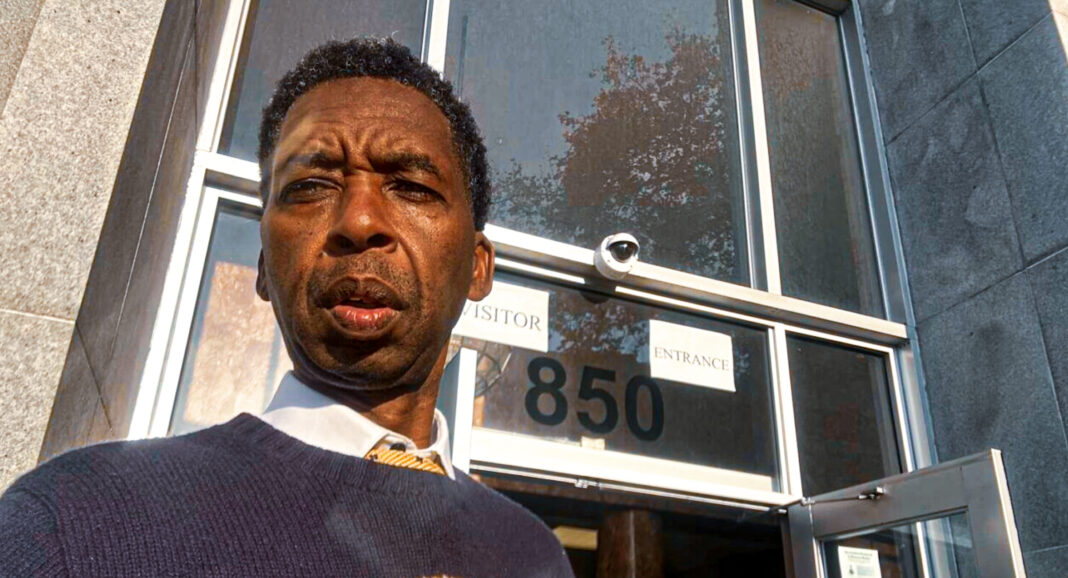
During his 2025 murder trial, San Francisco filmmaker and activist Kevin Epps wore blazers, dress slacks and shoes, and the occasional vintage sweater. After his conviction for voluntary manslaughter and sentencing, he now wears the orange tunic, pants and slippers of a prison inmate.
In an interview from San Francisco County jail, Epps discussed how he’s been adjusting to being locked up, what his next steps are, and what gives him hope and optimism for the future.
Needless to say that being incarcerated takes a toll on Epps’ spiritual, mental and physical health. On the morning of the day of this interview, trustees conducted a sweep of the pod unit where he and other prisoners are being held, after discovering fentanyl and methamphetamine had been smuggled into the jail. Drug tests were administered, and multiple people were hauled off to administrative segregation in another facility in San Bruno, about 20 miles south, to be placed on 24-hour lockdown. “They had the dogs in here sniffing, so it was kind of traumatizing.”
Epps, 57, realizes things could be worse. He initially faced up to 50 years-to-life in the 2016 fatal shooting of Marcus Polk, which he adamantly claims happened in self-defense. He was ultimately sentenced to six years after being acquitted of first-degree murder charges.
Some of his current cellmates, while younger than him, carry sentences of life without the possibility of parole. “Looking at this range of all these different issues and things that people are subjected to, it gives me hope to know that I’m going to be coming home one day in the near future.”
His three children, “who need their dad,” keep him grounded and focused. “I have to be there for them. I have to be strong no matter how challenging it is.
“I do cry, don’t get it wrong because this is, it’s emotional, man.”
Despite the reality of his surroundings, he says,“I’m holding up pretty good, considering the support that I have, which makes a tremendous world of difference under these brutal, barbaric circumstances.”
Community support for Epps has been constant, from the moment he was first charged in 2016, to the reopening of the case – initially dismissed due to insufficient evidence – in 2019, all the way up to his 2025 trial and sentencing this past April. More than 600 people signed a petition to the presiding judge (Van Aken) to grant him bail. in 2019. During his trial, supporters, including African American faith leaders and actor Danny Glover, held numerous rallies and press conferences outside the courthouse.
This did not go unnoticed by Judge Brian Ferrall, who took the unusual step of writing a letter to the California Department of Corrections and Rehabilitation (CDCR), the state authority who will decide which prison Epps will serve out his sentence. In the letter, Ferrall says, “the Court is of the view that the defendant’s circumstances are unique.”
The judge goes on to note that Epps stayed out of trouble during the ten years he remained out of custody, a time when he “worked extensively with community groups and religious institutions for the public good.”
These efforts, along with more than 50 letters of support received during the trial, “have left this Court with the distinct impression that Mr. Epps will be a productive member of society when he is released from prison.”
Epps says he could be transferred to another facility within a few weeks. He hopes to be assigned to the San Quentin Rehabilitation Center – close enough for his elderly mother, children and friends to visit regularly. His other reason for wanting to be assigned there is the “myriad of programs” San Quentin offers – including podcasts and a newspaper.
The CDCR, he notes, has evolved over the years in its approach to rehabilitation. “They kind of took on a Swedish model” in which inmates can receive Milestone credits for completing programs, and receive time off their sentence.
“I’ve been really immersing myself in everything I can do while I’m here to get me back to my family, to my kids and back to my work with the community, editing SF Bay View [Newspaper], filmmaking, all the things that I was doing before this happened.”
Shortly before his trial began, Epps received a prestigious Silver Award from the Bay Area Society of Professional Journalists for his efforts in revitalizing the SF Bay View. It’s one of his proudest accomplishments, and one that entailed manifesting a comprehensive, forward-thinking vision for a legacy Black publication,
SF Bay View, which celebrates its 50th anniversary this year, has faced numerous financial and internal challenges in recent years. With Epps incarcerated, questions about its leadership and direction have surfaced.
“I hope the work continues because the Bay View at 50 is at the crossroads” amidst what he calls a changing media landscape.
“I think it’s just such an important institution that I [first] worked for when I was 10, 11 years old.”
Becoming Executive Editor in 2023 was a “full circle” moment for Epps. In that role, he developed an internship program with SF State University and Community College of San Francisco, and built relationships with philanthropic foundations and African American media advocates California Black Media.
A point of emphasis, he says, was “trying to really lean into what the community said, what they wanted, and just expanding the paper to include more voices.”
What he heard from residents and business owners was, “where’s the positive, optimistic stories about the Black community?”
Epps hopes to continue writing from behind bars, and feels he is in a position to be a mentor to younger inmates. “Once I get to where I get to, we get Zooms and tablets now, [prisons are] kind of changing where I will have possibly access to the outside on a regular basis.”
Epps’ resilience reflects a level of maturity that comes not just from life experience, but also inner self-reflection. He maintains he acted to protect himself and his family, yet has feelings of remorse for the death of Polk, the estranged husband of his ex-partner’s sister. “A life was lost, no matter how it played out. …I think about that every day of my life.
“As a Black man, a father, an activist, I care about my people and my community. So for me to have to stand on something so traumatizing, it’s been a challenge.”
*Note: An earlier version incorrectly stated that 600 letters had been sent to the presiding judge in Epps’ trial. More than 600 people signed a petition seeking his release.