

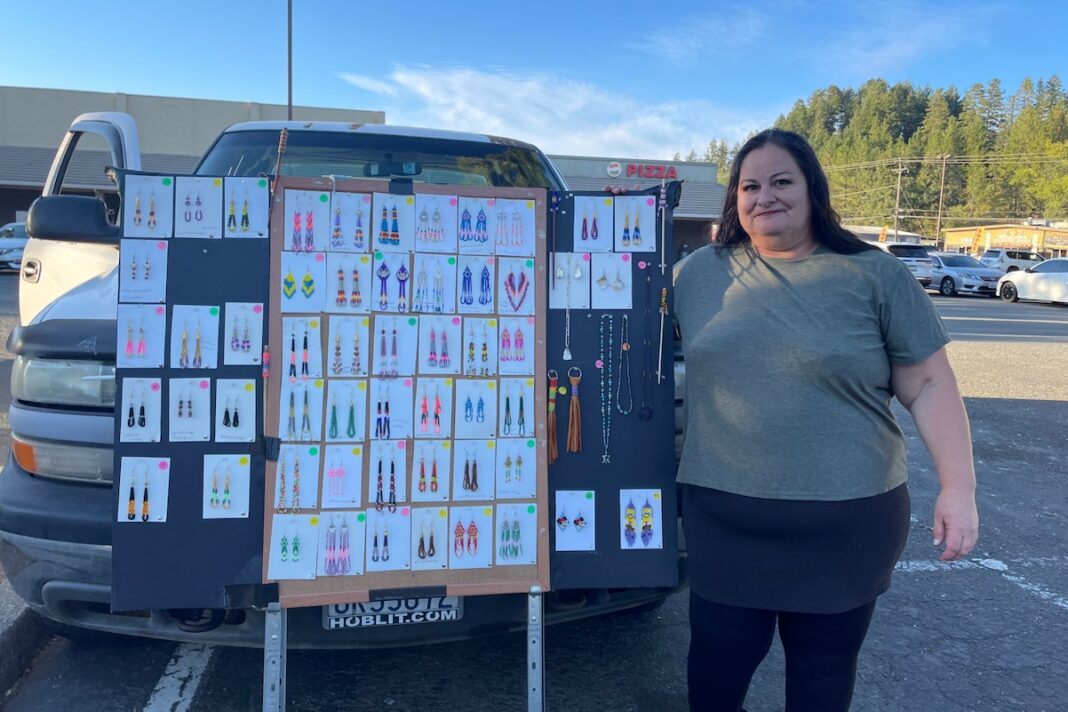

WILLITS, Calif. – Alishaw Enike Brice started beading with her mother when she was ten-years old. A mother of five grown children and grandmother of ten, Brice now sells her beaded jewelry at swap meets and tribal gatherings up and down the state.
For Brice, it’s a means to a living while also celebrating her Native identity, an identity her own tribe doesn’t acknowledge and one the federal government is proposing to erase altogether.
“It’s a legal hustle,” Brice says of her business. We meet outside a Grocery Outlet Parking Lot in Willits, a small town about 140 miles north of San Francisco in Mendocino County. Beside her is a makeshift storefront assembled out of cardboard emblazoned with the words ‘Native Made Jewelry’.
Brice previously set up shop under the freeway overpass and outside a local liquor store with the permission of the owner but was later chased off by law enforcement. “We’ve been harassed by the sheriff, shut down by the permit regulator for selling on Main Street even though we had permission from the owner to be there,” she explained, her voice tinged with frustration.
A descendant of the Coastal Band of the Chumash — whose roots span San Luis Obispo, Santa Barbara and Ventura counties — Brice is nevertheless unable to officially prove her membership in the tribe, one of more than 400 across the country that are not recognized by the federal government.
California is home to the largest Native population in the United States, numbering some 760,000 and largely concentrated in and around Los Angeles, according to census data. Like Brice, many lack official tribal membership, whether because they belong to a non-federally recognized tribe, such as the Coastal Band of the Chumash, or because of ongoing disenrollment by tribes themselves.
In Brice’s case, the issue dates back to her maternal grandfather.
Brice pulls out her phone, chock full of photos of her children, grandchildren, her mother and her late grandfather, Semu Huaute, an actor and member of the Ventura Actors Guild in the early 1900s.
According to Brice, Huaute passed on everything Native to his children and grandkids, from ceremonies and traditions to ways of coexisting with nature, everything except a tribal enrollment number.
“My grandfather was a rebel, so he didn’t want an enrollment number,” Brice explains, a not uncommon response at the time from Native Americans who bristled at what they saw as yet one more attempt at control of Native communities by the federal government.
That decision, understandable as it was, nevertheless carries with it implications for Brice and her own family today.
While the Coastal Band of the Chumash are not federally recognized — meaning members cannot access benefits afforded to tribes that do carry that designation, from housing to health care, education and financial assistance — it is recognized at the state level.
Membership brings with it benefits including access to cultural and traditional activities, as well as reduced in-state tuition, local health care access and child care support, none of which are available to Brice.
Jose Arceniaga is the program director of the Office of Child Care at the Inter-Tribal Council of California. He says enrolling families is easy if they have their proof of tribal affiliation, such as an enrollment number, along with proof of employment and school.
In Brice’s case, “I hate to hear stories like this,” says Arceniaga. “We get two or three calls like this each month. For our grant regulations, we unfortunately have to turn them down.” He adds, “It’s a struggle.”
Arceniaga says that Native Americans have always navigated conflicting pressures — in some cases that meant concealing tribal affiliation to preserve their lives and livelihoods and now being asked to prove that same affiliation for access to services.
“There was the saying, ‘Erase the Indian, save the man,’” continues Arceniaga. “It was a cultural genocide … There has to be a way to update the system.”
Instead, the Trump administration is proposing to eliminate any and all questions about race and ethnicity from the upcoming 2030 Census, data that has been included in the decennial count since it was first conducted in 1790.
In announcing the measure, the administration described what it sees as the “reduced need for or usefulness of this information.”
Critics, including A-dae Romero-Briones, see it differently.
“Long ago, we had treaties that said in exchange for land, certain services would be offered,” said Romero-Briones with the California Tribe Fund and Native Agriculture and Food Systems Investments. “When census [data] clouds the definitions of both tribal sovereigns, indigenous communities, tribal versus rural — it’s all part of a way to minimize the federal responsibility of the federal government to tribal governments.”
Native Americans have been among if not the most undercounted demographic groups in the country, including in the 2020 U.S. Census and the 2010 Census, with ramifications that extend from federal funding to political representation.
It is in essence another form of erasure, says Romero-Briones, who recalled recent efforts to increase the numbers of Native and Indigenous data collectors.
“They got more accurate data that way,” she acknowledged, “but the system is still imperfect. In order to collect data, there has to be a cycle of evaluation that has stopped with the Trump administration.”
Arceniaga echoes that same frustration. “It goes against all the treaties we signed,” he says. “We need a voice.”
As for Brice, she’s working to put the pieces of her life back together after years of struggle that include enduring periods of domestic abuse, drug and alcohol addiction, and incarceration. She says she tried to get a permit to sell her crafts. The permit itself cost $80 but she was also required to pay an $800 upfront fee for taxes.
“I didn’t have that kind of money,” she says, adding, “They’re making it very hard for the underdog.”
In the meantime, she’s leaning on the Mending Basket Resource Center, which supports Native Americans and their families in Willits with classes on topics ranging from navigating healthy relationships to sharpening a resume to supporting mental health and wellness. She’s also pursuing a degree in social work.
“I grew up around Native American intertribal culture and song and dance ceremony,” Brice says with a smile. “Now I’m teaching my six-year-old granddaughter to do bead work and handing down the tradition of ceremonies to my kids and grandkids.”
Sharon Sobota recently joined American Community Media where she helps manage a new Native/Indigenous Voices initiative. She is as an editing fellow with the UC Berkeley California Local News Fellowship.