


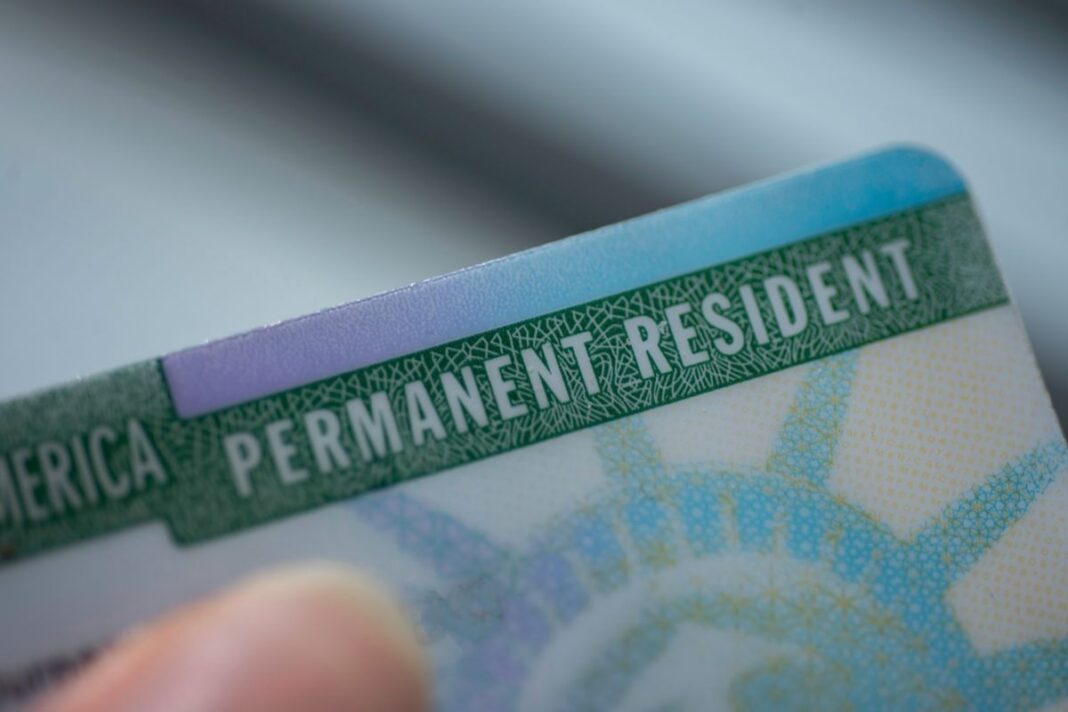

In October, a Korean woman was arrested by federal immigration agents at Los Angeles International Airport while boarding a flight to Texas. The woman, who had a pending green card application, was with her husband, a U.S. citizen at the time of her arrest.
For Koreans, the incident points to the fact that steps once thought to shield them from deportation no longer do so under President Trump’s immigration crackdown.
According to ICE, the woman, identified by her last name, Lee, entered the United States in 2021 under the Visa Waiver Program, which allows South Korean citizens to enter and stay in the US for up to 90 days visa free.
Lee remained in the county beyond the authorized period. In August of this year she married her U.S. citizen spouse and subsequently applied for permanent residency.
Following her arrest, Lee was detained at the Adelanto ICE Processing Center. On November 5, a federal judge temporarily halted her deportation proceedings and ordered her release. She is now awaiting further court proceedings.
Attorney Ji-il Kang, who represents Lee, said the judge granted her release after accepting arguments that proper legal procedures had not been followed during her arrest and detention.
A similar incident occurred on July 21 at New York’s John F. Kennedy International Airport, where a Korean man in his 20s, identified by his surname Park, was taken into ICE custody while attempting to board a domestic flight to Florida.
Park entered the United States under the Visa Waiver Program in March 2024 and married a U.S. citizen two months later. He filed a Petition for Alien Relative (Form I-130) in September 2024.
By June 2026, he had submitted his application to Register Permanent Residence or Adjust Status (Form I-485) and completed fingerprinting, leaving only his final immigration interview, according to reports.
ICE, however, determined that Park had violated the terms of the Visa Waiver Program by remaining in the country beyond the authorized 90-day period. The agency initiated administrative removal proceedings and issued a final removal order on the day of his arrest.
Following Park’s detention, 16 Korean American organizations, including the MinKwon Center for Community Action and the National Korean American Service & Education Consortium (NAKASEC), submitted a petition to the court calling for his release.
U.S. Representatives Jerry Nadler, whose Manhattan district includes Park’s residence, and Grace Meng also joined efforts to support him. His release status has not been confirmed.
NAKASEC, which has been assisting Park, criticized ICE’s actions, arguing that the agency unlawfully arrested an immigrant with no criminal record who had been following the established procedures to obtain permanent residency.
The two cases highlight the immigration enforcement risks that can remain even when foreign nationals qualify to apply for green cards through marriage to U.S. citizens.
Under current immigration law, certain immediate relatives of U.S. citizens, including spouses, may qualify to adjust their immigration status within the United States even after overstaying a visit under the Visa Waiver Program, provided they meet the applicable requirements. However, filing a green card application does not automatically grant lawful immigration status or protection from arrest and deportation.
Visa Waiver Program entrants also face additional restrictions that distinguish them from visa holders. Those who overstay their authorized visits may have limited opportunities to challenge removal before an immigration judge.
“Entering the United States under the Visa Waiver Program means that you are considered to have agreed that, if you overstay, you may be deported without the right to a removal hearing before an immigration judge,” Kang explained. “As a result, ICE can order deportation through an administrative process without going through regular immigration court proceedings.”
Meanwhile, ICE enforcement operations at airports across the country have reportedly intensified.
Stateline, an online news outlet, reported, citing a Department of Homeland Security official, that ICE has recently been making an average of 20 to 40 arrests per day at U.S. airports. The increase in airport enforcement has been linked to expanded passenger information sharing between the Transportation Safety Administration (TSA) and ICE.
Immigration attorneys are advising foreign nationals who have previously overstayed their authorized visits or have pending adjustment-of-status applications to carefully consider the risks before taking domestic flights.
“In the past, I used to tell clients that they could travel domestically as long as they had valid identification,” Kang said. “But now, I advise those who are in the process of adjusting their immigration status to avoid air travel whenever possible.”
The Asian Law Caucus has also advised noncitizens to consult an immigration attorney before traveling on domestic or international flights if they have pending immigration court cases, are applying for temporary visas, have previously received deportation orders or have criminal records.
This story was produced as part of “Aquí Estamos/Here We Stand,” a collaborative reporting project of American Community Media and community news outlets statewide.