


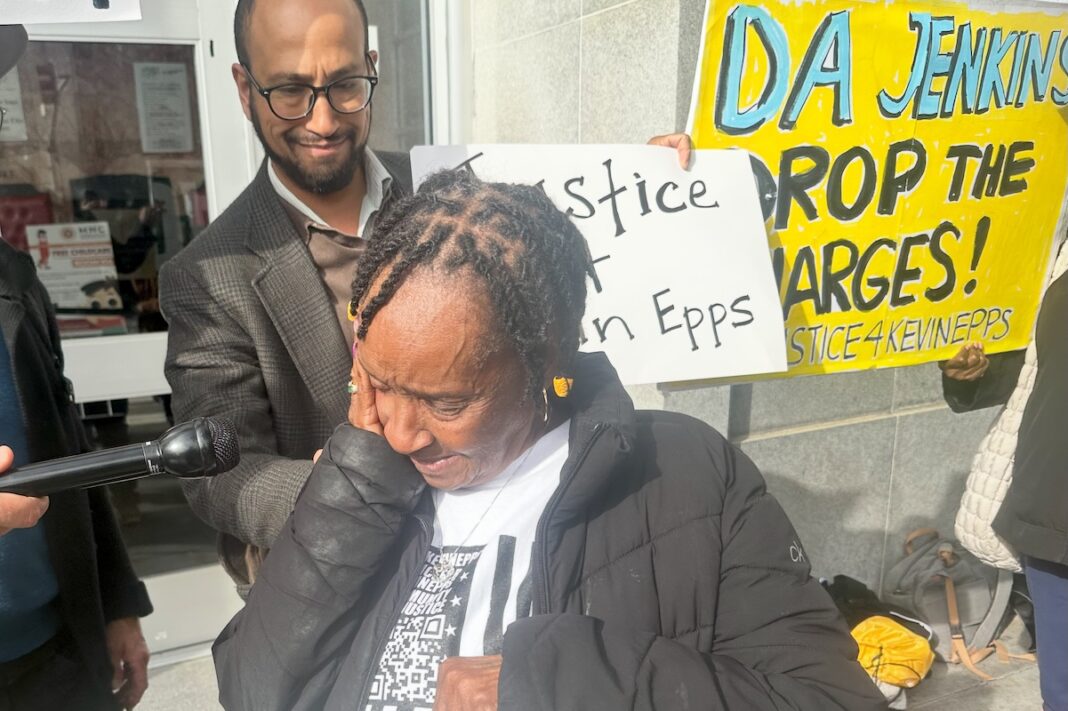
The defense in the Kevin Epps murder trial presented just one witness, Dr. Judy Melinek, an eminent forensic pathologist whose testimony appeared to supercede the expert witnesses who had testified for the prosecution earlier in the trial – including San Francisco Chief Medical Examiner Dr. Christopher Liverman.
Melinek, regarded as something of a celebrity in the field of forensic pathology – has specialized training in gunshot trajectory analysis and has testified in more than 300 trials. A Harvard graduate who went to medical school at UCLA, worked as a medical examiner in San Francisco and Alameda County, and authored two books, not to mention playing a cameo role on the television show “E.R,” Melinek is best known for her work in New York during the aftermath of 9/11, when she conducted hundreds of autopsies. She is currently an Associate Professor at UCSF, and runs her own forensic consulting firm.
Earlier in the trial, SFPD CSI Lt. Patrice Heath and Dr. Liverman had testified about the trajectory and approximate distance of the gunshots Epps, 57, fired that killed Marcus Polk, 49 at the time of the shooting. Their answers to the direct examination of prosecutor Jonathan Schmidt were often approximate or inconclusive, compared to Melinek’s, which were decisive and authoritative. At one point, she left the witness box to physically demonstrate the path of a bullet, using her body and a pen so the jury could more easily visualize what she was talking about.
Melinek confidently stated that an autopsy photo with a trajectory rod inserted to show the path of a bullet that struck Polk was incorrect, because the medical examiner did not account for the bullet’s deflection. “This path is not the path the bullet traveled — (the rod) isn’t following the point where it hit the rib.
“If this bullet had gone straight back to front, I would expect to see a round punched out hole. It’s hitting the hardest part of the rib and deflecting outward.” The trajectory, she said, “would not have been a straight line. The bullet got deflected inward through the torso.”

The implications of the deflection represent the difference between Polk being shot in the back, as the prosecution has contended, or from a more front-facing direction, as the defense has attempted to show. In Melinek’s opinion, the bullet “was going more left to right and then it got deflected to go back to front.” This assertion contradicts Liverman’s finding that the bullet traveled back to front, with no deflection.
Polk had two separate entry and exit wounds, which could have been from a single bullet or two. The forensic geometry, Melinek said, would mean that the bullet that stuck Polk in the arm could then have continued into his torso and chest cavity before exiting. This would mean his arm was outstretched, which would be consistent with Epps saying Marcus Polk came at him, as Melina Polk testified. If the arm was in a different position, it conceivably weakens the defense’s contention and strengthens the prosecution’s account.
During Schmidt’s cross-examination, Melinek repeatedly turned the tables on the veteran prosecutor by questioning his questions. “I can’t agree with that (question) the way you’re asking,” she said at one point. When Schmidt posed a hypothetical about various positions Polk’s arm could have been in, Melinek replied, “You can’t just do that. You’d run up to the limits of what the shoulder joint can do.”
Visibly flustered, Schmidt called for lunch break five minutes early.
When the cross-examination resumed, the exchange between the two remained contentious, as Schmidt attempted to undercut Melinek’s insistence the bullet had been “absolutely” deflected.
“I can’t answer the question the way you asked it,” she said when asked about the trajectory rod. After Schmidt quoted a “general rule” of deflected bullets from a forensic pathology reference text, she replied, “I completely disagree with that… the problem is the (phrase) general rule. I wouldn’t have phrased it that way because I’ve seen too many exceptions.”
Unable to impeach Melinek, the prosecutor indicated he had no further questions. The defense then rested its case.
Many questions remain, leaving Epps’ supporters to question whether Epps was receiving a fair trial. Most concerning was why Judge Brian Ferall ruled in pretrial motions in favor of the prosecution that much of Polk’s past history was inadmissible. This effectively kneecapped the intended defense.
Julian Davis, an attorney and 20-year friend of Epps, said he believes this trial signifies “a matter of public concern that touches on “…how self-defense laws are prosecuted and interpreted by our legal institutions.”

One key issue is whether the judge will allow Epps’ attorney to claim the “Stand Your Ground” defense, also known as the Castle Doctrine, in his closing argument. Davis questions whether “our self-defense laws, stand your ground, Castle Doctrine laws, et cetera, apply equally to somebody like Kevin as they would to any other more affluent or more privileged member of society.”
Davis said another issue has been Farrell’s limited experience in criminal court. “The prosecutor has been able to get away with far more than you would’ve (seen) with a more experienced judge in criminal matters,” he asserted.
Tobee Vanderwalk, a textile and performing artist and mother of three, who got involved with Epps’ defense around the time of his 2019 preliminary hearing, wonders why the case was reopened at all.
“My question still is, what happened in 2019 in the DA’s office?”
Wanderwalk finds the DA office’s commissioning of a digital animation by Jason Fries of 3-D Forensic inc. to be highly problematic. The animation, she explained, was “the way they hooked this whole case together” – but was ruled inadmissible in pretrial hearings.
In hindsight, she says, “if it was inadmissible (in 2025), I don’t think a judge should’ve signed a warrant in 2019 to arrest Kevin.”
Tabari Morris, a journalist for the SF Bayview newspaper (where Epps serves as editor-in-chief) and the news editor of the City College of San Francisco Guardian, is also a longtime friend of Epps. Excluding Marcus Polk’s past history and including “red herrings that don’t matter” like the marijuana found on the scene, add up to selective and unequal justice. “How this is even allowable is part of the bigger problem and the bigger issue, no matter who it applies to.”
The trial’s next phase, jury instruction, which will determine what jurors can and cannot consider, could well prove pivotal in a case that increasingly appears to have larger implications for how the criminal and court system treats Black defendants.
This story was produced in collaboration with California Black Media. It is part of ACoM’s ongoing coverage of the Kevin Epps trial.