


Roxsy Lin reported this three-part series while participating in the USC Annenberg Center for Health Journalism’s Domestic Violence Impact Reporting Fund. Read Pt. 1 here and Pt. 3 here.
This story contains references to suicide. Reader discretion is advised, as the content may be distressing for some individuals. We have changed the names of some sources in this story to protect their safety and privacy.
SANTA MARIA, Calif. – In 2002, Matilde, an 18-year-old Mixtec woman, arrived in Santa Maria, California, from Mexico, three months pregnant and with limited Spanish. Within days, she was planting chiles and pumpkins in the region’s agricultural fields.
By her fifth month of pregnancy, her employer sent her home, worried the physically demanding work — bending over for ten hours a day to pick produce, lifting heavy boxes and being exposed to pesticides used in the fields — could harm her or her baby.
The decision, meant to keep her safe, instead left her vulnerable at home. Rather than offering support, Matilde said her then 21-year-old husband, Ramon, responded with anger at the loss of income, pressuring her to find another job despite the risks to her pregnancy.
“He got really upset with me and told me I was overreacting, because a lot of the people in his town, his aunts and sisters-in-law, worked right up until they gave birth,” she said in Spanish. “He didn’t understand why I was so ‘delicate’ when I, too, came from a small town.”
Her experience is hardly unique. A 2011 survey of 100 farmworkers in San Diego found that as much as 16% of female farmworkers “reported partner violence perpetration, victimization, or both, in the past year.” Those numbers continue to remain alarmingly high across California.
Yet for members of the Mixtec community — who, together with other Indigenous groups from Southern Mexico, account for more than 6.5% of the overall population in Santa Barbara County — language and cultural barriers can often impede accessing needed services.
Matilde’s experience is a case in point.
Coercive control
Over time, Ramon became increasingly controlling. He took over the money Matilde earned working in the fields. When their first child was born, Matilde recalled having no clothes for the baby and relying on acquaintances who gave her secondhand clothing.
His behavior gradually expanded beyond finances. Matilde said he closely monitored her movements, rarely allowing her to leave the house alone and frequently checking her phone to see who she was talking to.
Sociologists and family law experts often refer to such behavior as “coercive control,” a form of domestic abuse that often goes unreported and, according to researchers, can lead to physical violence.
Even visits to her mother were cut short. As soon as Matilde arrived, her husband would call and demand that she return home. His constant insults and humiliation, meanwhile, left lasting emotional scars.
“That really affected me. His words were very hurtful,” she said. “He would even say those things to my children. When they didn’t do something right, he would call them stupid and tell them they were just like me.”
Seeking help
The abuse eventually became intolerable. Matilde found a job and moved away with her five children. Still, she was worried about her youngest daughter, who was 7 at that time.
“She didn’t want to live,” recounted Matilde, describing how the abuse at home affected her daughter. “Every time we talked, she would say she wanted to die because it was too hard for her to keep living.”
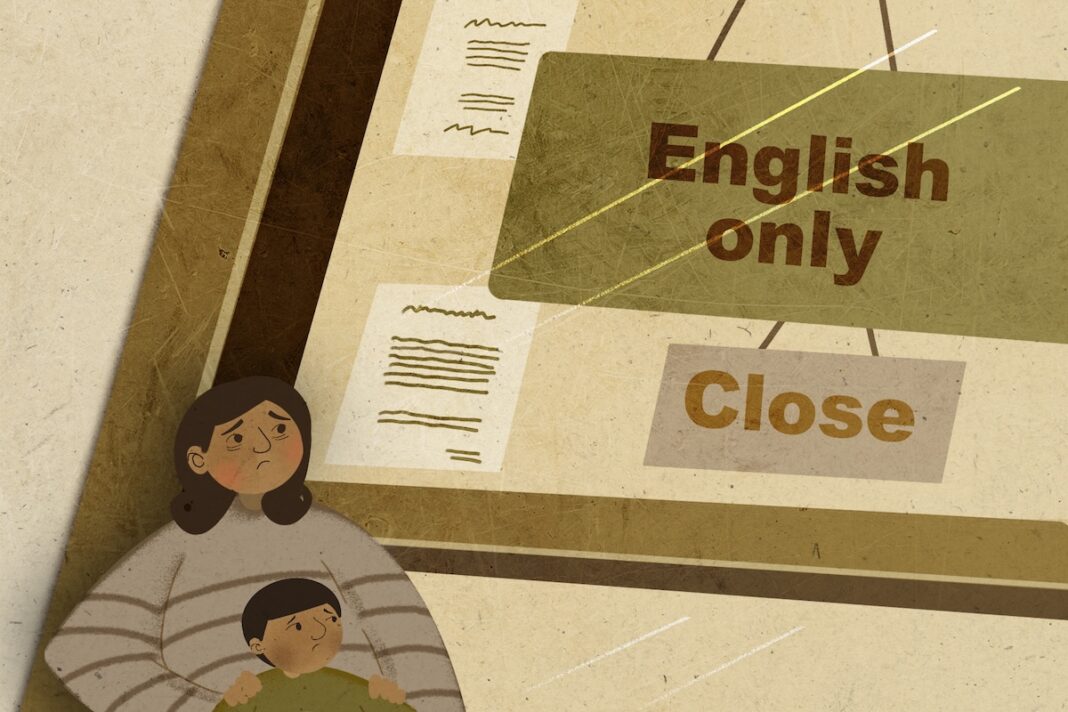
Matilde sought help from a social worker at the Santa Barbara County Department of Social Services in Santa Maria. According to Matilde, the social worker gave her a list of phone numbers to request assistance. She left voicemails in Spanish but never heard back. The social worker never followed up on her case.
Many Mixtec in fact have limited Spanish fluency. Regional variations of the language — there are up to 81, according to Mexico’s National Institute of Indigenous Languages — also complicate translation services.
“They may have someone who speaks Mixtec on the interpretation line,” said Fernando Martínez with the nonprofit Mixteco/Indígena Community Organizing Project (MICOP). “But about 90% of the time it’s very likely that the Mixtec variant doesn’t match.”
Forms provided by the Santa Barbara County Department of Social Services, meanwhile, are primarily offered in English and Spanish. Likewise at the state level.
ACoM reviewed resources at the California Department of Health Care Services (DHCS), where, for example, Medi-Cal eligibility forms are not available in Mixtec. At the California Department of Social Services (CDSS), only form AD 880 — used in adoption proceedings and cases involving the termination of parental rights — is available in Mixtec.
Targeted outreach
Advocates in the community also say that service providers often fail to account for the demanding schedules of Mixtec farmworkers when doing outreach.
“They should work on Sundays and set up their information table there at the swap meet,” said Francisco Lozano, president of the Mixtec Parents’ Advisory Committee in Santa Maria, pointing to a popular gathering place for local residents. “Instead, they say, ‘We only work until 5, then we close’ […] An organization that works for the Mixtec community needs to find a way to work around the community’s schedule.”
Most farmworkers work grueling shifts Monday through Saturday, leaving Sunday as their only day off, a day often reserved for essential tasks such as doing laundry, buying groceries, and preparing for the week ahead.
Lozano and others say what’s needed is more direct outreach, including visiting apartment complexes, walking through neighborhoods to leave flyers, or approaching agricultural fields during weekdays to share information. Without these efforts, they say, most in the community won’t know how to access available resources, or that they even exist.
Closed doors
After Matilde left Ramon, he began calling and texting her repeatedly, she says, threatening to kill himself if she did not come back. In one message he warned her that he was “capable of doing anything” if she tried to “start over with a new partner.”
Matilde went to the Santa Maria Police Department and showed officers the messages. She said they told her the texts did not appear to include a direct death threat. According to Matilde, officers said that if Ramon had beaten her or if she had visible bruises, the situation would be different. Without that, they told her, the messages by themselves were insufficient.
ACoM contacted the Santa Maria Police Department for comment, but despite several emails and phone calls, the department did not respond.
“It was a huge disappointment,” she said. “I thought that by going to the police and to the social worker, they would help me … But when they tell you that nothing is wrong, that you’re not in any danger, it’s like they’re sending you right back to your abuser.”
As a last resort, Matilde went to her children’s school to ask for help. She said school staff told her they could not help with her situation. Instead staff referred her to an outside organization that they said would provide therapy for her children.
The therapy, however, was never provided. Instead, Matilde said, she was told that the accusations she was making against her husband were serious and that the organization would keep an eye on her children. If staff determined the children were not safe with either parent, they told her, they would notify child protective services.
“Well, that was the final straw,” recalled Matilde, who says she feared losing custody of her children. She made the agonizing decision to return to Ramon. “I had run out of options. I had run out of ways to defend myself. The only solution for me at that time was to go back.”
Closing the gap
Advocates like Aurelia Sanchez with the local non-profit One Community Action say providers have to better understand the communities they serve, pointing to the need for cultural training that can help state and local agencies better respond to the traditions, experiences, and realities of the Mixtec community.
“Many agencies and institutions don’t have that,” said Sanchez, who is Mixtec. “They claim they do, but in reality, they don’t.” She added that outreach is often targeted toward the “Hispanic community,” noting, however, “we are not Hispanic.”
In Santa Maria, the primary provider of domestic violence services is Domestic Violence Solutions of Santa Barbara County (DVS). The organization operates a 24-hour crisis hotline and an emergency shelter for survivors. It also provides a range of non-residential support, including case management, emergency financial assistance when available, and practical assistance such as accompanying survivors to court and helping them file reports.
In an email to ACoM, DVS Executive Director Ken Oplinger noted his agency routinely partners with MICOP and Herencia Indigena, a Santa Maria-based non-profit offering English-Mixtec medical translation and navigation services.
“DVS staff interact with representatives of both organizations regularly, and we have shared training with both (we provide training on responding to survivors of Intimate Partner Violence and they provide cultural competence training),” he wrote.
According to Martínez of MICOP, the organization has not provided any formal cultural competence training to DVS.
DVS Director of Programs and Client Services Veronica Cubillo, meanwhile, said the organization recently hired its first trilingual case manager, who speaks English, Spanish, and a Mixtec variant.
While DVS has yet to formally expand services in Mixtec as the new case manager is still in training, Cubillo says her presence will eventually allow the agency to provide direct support to survivors who speak the same Mixtec variant.
For Matilde, who acknowledges that in her desperation she twice attempted to take her own life, such steps are critical.
“When you look for help, and you don’t find it,” she said, “the only solution feels like disappearing, ending everything, ending all the suffering.”
If you or someone you know is experiencing suicidal thoughts or is in emotional distress, call or text the 988 Suicide & Crisis Lifeline. Help is available 24 hours a day, seven days a week.
Roxsy Lin is a California Local News Fellow with the UC Berkeley Graduate School of Journalism.