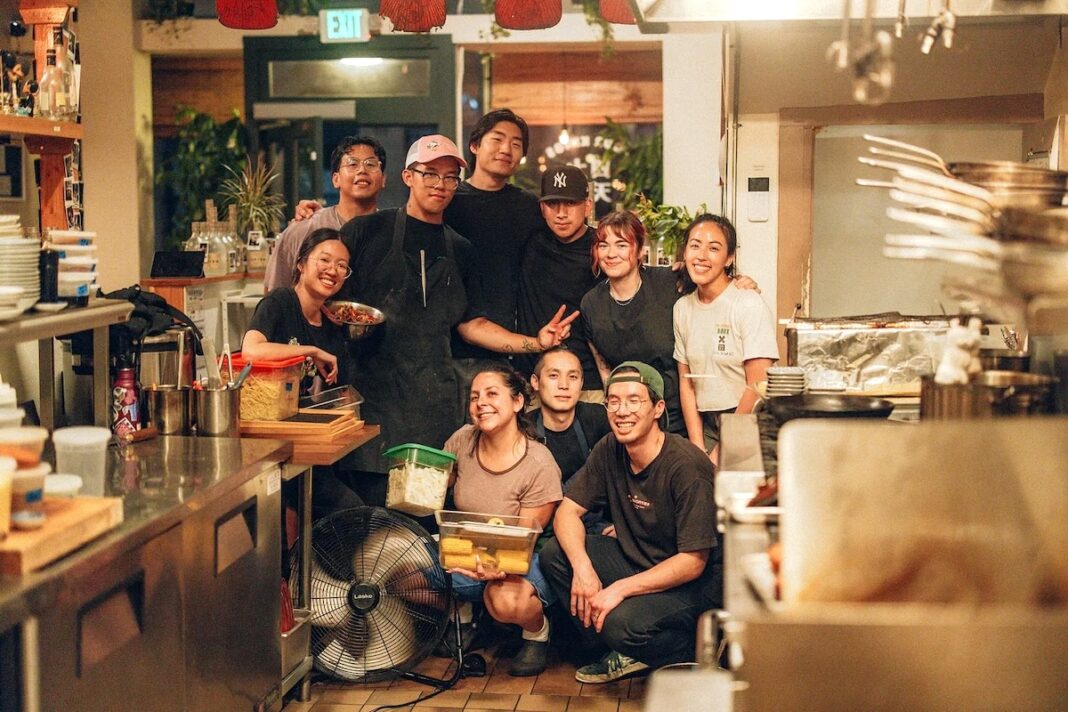
Every night at the Four Kings in San Francisco’s Chinatown, I glance up from my chef’s station and peek across to see how diners are enjoying the food — a mix of Hong Kong cuisine, Japan’s izakaya culture, and KTV.
I see young Chinese Americans. “Look!” they say, “This is Mapo Spaghetti,” a riff on the traditional Sichuan tofu dish. “I’ve been wanting to try it forever!”
I see Asian parents who are notoriously hard to please and wonder why they should pay $12 for Hainanese Chicken until the dish arrives — a galantine that reframes something familiar with new elegance — and suddenly they’re eating the dish along with their words.
I see Chinese exchange students dining solo and humming along to Cantopop ballads as they eat their Pork Chop Rice with Tomato and Egg and wonder to myself if the dish reminds them of the Cha Chan Tengs and the after-school meals they left behind.

It is these nightly vignettes that make me believe we’re on the cusp of something bigger for Chinese American cuisine, a $30 billion industry — there are more Chinese restaurants in the U.S. than McDonald’s, KFC, and Taco Bell combined! — and one that has, in subtle ways, become a victim of its own success.
Across the country, Chinese restaurants are struggling to define what their future looks like. Some continue to operate with chefs pushing 70 or 80. Others import chefs from China or close shop altogether. Reporting shows how Chinatown business in cities from New York to San Francisco have continued to struggle since the Covid 19 pandemic and the impact of President Trump’s tariffs.
At 116 years old, Sam Wo is the oldest Chinese restaurant in Chinatown, San Francisco. In recent years, it has gone in and out of business, scrambling for chefs or investors. When asked why he wouldn’t just pass the business down to his children, Chef Ho laughed and said he never planned to. The life is too hard, and he never wanted them to chi ku, or “eat bitter,” as the expression goes.
As of September, Sam Wo reopened with the backing of new investors, but its instability is a sign of the larger struggles aging Chinese restaurants across the country face.
Chef Ho’s reluctance to pass the torch runs deep among older Chinese. Confucianism taught filial piety. China’s ancient imperial exam system drilled into Chinese minds the idea that education is the path to upward mobility. Generations of discrimination in America and China’s own “Century of Humiliation” reinforced the desire to push children to climb higher, to be respected, and certainly not to find themselves toiling in a hot kitchen. Ho proudly proclaims his own children are now doctors and engineers.
The old guard of chefs and restaurateurs is running out of time and options. What happens next? Do these foodways fade, or do they evolve?

In San Diego, where I’m from, I can grab Tijuana style street tacos for lunch and that same night, sit down for a Michelin-starred tasting menu built around Baja-style seafood. Both ends of the spectrum feel recognizably Mexican.
Today, Korean restaurants like Atomix and Jungsik in New York have earned multiple Michelin stars with unapologetically Korean tasting menus. Benu reinterprets Korean flavors at the very top of global dining, claiming the mantle as San Francisco’s first three Michelin starred eatery.
Chinese food, on the other hand, is beloved, familiar, and flattened. When something is everywhere, it risks being reduced to its most recognizable forms. Think orange chicken, chow mein, or — maybe — dim sum in San Francisco’s Inner Richmond or hot pot in Flushing, barely the tip of the iceberg that is Chinese cuisine.
Over the past four years, I’ve traveled to and from China to learn about its Eight Great Cuisines. In Shandong, I dove into Lu cuisine — watching chefs turn pig’s liver into delicate scales with knife work so precise it felt like calligraphy, tasting abalone and sea snail pulled straight from the Yellow Sea, and learning how Confucius’s philosophy of order and balance reflects on the plate.
In Jiangsu, I explored Huaiyang cuisine — banquet tables lined with dishes as polished and graceful as the region’s gardens, flavors leaning toward a gentle sweetness, and every course unfolding with elegance. And in Guangdong, I immersed myself in Yue cuisine — breathing in the wok hei, tearing into char siu with sticky fingers, and sitting on low, plastic dai pai dong chairs late into the night in Hong Kong.
Can a paper take out box really tell all that?
Regionality within Chinese food is nuanced, each style shaped by local custom, climate, and trade. U.S. diners have yet to grasp that nuance — not in the way they understand the difference between Bordeaux and Burgundy wine, or Neapolitan and Sicilian pizza.
That gap is opportunity. We have the chance to introduce JinHua ham on the same stage as Jamon Iberico, or to put Moutai in the top shelf alongside a Junmai Daiginjo.
Previous generations cooked through necessity, adapting traditional Chinese dishes to the palettes of westerners and to the ingredients available. Chop suey, egg foo young, General Tso’s chicken, were all born from that combination of scarcity and ingenuity.
What they gave our generation is the privilege to approach food differently, not as a means of survival but as a tool to ask bigger questions, to experiment, and to create new stories. It is those stories that chefs at restaurants like Four Kings and Happy Crane in SF, or Bonnie’s and Win Son in NYC are telling.
Done right, Chinese food in America won’t just be shorthand for orange chicken or chow mein. It will stand as a cuisine with depth, refinement, and voice. A cuisine that holds our history, reflects our present, and imagines our future.
Kevin Chen is a food writer and chef at Four Kings in San Francisco. He writes on Substack, where a longer version of this story first appeared.